
Surfcasting basics - 2016

I’ve heard it said that surfcasting is one of New Zealand’s most popular pastimes – and it might be true, with thousands of sheds, garages and ‘man caves’ right around the country having a surfcaster in the corner or hung up in the rafters.
But it’s also fair to say that a lot of people’s experiences with surfcasting don’t involve much in the way of actual fish catching.
When I tell people I’m into surfcasting, the most frequent question I get is, “Do you actually catch anything?”
The impression I get is that, whilst a lot of people have given surfcasting a go, they generally don’t get past first base, so move on to things that provide more instant gratification, like diving and boat fishing. However, as the pages of this magazine often show, surfcasting does produce the goods – if you know what you’re doing. Further, as far as I’m concerned, the satisfaction of catching a trophy fish or a big bag of fish is greater when you’ve caught it with sand between your toes. You know you’ve earned it!
Becoming an advanced surfcaster who regularly catches fish takes time and a fair bit of trial and error, but becoming a proficient surfcaster who has an even chance every time he or she goes out, can be achieved much more quickly. Here, in the space of a few hundred words, I’m going to share some ideas and tactics that will get you catching fish and hopefully keep you surfcasting long enough to become an expert.
Learning from kahawai
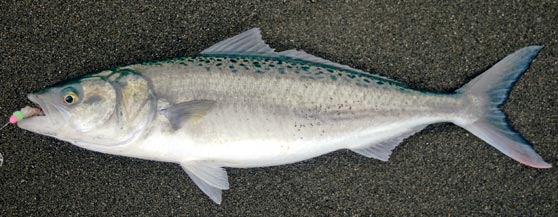
Kahawai really are the people’s fish and the species that novice surfcasters quickly become acquainted with. This is because they turn up just about anywhere at any time and take most baits. If just getting into surfcasting, I firmly recommend that you do what research you can to find out where to catch kahawai in your local area. To this end I suggest reading the area reports on www.fishing.net.nz, flicking through copies of NZ Fishing News, or visiting your local tackle store and having a chinwag with the staff.
River mouths and wharves are good places to start; kahawai are suckers for half a pilchard fished under a float or left on the bottom.
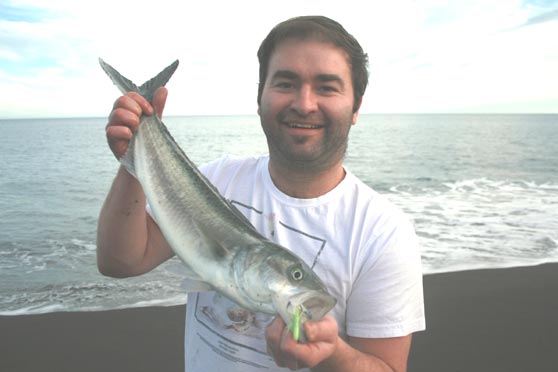
My early surfcasting was in the lower South Island, where kahawai are absent, but upon moving to Wellington kahawai gave me a serious enthusiasm boost. I happened upon them during my first few forays, and as someone new to the area they offered a lot, being big and strong, and biting just often enough to have me watching my rod tips like an eagle.
These qualities certainly help to hone a novice surfcaster’s core skills: baiting up, casting, and hooking and playing fish, all with a good dose of adrenaline coursing through their veins! Furthermore, because they are ready biters, you can make a few mistakes along the way and still not go home empty handed. For example, you might completely duff your cast, but a hungry kahawai hunting the shallows will still snaffle your bait.
All in all, kahawai will give you early rewards and excitement, and buy you some time towards building your skills before widening your horizons and starting to chase big snapper – like every serious surfcaster before you.
Buy a powerful 12-foot rod
One of the biggest impediments to early surfcasting success is a rod that’s too short or simply of poor quality. Both will prevent you casting baits any sort of distance into water deep enough to hold fish. Lesser-quality line, hooks and even reels will still catch fish, but from what I’ve seen, the wrong rod may not.
This is particularly the case when fishing into the surf of the open coast, where casts of 30-40m are usually required to reach the fish. I’ve lost count of the number of times I’ve seen people cast baits into water not more than a few inches deep, blissfully unaware that their bait is nowhere near the fish.
To avoid this eventuality, invest in a stiff rod (look for a large proportion of graphite) at least 3.66m (12 feet) in length. This will give you casting power not provided by cheap fibreglass rods, and immediately you’ll be casting further and into fish-holding water.
Twelve feet is a good functional length, being long enough to keep your line above the oncoming waves of the open coast but not so long that you can’t swing it around on a wharf or off the rocks.
Start in friendly fishing environments
Wind, swell and weed are enemies of the surfcaster. At their worst they can make fishing impossible and at other times just damned hard. Advanced surfcasters employ advanced techniques to combat the logistical challenges wind, swell and weed throw at them, but even they have to give the game away now and again.
Nature is powerful and nowhere is that illustrated better than on a beach with the wind whistling around your ears or a huge swell pumping in. Sometimes there is no point in fighting it – it’s just not physically possible to fish.
These are not scenarios for novice surfcasters, because to coin an oft-used surfcasters’ phrase, “You’re not really fishing.” That is, you don’t have a realistic chance of catching a fish. It might be that the swell is washing your line back to shore or there may be so much weed in the water that it catches your hook before a fish can.
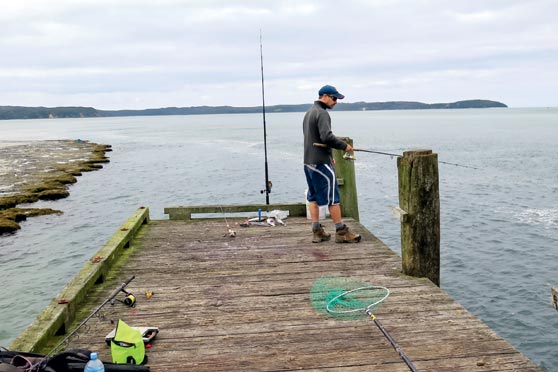
With this in mind, I think it’s really important that novice surfcasters start in friendly environments where they can get on with the business of fishing without the logistical challenges and plain discomfort of difficult conditions. Sheltered harbour waters, jetties and reclamations which drop into deep, calm water are ideal. While the fishing isn’t always first class in these conditions, you still might catch a kahawai, stingray or wrasse (i.e. spotties).
All of this is good experience, and your fishing skills (i.e. casting and retrieving, playing fish, preparing baits etc.) will generally improve in the process. Many fishermen, whether land-based or boat fishers, started out as ‘wharf rats’ fishing from local wharves, and there’s no better place to learn the basics.
Wait until the sun goes down
Darkness transforms many beaches and harbours from barren, fish-less deserts into productive fisheries. This is particularly the case over the shallow, sandy bottoms of harbours and surf beaches. In bright daylight most fish are very nervous about entering the shallows, leaving them hundreds of metres away from the surfcaster’s best cast. But the setting sun sees those same fish come into very shallow water, often no more than a metre deep.
One of my early fishing forays in Wellington involved a long afternoon and night session at Seatoun Wharf. During daylight I didn’t get a single bite, but with the onset of darkness I caught red cod after red cod – the difference in fish activity was phenomenal. Red cod may not be the most desirable fish in the sea, and neither are some of the other night-time feeders (think eels and small sharks), but catching them is a great way to hone the skills of baiting up, casting, hooking and retrieving fish.
A decent headlamp is cheap these days, so make sure you take one, because surfcasting in the dark without one is a nightmare. I’m a firm believer that surfcasters can and should catch fish most of the time, and this goal is readily achievable with a few basic smarts.
When starting out fishing, catching a few fish of almost any sort provides positive reinforcement and buys you enough time to start catching more desirable fish, which in turn builds your knowledge of them, along with your confidence.
|
|
This article is reproduced with permission of |

Fishing Reports Visit Reports
Outer Hauraki Gulf Fishing Report 17/09/26
Spring wind the handbrake. Spring is starting to make its presence felt in the outer... Read More >
Top of the South Fishing Report - 17/09/26
Early snapper in Tasman Bay. Well, spring is finally here, and the days are getting... Read More >
Bream Bay Fishing Report - 17/09/26
Good snapper catches reported. After Tangaroa turned off the fish tap for a month or... Read More >
Bay of Islands Fishing Report - 17/09/26
Pacific bluefin tuna for the lucky few. The last fortnight has seen more fishable days... Read More >


Monday 28 September 2026
Major Bites
 - -
- - Minor Bites
 - -
- - Tuesday 29 September 2026
Major Bites
- - Minor Bites
- -
Comments