
Surfcasting Adventure
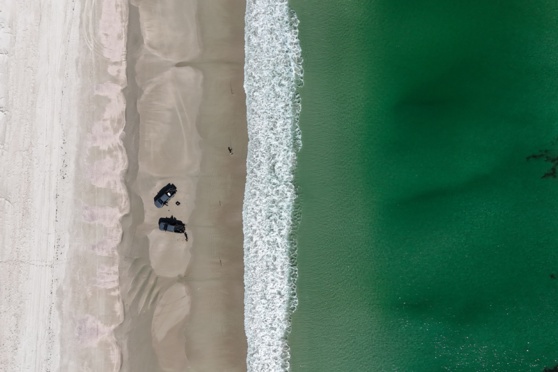
Surfcasting has always been a style of fishing I’ve enjoyed greatly, but for whatever reason I never strayed too far into the technical side of things. Maybe the simple zen of casting a line from the beach meant I subconsciously didn’t want to complicate matters. A bag of bait, a ledger rig, and a breakout sinker were about as deep as I went. Oh, I never went wading, either.
My finest surfcasting catch was almost inconceivable. Parched of fishing action during one of the Covid lockdowns, I walked onto a beach handy to Gisborne. With the sun well up, I rigged some skippie morsels onto a tarakihi flasher rig and biffed it out on a topwater combo. Distance was far from fantastic, but I wasn’t too concerned – I was simply happy to be fishing. Sitting the rod in the spike, I sat down and soaked in the serenity of the beach. Not five minutes had passed before there were a few taps on the rod.
“Just a picker,” I figured as the line went listless again. The rod then suddenly sprang into life, bouncing around violently. The thumps and solid weight felt like a snapper planing through the water, but surely it was a shark or a string of giant kahawai. The luxury of heavy line usually employed to drag kingfish away from rocky reefs meant that whatever it was, it didn’t stand much of a chance. There was a red flash in the waves, and washing onto the beach came a 19lb snapper that had engulfed two baits, with both tiny circle hooks embedded side by side.
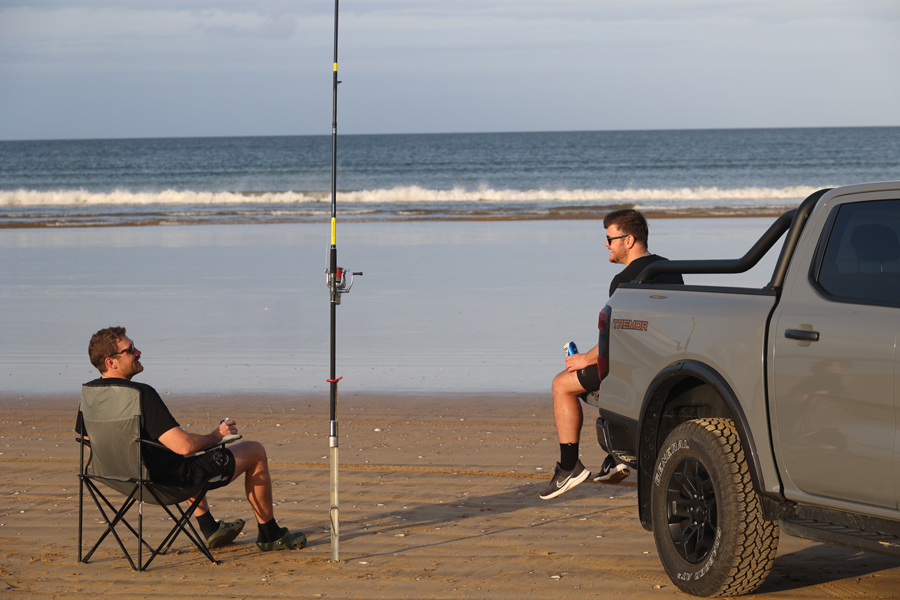 Surfcasting is a relaxing, social form of fishing.
I knew it was a fluke, confirmed by subsequent trips to the same spot yielding only the odd pannie snapper, amongst hordes of kahawai and spiny dogfish. Consequently, after the lockdowns it was back to boat or rock fishing, apart from the occasional solo evening fish at the local beach to clear the head after a long day.
Looking to do something a bit different for our summer magazine, the NZ Fishing News crew decided to fully commit to fishing the sand for a couple of days – sans boat so we couldn’t be led astray. Despite having some top-notch gear from Shimano and Daiwa, we were unfortunately unable to persuade any of their skilled surfcasting brand ambassadors to come along and hold our hands on the beach. Nevertheless, I did conduct some research and made a few calls before we ventured north, so this article could be described as a novice surfcaster’s attempt at obtaining expert advice and putting it into practice on the beach.
The gear
Now, flicking a line off the beach can be as simple as you’d like, or, like most types of fishing, you can really tumble down the rabbit hole. Fundamental to fishing on most beaches is a half-decent cast and hence most of the niche surfcasting kit is related to this. A long rod (at least 12’) affords more casting power, and also helps keep the line above the breakers when soaking baits. A high-capacity reel, typically a spin reel, loaded with light line is also par for the course – again, all to help you cast further. Our loan gear came spooled with 6kg mono, which seems to be the mainline yardstick.
But how can such light line handle the strain of the casting process? That’s where shock leader comes in, particularly tapered shock leaders which offer strength for the cast and reduced friction afterward as the leader flies off the reel. Tapered leaders are generally tied to the mainline with a tidily trimmed uni-to-uni knot – you want a slim connection to travel nicely through the rod guides. I know some casters prefer braid for its higher breaking strain at the same relative diameter as mono – this potentially quells the need for shock leader.
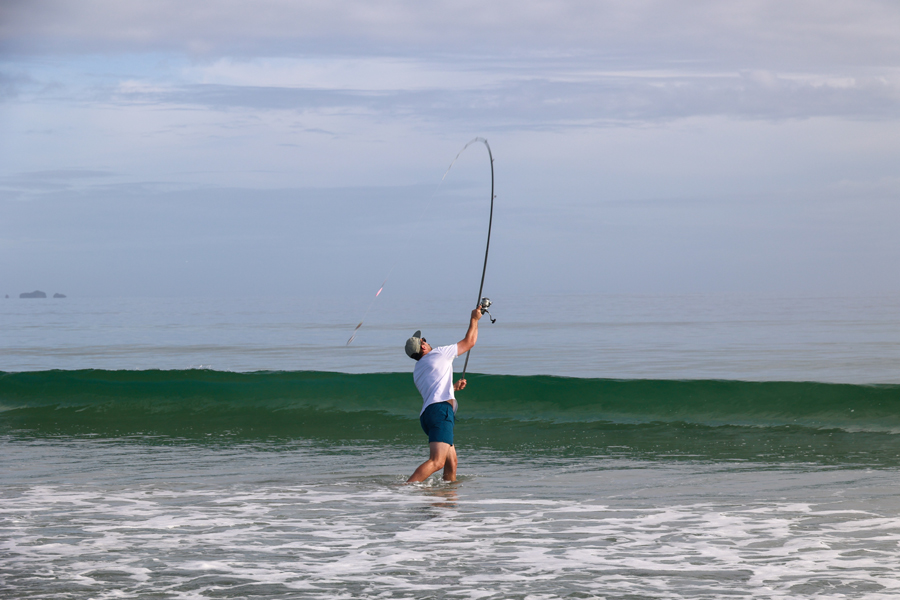 Having specialised surfcasting gear has a huge bearing on casting distance.
What about rigs? Well, there are plenty of options but the keenest surf fishos tend to favour the pulley rig. These rigs give extra distance to casts because the bottom hook is clipped down just above the sinker allowing a streamlined flight. The bait is released from the clip or impact shield upon impact with the water, allowing the bait to waft enticingly in the surge and current.
Although there are great pre-tied examples available for purchase, the pulley rig is not too complicated to make yourself. Floats are typically used in conjunction with these rigs to keep the bait away from crabs and constant sandblasting in the surge. If you can’t be fluffed with a pulley rig, a simple one-hook paternoster rig will cast OK. A two-hook ledger rig will achieve even less distance, although it does give you the option of fishing different baits. Making the effort to secure baits onto the hook with bait elastic, particularly if using softer morsels like shellfish, will help ensure baits survive the cast and stay there long enough for a decent fish to come along. If you’re making the effort to wade through the surf to get a decent cast away, you really don’t want to be checking your baits too often!
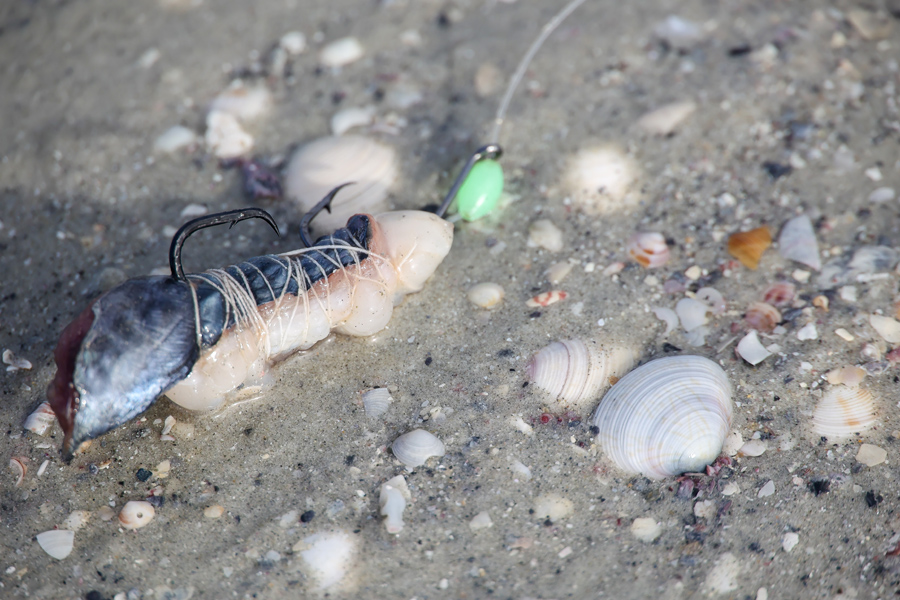 Take the time to tie your baits together with bait cotton when fishing the surf.
You rarely see a keen surfcaster without a breakout sinker. These streamlined sinkers feature spikes that dig into the sand, keeping your rig from drifting, yet pivot when pressure is applied to ensure the rig breaks away from the sand and can be retrieved easily. The spikes can be tuned to break away with more or less friction by squeezing them closer together or pulling them wider apart. Four-ounce sinkers seem to be a good all-round starting weight.
If casting isn’t really your thing, then you can always enlist the help of a fishing drone or kontiki. We packed the newly released SwellPro Fisherman FD1+ water-resistant fishing drone just in case we needed it. That’s not cheating, right?!
The fishing advice
Now, this is where things got genuinely interesting. For some facets, the advice I’d gleaned was largely consistent. However, there was a fair dollop of contradictory stuff, too.
“Low tide is best.”
“We slayed it at high tide last week.”
“The surf is way too big for the Ninety right now.”
“The surf is sweet as for the Ninety right now, bro.”
“Octopus is the best snapper bait.”
“Fresh kahawai is the best snapper bait.”
“You can’t beat crayfish for snapper.”
I suppose it’s like any form of fishing – anglers have developed theories based on their own experiences and then fished according to those. When they continue catching fish, their thinking is reinforced – a self-fulfilling cycle, you might say.
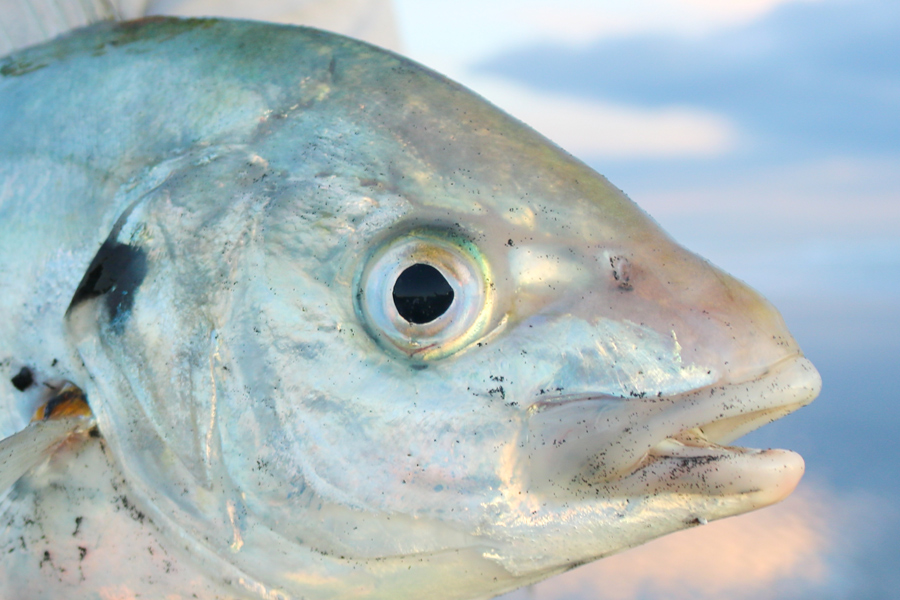 Fresh tuatua meat fooled this trevally.
Whatever the case, a couple of pieces of advice came through unambiguously: fish the change of light; and take time to read the beach. The change of light is easy enough to follow. However, reading the beach is clearly a skill learned from experience, and even though I can pick out most sandbars, rips, and gutters, it’s hard to determine a single spot where fish will be holding and feeding along many kilometres of beach. It’s a dynamic proposition when you factor in changing tides and swell conditions over the course of a session, too.
A couple of other interesting titbits of advice included looking for shells and tuatua beds, fishing where little creeks flow into the surf, and the east coast fishing better when there’s some surf to stir things up and bring the fish in.
Putting it into practice
As our departure date loomed it looked like we would be confined to the east coast. Huge swells on the west coast ruled out fishing Ninety Mile Beach which was a touch disappointing. It’s the mecca for Kiwi surfcasting and is home to arguably the biggest surfcasting competition in the world – the Ninety Mile Beach Snapper Bonanza. In stark contrast, there were ‘flat as a pancake’ conditions with offshore breezes out east. While it would make for pleasant fishing, we were forewarned that, without much surge, the fish probably wouldn’t be on the chew. Not that we were overly concerned, however, as we all know the best time to go fishing is when you can!
Basecamp for our couple of nights was at Rangiputa on the shores of the Rangaunu Harbour. Heeding some local advice that nice snapper had been caught in the area, our first hack was at Tokerau Beach on the way north. And boy, it was a real hack as we didn’t even get a nibble. The initial excitement for the productive fishing grounds of the north had waned slightly, but it was early days and we picked ourselves up for a late evening dig in front of our accommodation at Rangiputa. This proved slightly more fruitful, with small snapper and a couple of kahawai landed before darkness and the persistent wind drove us back to home comforts. While we hadn’t hit any boundaries, at least we’d put a few runs on the board (and some fresh bait).
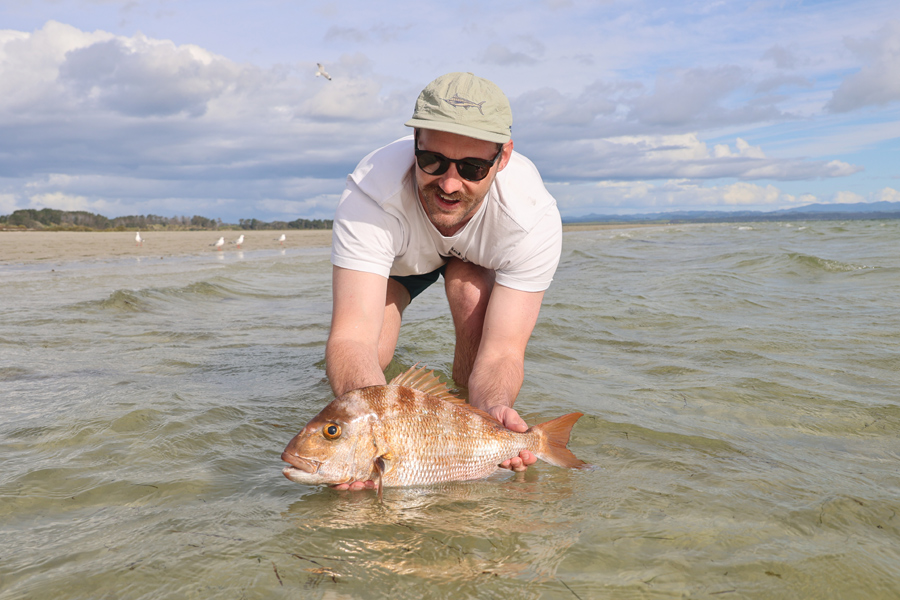 It’s not all about the surf – there can be plenty of fish in the harbours, too!
A plan was hatched to head ‘off the beaten track’ early the next morning – not only for the Ford Ranger Tremor review (which you can read on page 182 of this issue) but also to find some less-fished water. It’s always a bit risky venturing into new locations beyond listed public roads, but on this occasion, my Google Maps satellite-view research and chats with a couple of mates seemed to work in our favour. The signs encountered were only slightly vague as to public access, the locals waved rather than set up roadblocks, and we found ourselves on a stunning, squeaky white sand beach just as the sun was cresting over the horizon.
Not far down the beach we passed a keen local who was already setup and soaking a line. NZ Fishing News head-honcho Grant Blair never misses an opportunity to corner an unsuspecting member of the public to solicit fishing intel and wasted no time initiating one of his trademark natters.
“A few snapper have been caught first thing in the mornings,” was the executive summary of the discussion, and hence we were torn between taking time to find a good spot and getting on with getting a line in the water! With little swell, it was quite hard to interpret patterns, depths, and sandbanks beyond the shoreline, but an abundance of shells at a particular section of beach proved all the indication we needed to get the gear ready.
Tying a chunk of octopus tentacle acquired from Taipa Tackle onto a pulley rig, I was amazed at the distance I managed to achieve with my first cast – probably about 40m further than what I could achieve with a ledger rig. No doubt the featherweight, specialised surfcasting combos from Shimano and Daiwa, 6kg casting mono line, and tapered leaders played an important part, too.
Once our rods were back in the rod spikes, we took the slack out of our lines and anchored the breakaway sinkers. We’d been advised to set the drag lightly – you don’t want to overcook things with a lot of light 6kg line out!
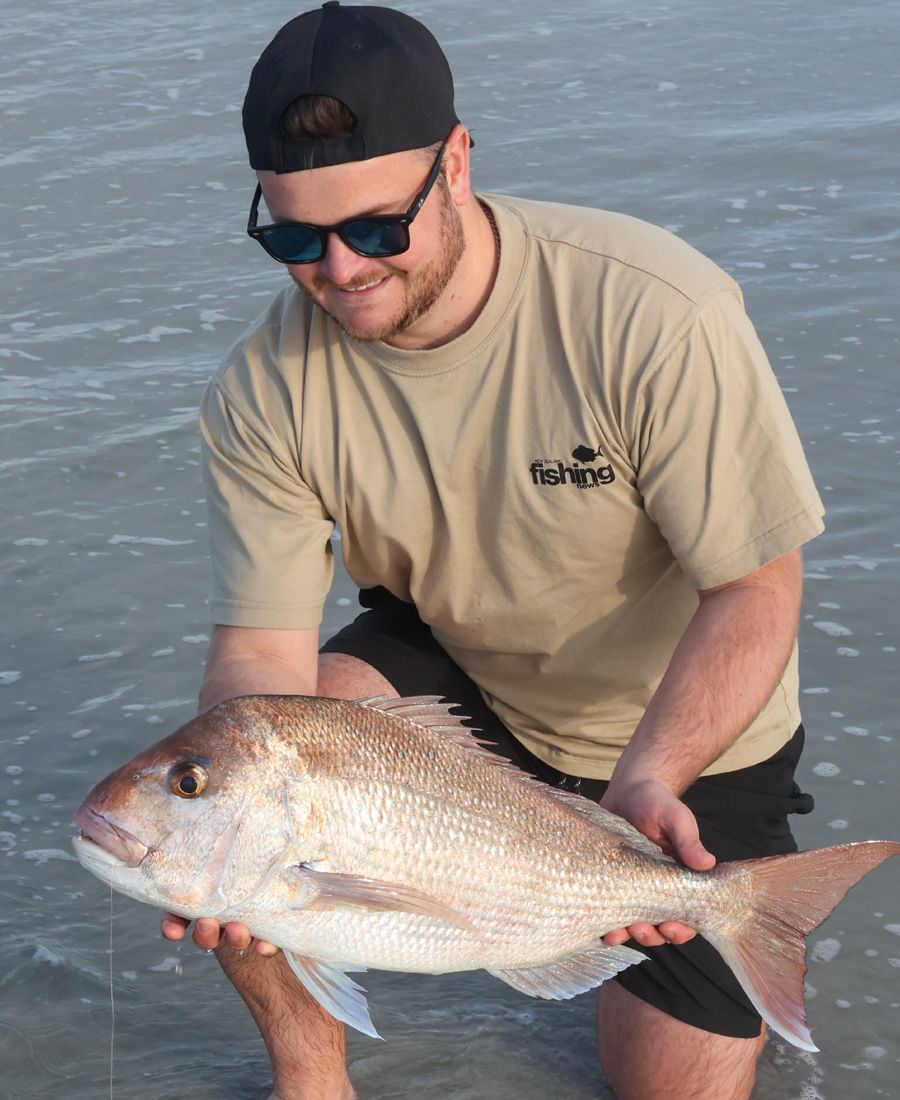 Josh Williams made the most of the morning bite time.
Deck chairs were set up and it was feeling fishy. Fortuitously, my rod was the first to buckle over. After a nice scrap, a pearly white Far North snapper appeared from the surge. At 60cm, it wasn’t a huge fish but my second biggest snapper from the surf, and this time I felt like it wasn’t a fluke. Just to prove that, indeed, we were doing something right, Josh Williams soon found himself with a jiggling rod and hauled in a similar specimen.
True to the explicit advice, the fish came off the bite as soon as the sun rose higher above the horizon. Well, to be fair, we thought they had until we decided to call it a morning and, after packing up all our kit back into the Rangers, Grant proceeded to wind in a decent snapper that he hadn’t even realised he’d hooked!
“Must’ve been swimming towards the beach,” he muttered as we poked fun at him.
Figuring the middle of the day doldrums were better suited to four-wheel driving, we opted to head off sightseeing and save our fishing energy for an evening change of light session closer to Rangiputa.
With an outgoing tide, the late afternoon fishing started off slowly, so we decided to pull out our secret weapon – the SwellPro Fisherman FD1+ drone. Even though we were drone fishing virgins, the SwellPro was straightforward to set-up – slide the battery in, attach the propellors, turn on the unit and the remote controller, attach the line to the bait release, and she’s ready to fly! This unit automatically calibrates its sensors to maintain stability and control during flight, bypassing the complicated calibration process required with some other drones on the market.
While we weren’t planning on dunking the SwellPro into the briny, its IP65 saltwater-resistant body, marinised motors, and self-floating design provided good peace of mind for a bunch of rookie pilots. We opted to send out a five-hook rig with a 6oz sinker on a heavier rod and reel combo, although the SwellPro can handle much more with its 2.2kg payload. Without a camera or the need to connect the remote controller to a smartphone or app, everything was easy to follow, and our flights and switch-controlled bait drops went off without a hitch. Further peace of mind is afforded by 35-knot wind resistance and an auto-return feature. The auto-return can also be triggered in emergencies such as low battery or signal loss.
The SwellPro drone bore more fruit than the ‘old-fashioned’ approach this time, with three pannie snapper hitting the sand in quick succession.
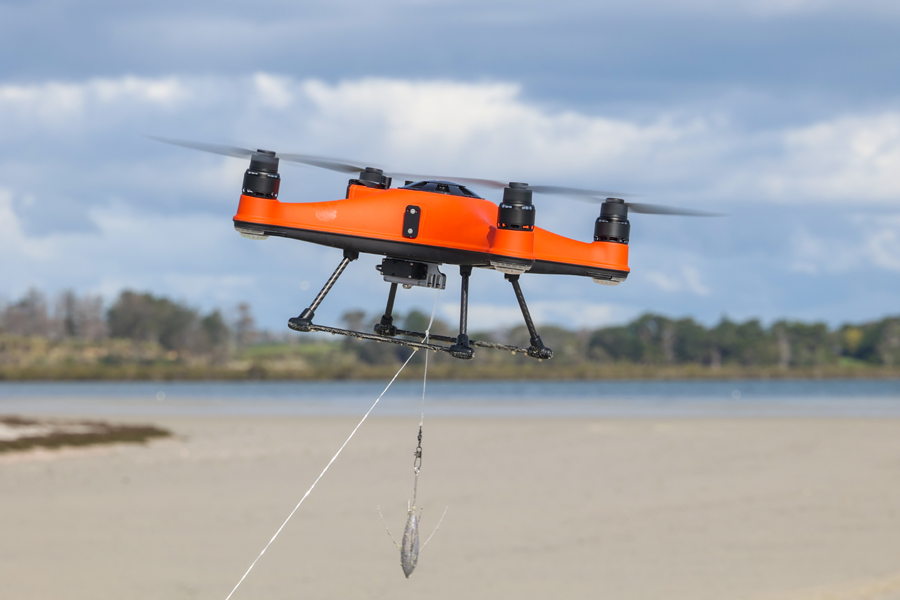 The SwellPro Fisherman FD1+ fishing drone in action.
Nevertheless, I must confess we were outdone by a resident who was fishing (and hollering) a few hundred metres down the beach from our spot. He stopped for a quick chat on his way home, wine bottle in hand, proudly showing off his brace of solid snapper. It was a humbling lesson that the potent combination of local knowledge and a bottle of Jacob’s Creek can outperform even the finest of fishing technology.
The next day we opted for a more leisurely start and paid the price with slow fishing action. The silver lining was spending the morning on an even more scenic Far North beach. Mixing it up, Tom Clancey from Ford New Zealand tied on some fresh tuatua meat with bait cotton as a last throw of the dice and nabbed himself a nice trevally. And that was all she wrote for us on the fish front.
The Far North beaches had not delivered great quantities of fish, but we had an awesome time, teased some quality snapper onto the sand, and each catch felt genuinely satisfying. Based on my limited experiences, it seems like surfcasters really earn their fish, and they do it in some majestic surroundings. I’ll certainly be dedicating more fishing time to the sand in future… but I’m afraid you’ll never see me tying on crayfish for bait.
- Words by Nick Jones
- Images by Grant Blair & Nick Jones
Fishing Reports Visit Reports
Outer Hauraki Gulf Fishing Report 17/09/26
Spring wind the handbrake. Spring is starting to make its presence felt in the outer... Read More >
Top of the South Fishing Report - 17/09/26
Early snapper in Tasman Bay. Well, spring is finally here, and the days are getting... Read More >
Bream Bay Fishing Report - 17/09/26
Good snapper catches reported. After Tangaroa turned off the fish tap for a month or... Read More >
Bay of Islands Fishing Report - 17/09/26
Pacific bluefin tuna for the lucky few. The last fortnight has seen more fishable days... Read More >


Friday 25 September 2026
Major Bites
 - -
- - Minor Bites
 - -
- - Saturday 26 September 2026
Major Bites
- - Minor Bites
- -
Comments