
Surf-casting tips for finding fish

Become a TEN-PERCENTER!
Few shore-based anglers are better qualified than Bruce Basher to set learner and intending surf-casting fishos off on the right track…
I once read surfcasting described as ‘chuck and chance it fishing’ (but not in this magazine, thankfully). If you believe that, you’re also probably one of the 90% of anglers who catch 10% of the fish. Fortunately, to reverse this percentage, all you need to know is how to find the fish!
Fish tend to hang around areas where food is available, or else likely to be (sort of like humans hanging around a pie shop!). These situations include shellfish and worm beds, or deeper spots such as holes or channels. Spotting them is your key to success.
Deeper areas will show up as darker or calmer areas of water between wave patterns. These wave patterns are more easily seen, along with anything else that may look at bit fishy, when checked out at low tide and/or by viewing from a higher vantage point. For instance, sandy, stirred-up water in amongst cleaner or calmer water could mean either a small sandbank – or a shoal of hungry giant snapper feeding! Worth a cast or two, don’t you think? But even at high tide you can get a good clue as to where shellfish beds are by looking for shells washed up onto the beach. Find a spot where these two aspects combine, and your prospects change from ‘fishing’ to ‘catching’ in a big way.
There are two prime times when fish come on the bite each day, making them easier to catch. These occur an hour or two leading up to and following sunrise and sunset, and are generally referred to as ‘change of light’ periods. At such times the fish often come well within casting range and therefore become prime targets for the thinking surfcaster. However, having said that, don’t despair if you wish to try fishing at other times, as fish can be caught at any time, day or night. It’s just that the middle of the day is generally less productive.
In all cases though, keep awake and watch what is happening as the tide changes, as this can make a big difference, too. What might not have been obvious at high or low tide, can be revealed as the depth of the water changes.
I was once the big benefactor of this when fishing a club competition. I’d arrived at a good spot to find two other club members already ensconced with about 50 metres or so between them – and I couldn’t believe the potential I could see in the gap. So, after being assured they didn’t mind my fishing there, as “the fishing is really slow”, I got into position and cast out.
I was landing the second of five good shoalies when one guy came over, patted me on the back, and said he was embarrassed he’d not spotted the hole I was fishing into earlier. In response, I told him to angle his casts over my way – and he ended up securing a couple, too. As for the other guy, all he did was bitch and moan at the club weigh-in, saying I’d pushed in!
I often fish with the first guy to this day, but the other guy? Well, knowing him, he’s probably still bending someone’s ear moaning about it to this day and still not actually catching anything.
Surfcasting is what you make it: the more effort you put in, the greater the rewards. Think of the three ‘L’s’ when starting out. ‘Look, Listen and Learn’ will see you move towards that magic ‘10% of anglers’ sector.
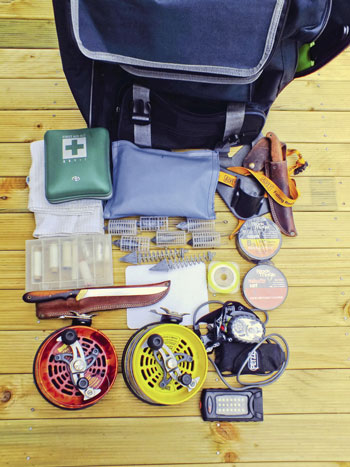
Now you need to ‘tune up’ your tackle box or pack. No need to take a mountain of stuff on a day trip, or any trip for that matter. Rigs and traces can be made up well in advance and kept in a rig wallet. A small spool of pre-made shock leaders saves taking spools of extra mono.
Also, have a think about how many sinkers you may need. My worst loss of sinkers in one day was only three, yet at the time I carried at least a dozen.
If you use only two rods and reels at any given time, why take more? If you’ve serviced them well, they shouldn’t give any problems. A spare spool or two is fine in case of snap-offs while casting.
The point I’m making here is to be absolutely brutal when pruning out all the unnecessary gear. Then add a minimal amount of gear until you’re comfortable all the bases are covered. You’ll be surprised at what is left over – and your back muscles will thank you for it.
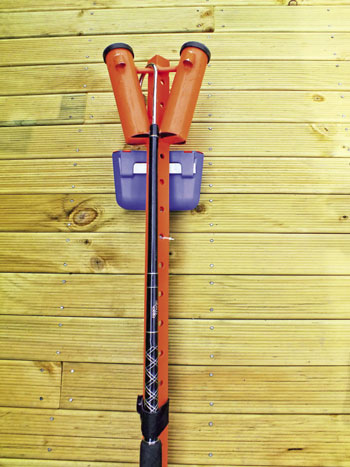
My biggest weight-saving was to ditch my beach spikes and make one that took both rods. This worked very well but, as it was made of stainless steel, it was rather heavy.
A visit to an aluminium welder made the ‘mark 2’ model vastly lighter. A look at the photo here will show you that I’ve mounted an Alvey bait bucket to it, and attached my Black Magic gaff via some rod wraps. No running back and forth for me!
A few years ago I saw the classic mistake as a result of not having a gaff or landing net close at hand. I was fishing with a husband and wife team when the wife hooked into a good fish. Hubbie went back over some rocks to assemble a landing net and took ages to do so. The guy’s wife did a great job on the fish, a thresher shark, and was now in real danger of losing it close to the rocks. Husband had still not come back with the long net.
Fearing the worst, I went back over the rocks to find him sitting on his freckle having a smoke!
When I yelled to him that it was a kingfish, he flicked the cigarette so hard I think it’s still in orbit and then did a superb mountain goat impression getting back over the rocks! Boy, did he cop a serve from his wife when he finally arrived!
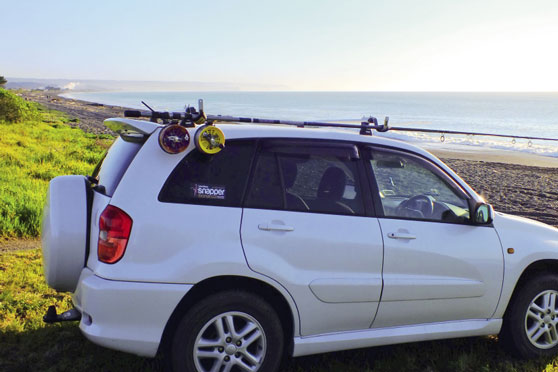
Whatever you do whilst surfcasting, remember that the more soak time you get the better your chances of catching. I came across a top time-saving gadget that I use when moving from spot to spot in my 4WD vehicle. Instead of breaking down my rods each time I move, I now just place them, fully assembled, into my Alvey roof racks. If you look at the photo, you will see that my Alvey reels are still mounted, minus the BOS sinkers. Reels of any type can be used for this system, and you won’t have to clamber up onto something to access them. This allows me to get a fresh bait into the water at a new spot very quickly!
Hopefully, over the past month or two, I’ve been able to give you enough ‘food for thought’ to make your foray into the world of surfcasting more successful. There are more advanced things to try, but these are for a later article – editorial gods willing!
|
|
This article is reproduced with permission of |

Fishing Reports Visit Reports
Outer Hauraki Gulf Fishing Report 17/09/26
Spring wind the handbrake. Spring is starting to make its presence felt in the outer... Read More >
Top of the South Fishing Report - 17/09/26
Early snapper in Tasman Bay. Well, spring is finally here, and the days are getting... Read More >
Bream Bay Fishing Report - 17/09/26
Good snapper catches reported. After Tangaroa turned off the fish tap for a month or... Read More >
Bay of Islands Fishing Report - 17/09/26
Pacific bluefin tuna for the lucky few. The last fortnight has seen more fishable days... Read More >


Friday 25 September 2026
Major Bites
 - -
- - Minor Bites
 - -
- - Saturday 26 September 2026
Major Bites
- - Minor Bites
- -
Comments