
Summer beach basics
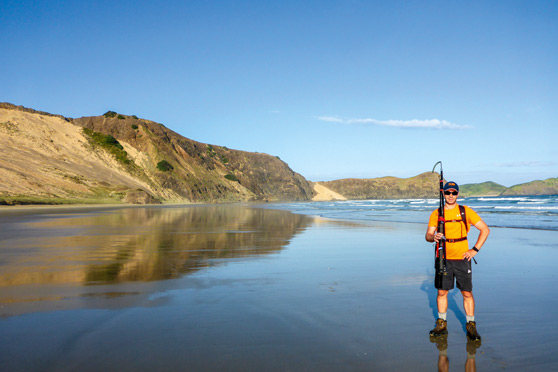
Undoubtedly this is the time of year when the ‘long rods’ make the most appearances on our beaches as the long school and working year winds down and suddenly free time and warm weather is upon us. With this in mind, I thought it timely to revisit beach basics to help make those special summer outings as productive as possible.
Where do I fish?
You may be limited in your beach choices by your chosen holiday destination or family circumstances, in which case you may just have to fish wherever you are (if so, skip down to the sections below).
But if you do have choices, do your homework – read previous editions of New Zealand Fishing News, visit the local tackle store or go online. Even within small districts, some beaches fish much better than others.
Additionally, in summer, popular holiday spots can be busy with swimmers, boats, kontiki longlines and surfers. Not only does this activity spook fish in the relative shallows of the surf, but it can hamper your ability to fish on your own terms.
Over the years I’ve had my lines crossed by surfers and jet-skis. With generally over 100m of line lying horizontally out to sea, surfcasting does not coexist easily with other watersports. Therefore I would firmly recommend seeking out a quiet corner of the coastline where the fish are less disturbed, and you can go about your fishing without annoying distractions.
When do I fish?
Summer means long, bright days. Although you might feel instinctively drawn to the beach and the feel of sand between your toes during the warmth of the day, this is generally not the best time for fishing. You may catch the odd passing kahawai or a stingray or eagle ray basking in the sun-warmed shallows, but mostly it is slim pickings. This is also the time of day when people and watercraft are at the beach in the greatest numbers.
Many of our main surfcasting species (snapper, trevally, gurnard, kahawai and moki, to name a few) feel exposed in shallow water under a bright sun, and generally only move in at dusk, dawn and during darkness (the ‘three Ds’). Getting up early before the crowds, or waiting until they’re back at the campsite or bach barbequing the steak and sausages is when you should make your move. You should have the beach more or less to yourself and the fish are much less wary.
On deeper beaches, time of day is less important as the extra depth improves daytime fishing prospects. In addition, such beaches are generally less safe for swimming and so don’t experience the same crowds.
What do I fish for?
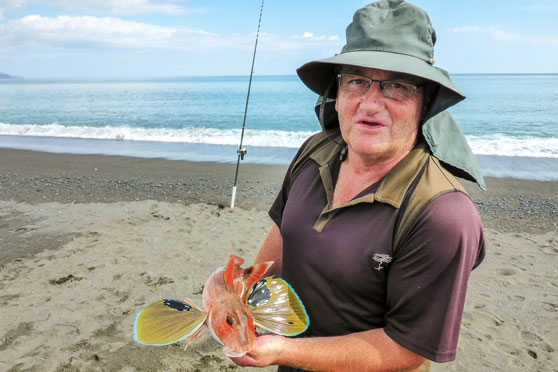
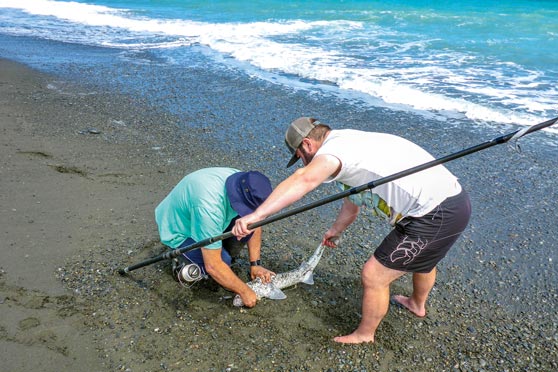
This will depend on where in New Zealand you are. In northern parts, snapper and kahawai are likely to feature, and rays and big tope sharks are also very active at this time of year. They move into the shallows and in some cases drop pups in the sanctuary of warm, shallow water.
In the transition zone of central New Zealand, snapper will be less prevalent, but gurnard and moki are present in certain areas. Kahawai is an important staple species throughout this region and rays are also present, but the big tope sharks of northern New Zealand are generally absent.
In the South Island, both the west and east coasts produce elephant fish, rig and seven-gill sharks – daytime fishing can be productive in remoter areas and where deeper water is found. Around rocky fringes, blue cod and moki will also turn up, and snapper, though hard-earned, turn up on the west coast.
How do I choose my spot on the beach?
On shallow, surf-type beaches, my chosen spots are always governed by where the best looking, deepest water can be seen. These beaches present a mosaic of shallow white water, breaking waves, rips and channels.
Understanding and responding to these features deserves an article in itself, but generally speaking the fish will be present where the water is deeper, offering them access or egress (i.e. through channels), a ready supply of food, or some shelter (they will sometimes sit in deep holes on the down-current side of bars where waves safely wash over them).
Unlocking this puzzle is complex when you’re standing on the beach looking at it, so the best approach most of the time is to look for the most accessible deeper water, which tends to come in three main types:
- areas, where the waves are breaking close to shore and the deeper water ‘beyond the bar’, can be reached by casting;
- deeper channels inside the bar close to shore; and
- rips or holes – rips are easily picked out as channels that run at right angles to the oncoming waves, taking water back out to sea. Quite often the water in them is discoloured, but they can be a good place to fish because food is carried along by the outgoing water, meaning they act like a natural berley trail.
The make-up of waves, channels, bars and rips will change as the tide rises and falls and therefore it is important to keep an eye on the water you are fishing and be prepared to move along the beach as the tide changes. This is absolutely essential during daylight hours when the fish will only be present in the best parts of the surf, but becomes less important as they move into the surf zone in greater numbers and with more confidence after dark.
On steeper beaches, the beach profile is more uniform so choosing the best spot on the beach is more of a guessing game. However, there are often choices to be made regarding proximity to rocky fringes (beneficial if chasing species like moki or blue cod), variations in water quality (slightly discoloured water can fish better in daylight, cleaner water fishes better in low light), and more open sections of beach may experience stronger currents and fish movement.
However, a good strategy on these beaches is simply to choose a spot, fish it, and then move 100m along the beach if it isn’t producing fish. For no apparent reasons these beaches can produce startlingly different results from spot to spot. The key is to remain agile in your approach, with your gear arranged so that it is easily packed up and moved.
What tackle and bait do I need?
Tackle and bait should vary from spot to spot, so the best advice I can give you is to do your homework on local species and bait preferences. As a general rule, oily fish baits such as pilchard, skipjack tuna and trevally are good all-round baits nationwide. However, shellfish baits (mussel, paddle crab) can come into their own in southern waters holding moki and rig.
I’ve written before that I’m an advocate of stiffer surf rods for beginners (minimum length 12 foot or 3.66m) as these can be cast much further than lower quality, glass dominant rods and also have sufficient power to subdue any bigger fish encountered.
On shallow surf beaches ‘keeping a bait out’ can require constant effort, but if possible, I’m a big advocate of fishing two rods at all times – this literally doubles your chances of success.
Another big consideration is your choice of rig. On shallow surf beaches, a clipped-down long-cast rig design is beneficial because the best water is often at the limit of your casting ability and you’ll need every advantage you can get.
On deeper beaches, I’m an advocate of simple ledger rigs because casting distance is less important and these low maintenance rigs are strong and don’t tangle. These days break-out sinkers are a fundamental part of every surfcaster’s armoury – make sure you have half a dozen of these before hitting the beach.
What other gear will I need?
With warmer weather, summer offers the opportunity to keep things simple and relaxed on the beach, but here are a few hot tips for other gear to take to the beach:
- Chilly bin – on a hot afternoon there’s nowhere to hide on the beach, and a good chilly bin will keep your bait and catch cold and fresh. Without it, they will fry and be no good to you at all.
- Sunhat and sunscreen – I’m not a huge fan of the beach umbrella, simply because I tend not to sit still during a surfcasting session and they become a liability in the wind, but it is still important to keep yourself protected against the sun.
- Rod spikes – in my mind these are a must at all times of the year, but in summer I often see people standing holding their surf rods or leaning them on a piece of drift wood. Having your rods firmly set in decent rod spikes maximises your chances of hook ups on biting fish and keeps your hands free to attend to other tasks such as baiting hooks.
- A headlamp – as noted above the best fishing is often after dark when a bright headlamp is essential for attending to all the key tasks of surfcasting and closely watching your rod tips for bites.
- Scissors – in my opinion, a pair of strong scissors is more useful than a bait knife. It can be used to cut baits precisely, cut line, remove bait elastic from hooks and even to gut fish (I regularly gut and gill kahawai without the aid of a bait knife).
Finally, enjoy the balmy days and nights coming our way and good luck. Hopefully, your efforts will be rewarded with some healthy catch bags!
|
|
This article is reproduced with permission of |

Fishing Reports Visit Reports
Manukau/West Coast Fishing Report - 15/10/26
Big spring snapper in 60 metres. The El Niño weather pattern isn’t going to be... Read More >
Rotorua Fishing Report - 15/10/26
Solid start to the season! The Rotorua lakes have all started the season well, and... Read More >
Tutukaka Fishing Report - 15/10/26
Big snapper in shallow. Things remain relatively quiet on the fishing front out of Tutukaka,... Read More >
Tauranga Fishing Report - 15/10/26
Bait and temperature on the rise. It’s been great to get out and see some... Read More >


Wednesday 28 October 2026
Major Bites
 - -
- - Minor Bites
 - -
- - Thursday 29 October 2026
Major Bites
- - Minor Bites
 - -
- -
Comments