
Straylining – The Basics

Straylining is right up there with Bay of plenty young angler Hayden Speed’s favourite styles of fishing for the fact it is active, exciting and will often produce a really big fish.
Aside from all of the other points I will cover in my column both this issue and the one following, my single biggest tip when straylining is to present your bait and berley in conjunction with each other at the correct depth for where the fish are holding. For example, there is no point having your berley flowing out over the surface in a strong current with your bait weighted on the bottom, or vice versa.
Straylining can be technical (for those who want to analyse all of the tips and tricks), or it can be as simple as putting a piece of bait on a hook and flicking it out. There’s no right or wrong, only many opinions about what works - or may improve your chances. This article shares my opinion on all things ‘strayline.’
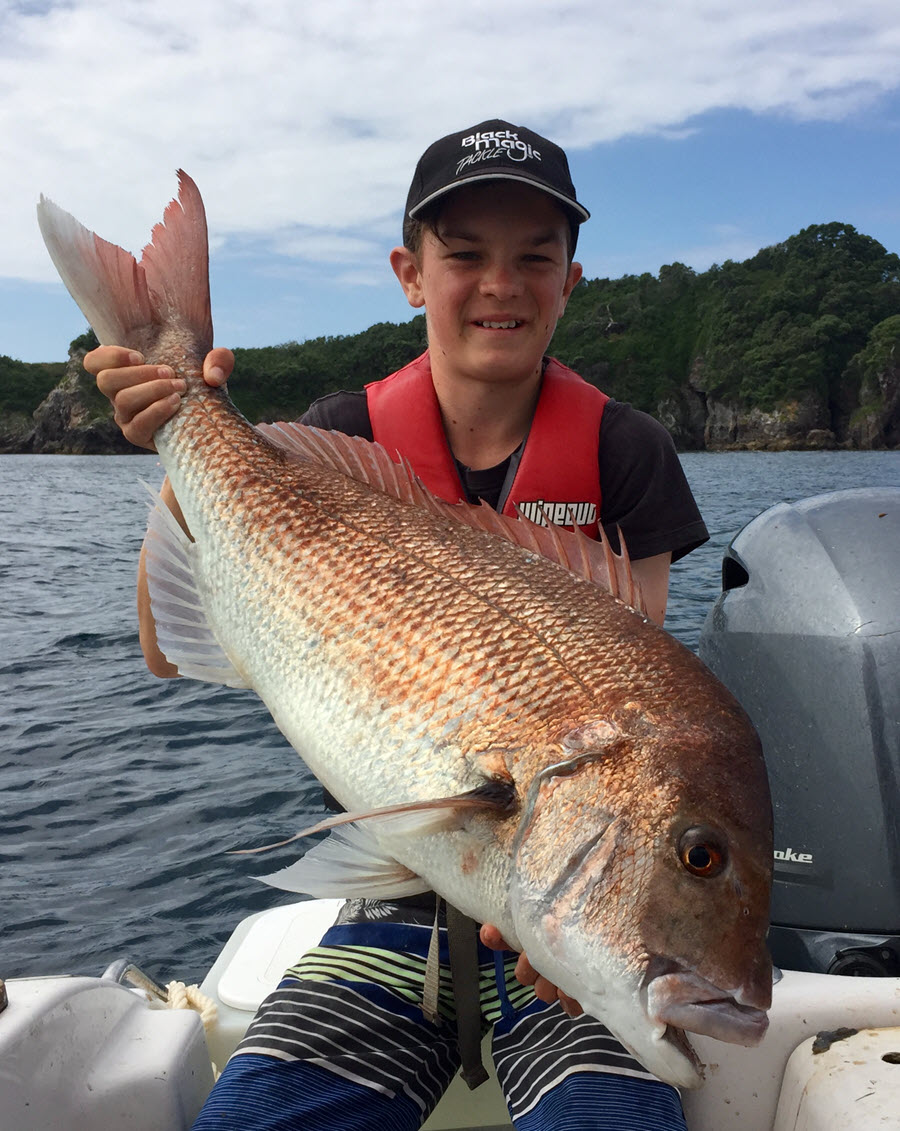
My personal best snapper caught straylining at plate island using half of a blue mackerel.
Spin reels (or fixed spool reels) are great for casting and many will have a ‘baitrunner’ function which is a great advantage for some. This gives you the option to fish the reel in-between in gear or in free spool. In Baitrunner mode, the fish can eat and move off with the bait with minimal resistance. A bait deployed in ‘baitrunner’ mode can be a great option to have unattended ‘out the back’ whilst you fish with another rod or are sitting back relaxing.
I will often lean the rod against the back of the boat as opposed to sitting it in the rod holder. This decreases the angle between the line and the rod tip, as well as any resistance.
Overhead reels will take some practice to cast as efficiently as you would with a spin reel. However, similar to the ‘baitrunner’ function on a spin reel, most overhead reels will have a clicker, which can be used to prevent an overrun if the reel if fished in free spool.
Overhead reels are versatile and can be used for other methods - trolling, live baiting or bottom bouncing. One clear advantage is their simplicity of laying line onto or coming off the reel. Because the line is wound straight on or comes straight off the reel (without being wrapped around a fixed spool) there is far less chance of suffering from ‘line twist.’
There are advantages for both options. Personally, I fish spin reels for their casting capabilities and the ability to leave the rod whilst I do something else. Regarding rod selection, they just need to be matched to your style of reel and chosen line weight.
Using berley is a must have when straylining.
Braid v Mono
Once you have your combo sorted the next debate is what to spool it with - braid or mono. Braid has very little stretch which means that you will feel just about everything, however it has minimal abrasion resistance meaning you're likely to get busted off if a fish gets you into a sharp reef. Mono has more stretch and a higher level of abrasion resistance. It is cheaper than braid and can align with the IGFA line class categories. My preference is to go for IGFA rated mono in the 6 - 10kg range. This is an all-round weight that allows me to fish comfortably over a reef knowing I will have some form of abrasion resistance, whilst still being light enough to fish along sandy beaches.
I will then attach the mainline to 1.5m of trace - either by using a swivel, or by a back-to-back uni knot. It’s important to match the trace weight to the location and size of the fish you plan to catch. If I'm fishing over a very shallow rugged reef for big snapper, I will use 60lb trace 60lb to give me some protection should the fish get me to ground. Likewise, if I am fishing over a sandy beach where getting busted off isn’t as likely, I’ll opt for 30lb or less.
.JPG)
You can see the wobbly pot positioned in mid water flowing back over the fish sign below.
Hook rig options
If using big baits (heads or whole fish) I like to run two J hooks as it makes rigging the larger offerings easier and also provides a good hook up rate. To be IGFA legal, both hooks must be fix to the trace. The distance between the eyes of the hooks must be more than a hook's length but no more than 30.45cm apart. I will use a bigger 8/0 hook on the bottom and a smaller 5/0 ‘keeper’ hook ‘snelled’ onto the trace about 20cms up, the distance between the two hooks depends on the size of baits I plan to use. Having two different sized hooks - one big, one small, allows the bait to be rigged in a more natural way.
If your bait is struggling to drift down due to the depth or current, I will add a ball sinker between the hooks. When I rig my bait the sinker will drop with the bait, presenting it as naturally as possible. The size of your sinker wants to be the smallest weight possible to reach the target zone without causing the bait to descend too quickly, or risk it being pinned on the bottom where it may get snagged or just not seen amongst any weed.
Hook choice comes down to personal preference. J hooks are great when used in a double hook rig as mentioned but they do ideally need to be ‘struck’ to set, whereas all the circle hook needs is a slow lift of the rod. A single circle hook is fabulous if using strip baits where the hook can be attached to one end of the bait. If I need to add weight to a circle hook trace, I will loop the trace through the hole in the ball sinker twice, stopping it sliding up the trace and tangling. Pinning it with a toothpick will do the same thing.
Circles reduce the likelihood of gut hooking the fish - which is great if you intend to release it. My suggestion is to use J’s for big baits when targeting big snapper and circles when fishing over the sand or targeting pannies.
.JPG)
A single-hook rigged strip bait – one of the writer’s favourites.
Getting baits back
The technique for straylining is straightforward. Once I've rigged my bait, I will cast it back into my berley trail. You’ll often find that the bigger fish will sit further down your trail, cleaning up the scraps that make it through. By casting, you are giving your bait a head start to reach those bigger fish without suffering from smaller ‘pickers.’
Once I'm confident that my bait has reached my desired depth, I will click the reel into baitrunner mode or just lightly hold my thumb on the spool - depending on my set up choice. Once a fish takes the bait it is important to let the fish run, the length of this will depend on your bait size and its firmness. I like to fish big baits, with my personal favourites being a blue mackerel head or a fillet of kahawai. With these baits I let the fish run for about 6 - 7 seconds before setting the hook.
In the next issue we will look at the effects of current, boat location and the best way to deploy berley.

May 2022 - Hayden Speed
New Zealand Fishing News Magazine.
Copyright: NZ Fishing Media Ltd.
Re-publishing elsewhere is prohibited
Fishing Reports Visit Reports
Outer Hauraki Gulf Fishing Report 17/09/26
Spring wind the handbrake. Spring is starting to make its presence felt in the outer... Read More >
Top of the South Fishing Report - 17/09/26
Early snapper in Tasman Bay. Well, spring is finally here, and the days are getting... Read More >
Bream Bay Fishing Report - 17/09/26
Good snapper catches reported. After Tangaroa turned off the fish tap for a month or... Read More >
Bay of Islands Fishing Report - 17/09/26
Pacific bluefin tuna for the lucky few. The last fortnight has seen more fishable days... Read More >



Friday 25 September 2026
Major Bites
 - -
- - Minor Bites
 - -
- - Saturday 26 September 2026
Major Bites
- - Minor Bites
- -
Comments