
Straylining technique

There is a bit more of an art to stray-lining than finding fish on your sounder, heaving the anchor over the bow and dropping your lines down.
From preparation to looking at likely areas, to anchoring, bait presentation and the gear to use, I will explain how you can catch more fish, more often.
Since lure fishing for snapper really took off around 2003 - 2004, and more so now with social media’s fixation on work-up fishing, it has created an abundance of ‘experts’ overnight.
Some of the best snapper fishing I have had has been in a work-up using jigs, but to be honest, even though I was the skipper and positioned the drift, there was almost zero skill involved, apart from making sure your knots were 100%. The person who should get the credit is the one with the best eyesight on the day for finding the birds and consequently the action underneath them!
But put someone who has done very little stray-lining next to someone who has done a lot and the results are easily in favour of the seasoned bait fisherman. Now don’t get me wrong – lure fishing is easily one of the most enjoyable forms of fishing, but not always as rewarding as a decent stray-line session. Soft-baiting in the wash or in extremely shallow areas is maybe the only other scenario that comes close.
Stray-lining is a form of bait fishing where the bait is presented in such a way that it looks like it’s naturally floating down through the water column, as opposed to sinking unnaturally with excessive weight. The benefit of this approach is that fish will more likely attack or eat the bait as the sink rate is much slower and it looks far more natural.
And I’m guessing the word stray-lining means your bait is ‘stray’ or running free with the current with nothing obstructing its movement as it descends.
Straylining study
The number-one rule for this style of fishing is to have the wind and the tide running in the same direction. if the wind opposes the tide lines and or berley tend to head towards the anchor or to one side of the boat, which isn’t ideal.
You want to fish from the transom behind your boat so you can utilise the space in your cockpit and also cast your baits out over an area not obstructed by anything.
Before heading out it is vital to check the weather as this will determine where you can fish or should be fishing. For example, Auckland’s predominant wind is a south-westerly so most of the time in this wind an outgoing tide will fish much better. With any wind from the north-east or east it’s better to fish during an incoming tide.
There are ways around when the wind opposes the tide, but they always involve getting out of the wind, finding a spot where the current is stronger than the wind, or tying the anchor to an alternative position on the boat to swing the hull around.
Sometimes there is no point getting up at the crack of dawn to stray-line when the wind and tide don’t line up until later in the day. That’s why people, without knowing better, often say the fishing was slow and then suddenly got better later in the day. The reason could well be that the tide turned in the direction of the wind and the fish came on the bite.
I’m a firm believer in change of light fishing (dusk and dawn), so if the tide is turning early in the morning or late in the evening and the wind and tide are in sync, these are generally the best times to stray-line.
Scoring a strayline spot
When it comes to finding areas to stray-line, it is always a good idea to study charts and look for structure, contours, drop-offs, kelp beds, reef, current and baitfish. Snapper tend to hang around most structure or anywhere near current, as these provide ideal feeding conditions for them, with the exception of fish feeding over sand around baitfish or shellfish.
So, when finding snapper on your sounder around structure, it’s important to anchor the boat in the best position possible, taking into account how much anchor rope you will need to deploy, where your berley will end up and where you can cast your baits. There is no point finding fish on the edge of structure and putting the anchor down until you have worked out exactly where the boat will end up sitting.
You want to be casting your baits back into where the fish are holding, not having them somewhere out to the side or straight under the boat. I don’t think it’s uncommon for people to find fish, put the anchor down and think the fish aren’t biting, before making the decision the head elsewhere when maybe it is a case of their baits not ending up in the zone.
If it takes you 10-20 minutes to get the boat in the correct position on marked fish, so be it – it’s worth the wait even if your crew is getting impatient. This could mean the difference between an average day’s fishing or an exceptional one.
Anchoring is key, and it still amazes me how many people have no idea about when an anchor should be deployed in relation to where the fish are holding.
Practice makes perfect, so use your sounder to mark fish then see where the boat is sitting after anchoring and where your baits and berley are ending up. If you’re off the mark by 10m or so, then pick up and move until you get it right.
Presenting your bait
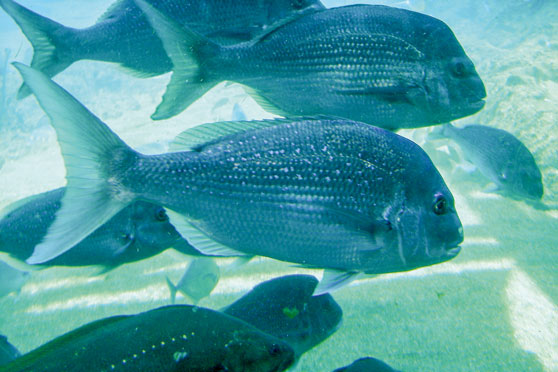
I won’t go too much into bait presentation, but for your bait to look natural and enticing it’s best to start with minimal weight. Use just enough to get to the bottom – if the tide or current picks up you can always add more. It is best to do it this way than start with too much weight, as it’s easy to get lazy and leave the excessive weight on – you’re getting to the bottom easily, so why change it? But with the lightest possible weight, nine times out of ten your bait will get hit while it’s floating down naturally before it has a chance to reach the sea floor.
Straylining gear
For effective stray-lining you need reels that you can free-spool, so either an overhead or baitcast reel is preferred. If using spin gear or fixed spool reels, you’ll want a reel that has a ‘bait-runner’ function so the fish can run with your bait while it’s out of gear. Timing the strike can be different for every trip, depending on how the fish are feeding and whether you are using circle of conventional hooks.
Stray-lining is an enjoyable way to target fish and requires a bit more planning and thought compared to just dropping a ledger rig or dropper rig down and sitting it in the rod holder. But once you’ve worked all the key elements and have got them all right, you’ll catch a lot more fish in no time.

|
|
This article is reproduced with permission of |

Fishing Reports Visit Reports
Outer Hauraki Gulf Fishing Report 17/09/26
Spring wind the handbrake. Spring is starting to make its presence felt in the outer... Read More >
Top of the South Fishing Report - 17/09/26
Early snapper in Tasman Bay. Well, spring is finally here, and the days are getting... Read More >
Bream Bay Fishing Report - 17/09/26
Good snapper catches reported. After Tangaroa turned off the fish tap for a month or... Read More >
Bay of Islands Fishing Report - 17/09/26
Pacific bluefin tuna for the lucky few. The last fortnight has seen more fishable days... Read More >


Friday 25 September 2026
Major Bites
 - -
- - Minor Bites
 - -
- - Saturday 26 September 2026
Major Bites
- - Minor Bites
- -
Comments