
Straylining Basics - (Part 1)

The problem with ‘A to Z Guides’ is that most of them start somewhere around T, not A. This article is going to start at the beginning and won’t get anywhere near ‘Z’.
What’s straylining?
At the fish end, it’s a hook-bearing bait tied to a line. This is the simplest form of fishing with dead or cut baits there is. You can make it a lot more complicated, with secondary hooks and weighting, but they are unnecessary for starting, and they are unnecessary long-term as well.
As a little kid, I was straylining long before I ever heard the expression. I was catching meals of eels in the creek behind our house with a baited hook tied to the end of a 2-metre piece of monofilament that at the other end was tied to a 10-centimetre stick. The stick was for storing the line between expeditions and for holding the line in my hand when a big angry eel was trying to escape.
I found the description ‘straylining’ when, as a slightly older kid, I started going out on reef fishing boats in the Bay of Plenty. Crusty old blokes would cast unweighted big baits out the back of the boat as hopeful offerings when at the same time using handlines to catch fish such as tarakihi with weighted ledger rigs around reefs in about 30-40 metres of depth. The hope was that a big snapper, or even a kingfish, would snaffle the free-floating bait as it slowly made its way down the water column. Big baits on single hooks, floating down the berley trail made by all the bait on ledger rigs used by the 40 or 50 fishers aboard the old Ratahi. All the biggest fish were caught with these straylines.
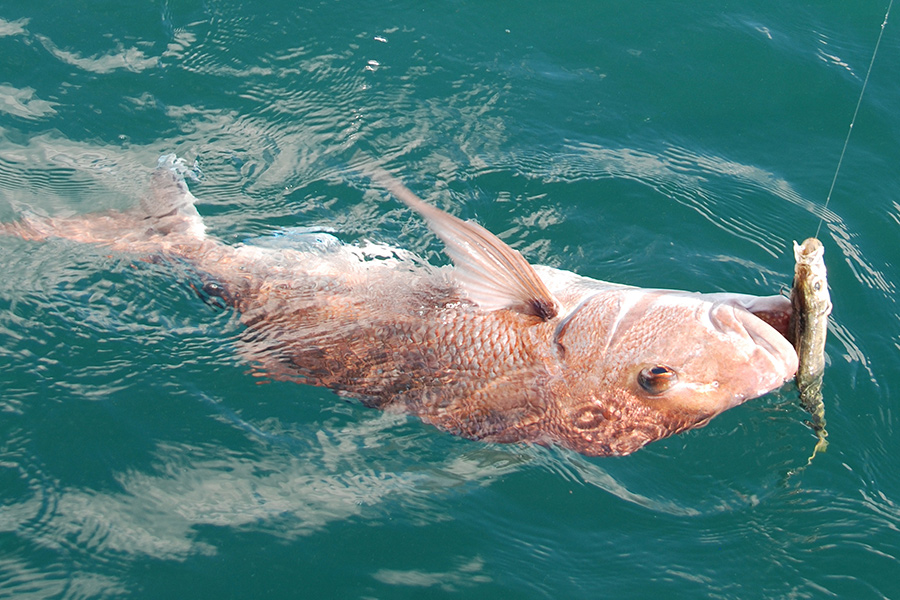
Big baits on big hooks’ is a simple mantra to follow.
Here are important factors that I learned all those years ago:
• Current and structure. The targets of straylining were hanging out around reef systems, specifically downstream in the tidal flow.
• Berley. What I’ve just described did not have berleying or groundbaiting as a separate element, but it was provided as the scent and scraps from all the baited lines that were in the water.
• Big baits on big hooks. The smaller fish were interested in the small baits that their teeth could get purchase on; the bigger fish were happy to grab baits that were going to feed their size more efficiently than by trying to pick up numbers of smaller scraps.
• Stay in one place. The whole idea of dispensing berley is that you bring the fish to you. Whether fishing from a boat or from the shore, stay where your berley goes from.
• Unweighted hooks. No weight lets the bait drift gently down through the water column. Later in this article, we’ll look at when you might need to add a sinker of some sort, and why.
Fast forward a generation, and my son was passing on to me learnings from his highly expert and effective fishing mentors. They were land-based fishing for snapper – large snapper. And what were they doing? Casting from the shore unweighted big baits on big hooks tied directly to their mainlines. Bags with plenty of berley deployed off the rocks to bring the fish in, fishing spots chosen for underwater structures, in tidal flow and plenty of kelp. The biggest difference from what I’d been seeing as a youngster was that these folks were fishing in shallow water, anything from 1m to 8m in depth. But the core principles are just the same: current and structure, big baits, berley aplenty, and very simple set-up.
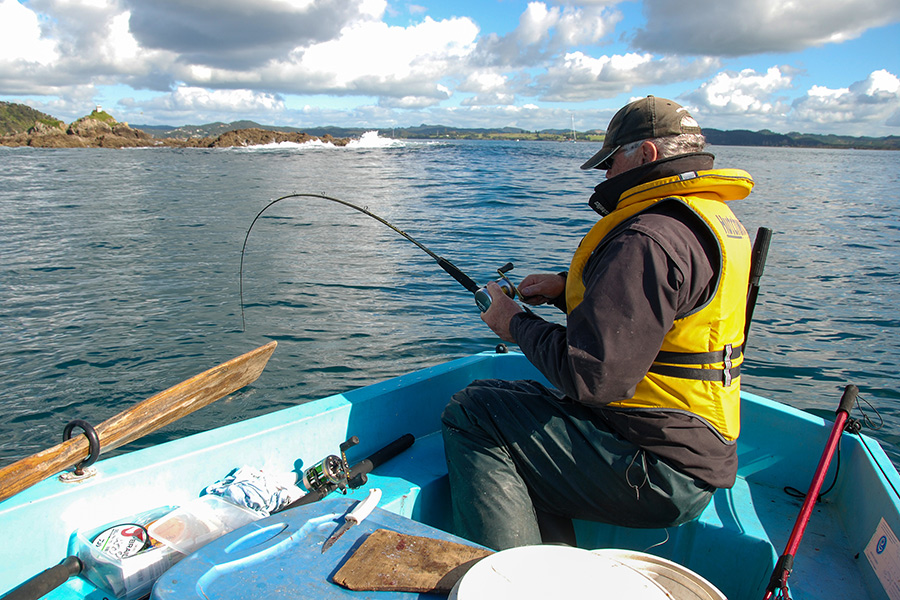
Straylining needn’t be a complicated aff air – PJ proudly straylines from his simple dinghy setup
Lines, rods and reels
The important part, the fish end of it all, is the hook attached to your line. I prefer circle hooks, not only because of their effectiveness but also to minimise damage to fish. We will discuss this in more detail in Part 2 of this series.
For many anglers, in contrast, the important part is what they get sold: the line, the rod, the reel. These items are not irrelevant, and the infinite variations all have their various places. The beginning of sorting out all the variations is a pretty simple exercise. Match the gear. Light line goes with a light rod goes with a light reel. Heavy line goes with a heavy rod goes with a heavy reel. Next, budget. Go for the best gear you can afford. If you have a restricted budget, look for higher-quality lightweight gear rather than lower-quality heavier gear. Size and weight in fishing tackle often equate roughly with money. But size and weight of your gear has no bearing at all on what you hook. Personal preference issues now start to take over here.
One is whether you connect your mainline to a leader of some sort. Though I mentioned earlier casting lines from the shore with the hook tied directly to mainline, most strayliners favour using leaders rated at a heavier weight than the main line, anything up to 60lb-rated monofilament. Myself, I find 30lb fluorocarbon line is plenty to withstand the rigours of running past rock.
Heading away from the fish’s end, there’s the matter of mainline material. Many strayline fishers like monofilament, thinking that its stretch will allow a tentative and wary fish to take without noticing much resistance on initial contact. My contradiction says to use a braid line, allowed to run free, because its very non-stretch directness allows the fisher to detect the slightest touch. Lines rated at 10 to 15kg are the usual choices in either instance.
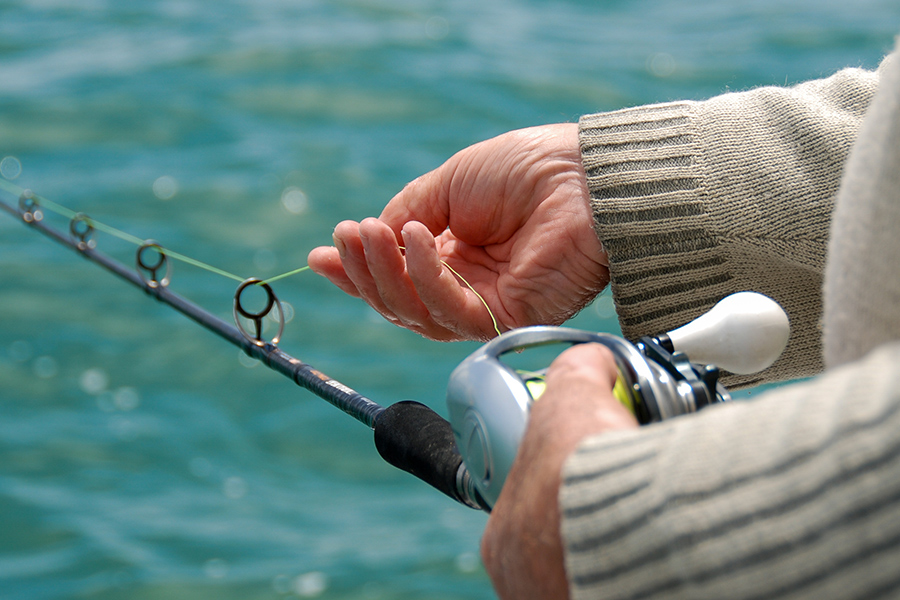
In contradiction to most strayline anglers, PJ prefers a braid line, allowed to run free, because its very non-stretch directness allows the fisher to detect the slightest touch.
Straylining in its purest form, and the form that I prefer myself, has the bait unweighted. In areas of high current flow, or if you’re fishing in depths of 30 metres or more, you might want to add a light sinker by running the leader through it immediately above the hook.
If you’re using monofilament mainline, it’s wise to tie the leader on using a swivel to avoid tangling from line twist. This is most important if you’re using a fixed-spool or “eggbeater” reel. If using a braided line, one of its major advantages is that you can easily dispense with the swivel, thus saving one knot and giving the ability to run the line up the rod some way on retrieval, which can make landing fish easier.
Knots, leader or line to hook, braid to leader, and leader to swivel and mainline to swivel, also tend to be matters of preference. Many fishers swear by uni knots. One of the best pieces of advice I’ve seen is: “Find knots you like and perfect their tying – that’s more important than which exact knots to use.” Google and YouTube are full of knot-choosing and tying items.
Now, up to the equipment that first catches your eye in the tackle shop: rods and reels. It’s blindingly obvious that these need to match each other. I go for rods that are rated at a bit less than the line strength I intend to use. So, for 10kg line, I’d use a 6-8kg rod; for 15kg line a 10-12kg (or 10-15kg) rod. For sensitivity to bites, relative lightness, and, yes, durability, I use carbon fibre and carbon fibre composite rods.
Similarly, reel choice is dictated not just by price but also by the line weight you intend to use. Line capacity of 150 to 200 metres is plenty. More pricey reels should have better and smoother drag systems. The drag is a clutch that preserves your line from sudden tugs by the fish. I usually set drags at about 1/3 of my rod’s strength rating, but in straylining seldom more than 3-4kg. The easiest way to set a drag is to use one or more milk bottles with water in them: 1kg = 1 litre. A deadlift of the bottles tied to the end of the line, the bottles directly below the rod tip and the rod held horizontally; set the drag so you can just lift the bottles off the ground before the drag slips. But remember… it ain’t what ya got, it’s the way that ya use it!
Where to Fish
Assuming that you’re going to set up a berley trail, this is going to explain itself as we go along. Even if you’re not, for the same reason that a berley trail is best set up in the areas I’m describing, bait alone will also work better here than in the middle of nowhere. The principles apply whether you’re fishing shallow or deep water.
What you want is a place where fish will be funnelled to your line. Think of the funnel as having its tight end at your hook, and the big wide-open mouth as the area that scoops the fish in to head toward your hook. So, the ideal place has current flowing through some constriction where you are, and then opens out; this will spread the berley and chum out from you into a wide area, leading the fish to narrow down their travel toward your hook. You’re using the venturi effect of water flowing into say a gap between reefs to speed up the flow of berley through the gap, and then disperse it widely on the far side. You position yourself just upstream of the gap between reefs. This works similarly with water flowing around the side of a reef, or at the intersection of two channels in a harbour, or around a point of land; so you position yourself to the side and upstream of a reef that’s by itself, or just on the upstream side of a point of land. Fish of all sizes conserve energy by hanging out in the downstream sheltered side of structure like this. Positioning as I’ve just described takes the berley to them in exactly the same way floating natural food arrives. They pop out to investigate, only to find the easy pickings have hooks. Anchor your boat and stay there; drifting at the same speed as the berley won’t achieve much. Or if fishing from the shore, stay where you started. The berley trail will take a while to be fully effective. Don’t panic and move away.
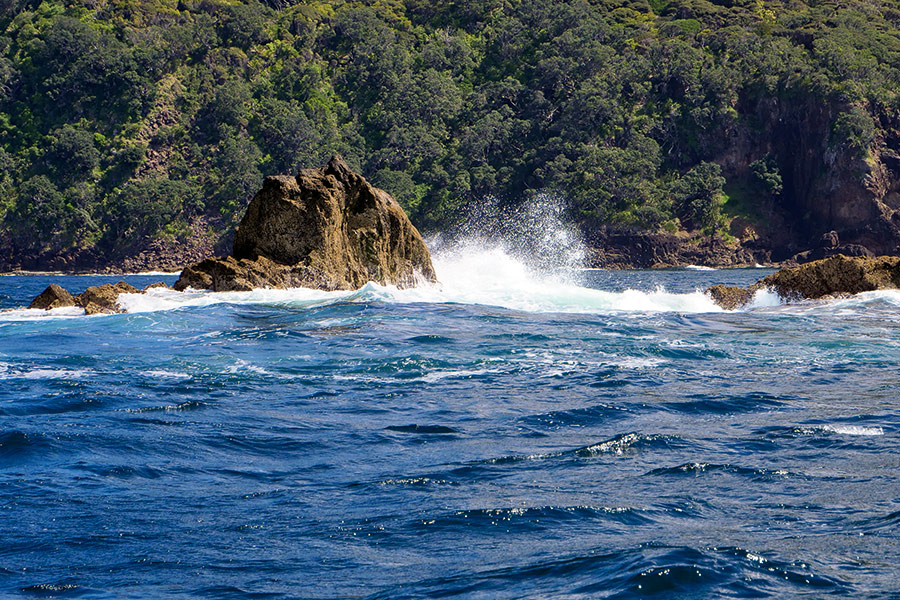
PJ prefers spots where berley will be dispersed widely, such as areas where water flow is constricted and sped up through gaps between reefs.
Next time, we’ll discuss berley, baits, and how to fish ‘em.

July 2023 - Peter Jones
New Zealand Fishing News Magazine.
Copyright: NZ Fishing Media Ltd.
Re-publishing elsewhere is prohibited
Fishing Reports Visit Reports
Outer Hauraki Gulf Fishing Report 17/09/26
Spring wind the handbrake. Spring is starting to make its presence felt in the outer... Read More >
Top of the South Fishing Report - 17/09/26
Early snapper in Tasman Bay. Well, spring is finally here, and the days are getting... Read More >
Bream Bay Fishing Report - 17/09/26
Good snapper catches reported. After Tangaroa turned off the fish tap for a month or... Read More >
Bay of Islands Fishing Report - 17/09/26
Pacific bluefin tuna for the lucky few. The last fortnight has seen more fishable days... Read More >



Friday 25 September 2026
Major Bites
 - -
- - Minor Bites
 - -
- - Saturday 26 September 2026
Major Bites
- - Minor Bites
- -
Comments