
Stray-lining heavy tackle method
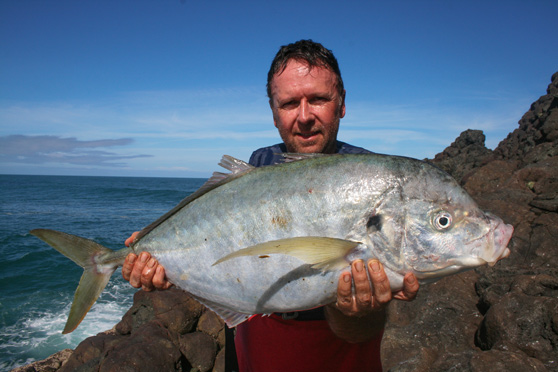
Stray-lining is one of my favourite fishing methods, especially from big ledges, amongst reefy territory, and in areas of big swell and current.
Consequently, when all these aspects are found together in one place, the combination provides a great recipe for hooking big fish – everything from kingfish, XOS snapper and trevally, through to various species of sharks.
You may have noticed my enthusiasm for light tackle in some of my earlier columns, but except in ideal conditions, heavy tackle tends to be a more practical option. Otherwise, powerful fish will simply motor off, often taking the angler’s line into contact with jagged rocks and weed clumps in the process, or they can deliberately burrow into the bottom structure at any time, leading to snagging and break-offs. As the old saying goes, ‘Don’t bring a knife to a gunfight’.
Before I start talking tackle though, I want to cover off the locations and fish species likely to be found there.
Location, location, location
In this instance I’m not talking about a bunch of scraggly rocks poking out of water that’s two or three metres deep – although there’s nothing wrong with that scenario. Rather, I’m talking about big ocean rocks that drop off into five to 10 metres of water at your feet and which are subjected to real current and sea. Places that spring to mind are Cape Brett, Cape Karikari, Cape Runaway and Lottin Point.
In these sorts of locations, it’s quite common for the sea to rise and fall disconcertingly with the swell. Consequently, fishing from safe/dry rocks can involve setting up several metres above water level. If there is good current present – and I’ve fished some spots where the current rips past like a fast-running river – you have a conveyor belt of water bringing fish past your baits.
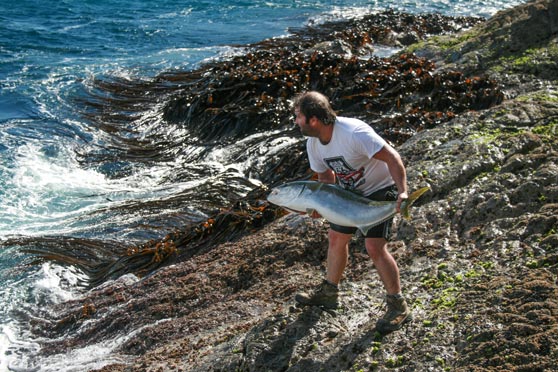
While I have noticed places like this tend to be very ‘sharky’, these locations are also very good for XOS trevally and kingfish, with the only disadvantage being that the current and swell can make live-baiting for kingfish difficult. Big snapper will turn up now and again too, although such ledges do not provide my ideal snapper country. For the latter, I prefer shallower water in low-light conditions, as fishing exposed rock ledges can only be done safely during daylight hours.
In some of these locations, at the right time of year, there is also the possibility of pelagic species such as marlin, tuna and Kermadec kahawai turning up, but these are extremely rare prospects, so I’ll leave them for someone else to chase and write about.
The usual suspects - how to handle them
Using stray-lining techniques in the type of locations outlined earlier, the ‘saltwater trifecta’ of XOS kingfish, trevally and snapper are all quite catchable, and big tope and bronze whaler sharks will also occasionally rise to stray-lined baits if a good berley trail is established.
Kingfish above 10kg are capable of deep, strong runs against a heavy drag initially, but these diminish as the fight goes on. So if you survive this early onslaught, the fish typically rises in the water column and makes shorter arcing runs back and forth in front of your position.
This is real stand-and-deliver fishing, and the best technique involves applying maximum pressure – except when you’ve been ‘reefed’ and can feel your nylon running through rock and weed. If the latter occurs, it can pay to back off and hope the fish swims your line free.
Keys to success when fighting all the species covered here involve keeping your rod tip high and maintaining regular and vigorous rod pumping, never allowing any slack, especially when battling big kingfish. Pumping keeps them under pressure and off-balance.
I will deal with trevally next, even though they are the smallest of the three species, as they are second only to kingfish in the fighting stakes. (In fact, if they grew as big as kingfish, I’m convinced they’d be the toughest of the lot.) Growing to around 10kg in our waters, and with big flanks and a rapid tail beat, they are top-class scrappers and my favourite fish. Unfortunately, even though specimens over five kilos are encountered reasonably frequently from the locations I’m talking about, landing one is a tough ask off the rocks. Fish of this size behave rather like kingfish, but as they’re smaller, you can turn them earlier and raise them up the water column more easily. Consequently, if I know I’ve hooked a trev, I believe I can ‘lock up’ on it – that is, play it with an uncompromising drag setting that doesn’t allow the fish to pull any line at all.
There is a lot of talk about trevally having soft mouths and the need to play them relatively gently, but this strategy is of no use to anglers in a rock-fishing scenario. Simply put, playing them with only light to moderate pressure will have you hung up in the nearest reef faster than you can say “Bugger!” Sure, I’ve lost a few fish to pulled hooks as a result, but I’ve caught plenty, too.
Assuming you have hooked a big trevally, with the line now stretched like a guitar string between the two of you, chances are it will be fairly close to the surface, rattling off a series of scorching, arcing runs left and right in front of your position. Normally this is visible to you, and their speed is impressive to experience.
However, when the trevally cannot pull you left or right any further, it will turn and head back in the opposite direction. The trick is to ride out these runs and take up as much slack line as possible at each turn. If you really stand your ground with a heavy drag, it is possible to have a spent fish at the water’s edge after 6-10 runs. Overall these fights don’t last long – usually not more than five minutes – but they are physically demanding.
Big snapper are a different proposition because they are usually hooked closer to the bottom and fight very differently. Snapper scrap in a much more erratic fashion than kingfish or trevally, tending not to go on the big scything runs in one direction, instead lunging this way and that, punctuated by their well-known head nods. The key is to try and get them up off the bottom as soon as possible, again keeping your rod tip high and the pressure on. With every turn, the fish gives you a chance to take line, and it is important you do so: snapper grow to well over 10kg and, with fish of this size, it doesn’t pay to give them second chances.
Every snapper is different: some float up on their side spent after a hard fight, presenting very easy net and gaff shots, while others make a last-moment dash and earn their escape right at the end, so it pays to remain vigilant throughout.
Tame them with tough tackle!
I’m a big fan of nylon. Although braid is generally quite a tough material, it’s also much thinner than nylon of similar strength, making it more prone to breaking if damaged.
Also, as already touched on, this type of fishing is quite physical, requiring anglers to firmly hold their standing position and apply maximum pressure throughout the fight. As braid has almost no stretch, it can lead to anglers getting jerked and pulled around the rocks, perhaps causing them to stumble, which can be dangerous. (I suppose you could argue that the stretch in nylon means fish get a headstart to the nearest reef, but I’m prepared to live with that for a more solid footing on the rocks.)
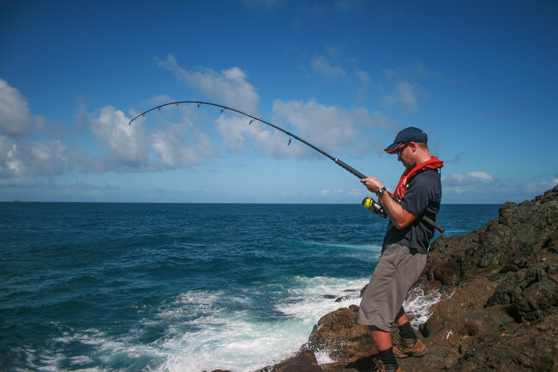
I typically use 15kg mono line, and if big kingfish or snapper are in the vicinity, I couple this with a leader of 80 or 100lb (37-45kg) that’s long enough to give me one ‘wrap’ around my spool. I can then hold a heavy fish at the base of the rocks, with some protection at the business end, whilst one of my buddies gaffs or nets the fish. (Consequently, if fishing a dangerous spot that’s well above the waterline, I will lengthen the leader accordingly.)
In real tiger country, you can stray-line with very heavy (24kg/50lb) mono directly off your spool. One of my mates, who spends a lot of time fishing for kingfish, does this because he believes stray-lining is the most effective means to hook kingfish (after attracting them in with live-baits), so it makes sense to use tackle that ensures a reasonable chance of success. Although I’ve personally not gone to this level to date, I can see a lot of sense in it when big fish are around in numbers.
With trevally, I have regularly used 15kg mainline without a leader for the simple reason that, by itself, the line has the strength and abrasion resistance to tackle these fish. Without the weight of a big kingfish or the teeth of a big snapper to contend with, 15kg line is usually strong enough to do the job, and it casts further without the extra drag of a heavy leader.
Which brings me to another point: When using 15 or 24kg mono, consider fishing without a leader. Whilst tying the hook directly to the mainline does not provide the extra protection at the business end, at least there’s only one knot to worry about. I’ve seen many fish lost to a broken join. Although it won’t be appropriate in every fishing scenario, fishing without a leader is something to bear in mind.
Now for suitable rods and reels. I use a Shimano 15-24kg combo that incorporates a very stiff, seven-foot-long rod. This allows me to apply firm pressure and keep the rod tip high, helping me to keep the line above dry rocks when fish run sideways. The reel is a heavy-duty eggbeater capable of exerting 20kg of drag – although 10 kilos of drag is more than most people can comfortably handle while standing on the rocks. Of the species covered, only big kingfish can pull string against 10kg of drag, and even then that’s not for long.
There are many variations on this style of outfit, including free-spool reels and/or longer rods – a matter of personal preference. However, there are some fundamentals that I would stick to, because when the fish are big and the line is stretched, things tend to go wrong more quickly and more often.
• Avoid short rods (anything under about seven feet), as they don’t provide the necessary elevation to keep your mainline clear of the rocks.
• Avoid overly soft rods and rod tips for the same reason – these fold over easily, effectively shortening their length.
• Use good quality reels capable of putting out at least 10kg of drag, that can cope with some serious workouts. This type of fishing will cook cheap reels! Having high quality, well-maintained gear enables anglers to focus on the fishing rather than worry about the gear’s short-comings.
As one last comment on tackle, I note my rod doesn’t have a gimbal nock, so I don’t get the leveraging benefits of the gimbal-harness system. Instead, I have adopted a pretty efficient (but admittedly less powerful) technique that sees my rod tucked under my arm. However, there are rods available with gimbals that would be perfect for this type of fishing; again, every little advantage can be critical when fishing this way.
Heavy-duty stray-lining for big kingfish, trevally and snapper is my favourite land-based fishing scenario. However, although my most memorable captures have come this way, the biggest fish I’ve lost are perhaps more memorable still! I’ve been blitzed by kingfish over 35kg and trevally of 10kg, and that’s what keeps me coming back for more, year after year.
|
|
This article is reproduced with permission of |

Fishing Reports Visit Reports
Outer Hauraki Gulf Fishing Report 17/09/26
Spring wind the handbrake. Spring is starting to make its presence felt in the outer... Read More >
Top of the South Fishing Report - 17/09/26
Early snapper in Tasman Bay. Well, spring is finally here, and the days are getting... Read More >
Bream Bay Fishing Report - 17/09/26
Good snapper catches reported. After Tangaroa turned off the fish tap for a month or... Read More >
Bay of Islands Fishing Report - 17/09/26
Pacific bluefin tuna for the lucky few. The last fortnight has seen more fishable days... Read More >


Friday 25 September 2026
Major Bites
 - -
- - Minor Bites
 - -
- - Saturday 26 September 2026
Major Bites
- - Minor Bites
- -
Comments