
Stickbait tips and techniques for billfish
This summer anglers are going to see an influx of topwater casting action for sure, it is huge overseas and bound to be the next big thing to hit our shores. With the increase of top quality tackle designed solely for this purpose we are going to be spoilt for choice. But we may be thinking a little one-dimensionally as most will more than likely be chasing our hard fighting New Zealand kingfish. However, after a recent trip to Asia, my eyes were opened to a whole new range of possibilities that many have never considered.
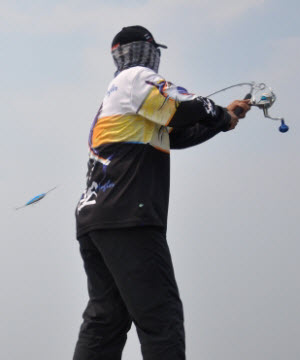 It was on this trip to Rompin, a small coastal town in Malaysia, that I released the huge potential we have in New Zealand of targeting billfish with topwater lures.
I was as an invited guest of my good friend Mark Richards to Rompin. Mark co-owns and operates Kaiser Pro Shop, a specialist topwater and jigging tackle store loacted in the heart of Singapore. He had organized this trip with a local topwater guru and legend “Robson”. I never found out his last name but you only need to mention topwater and Robson in the same breath and budding fishermen in Singapore and Malaysia know him in some way. Robson is the expert in this field and takes small groups of local and overseas anglers to the topwater hotspots around the world. He teaches them the finer points of this method of fishing and as I was to find out he knows a thing or two about the rods, the lures and how to rig them for billfish.
Rompin
Rompin is the undisputed capital of the world for sailfish and there are many ways to target them, for us it would be topwater casting, jigging and some live baits.
This small coastal area comes alive with charter boats and anglers from all over the world for the period of around two to three months prior to the monsoon season.
I had firm plans not to leave Rompin before firstly landing one of these majestic fish and secondly learning as much as I could about the lures and rig set ups for hooking them. I wanted to see just how transferable it could be for our conditions here in New Zealand on marlin. Both Robson and Mark saw no reason why these methods couldn’t be used here but there were a few things I needed to understand first.
Travelling light, so I could pack as much duty free in my bags for the return home, I had only packed two rods and a reel I wanted to tackle test. I had with me a two-piece 7' 8" PE3 Synit Surface Zone Topwater rod mated to a small Shimano Stella and my trusty DeepShot 150 light jigging rod with a brand new Shimano Talica 8 single speed. The rig later proved to be a hit with the local boatmen, but that’s another story.
I didn’t have to worry about stick baits or poppers with Mark being in the trade. He had a huge array of his own designed El-Toro lures, from 40-80 grams - all with different swimming actions - and a few of the better known Japanese imported lures he had removed from the top shelf of his shop before we left Singapore.
Sailfish on Stick baits and Poppers
Start time was a gentle 7.00am and even then the temperatures were rarely less than 25 degrees and very, very humid. After a quick buffet breakfast each day it was a quick five minute drive to the pier at the river mouth where we boarded our boats. It was very hard to get a bearing after we left the river mouth because of the haze. All I knew was the land behind us quickly disappeared quickly as the twin 150hp Yamahas powered us out to sea. We must have travelled for around an hour or so and there was a flotilla of craft both in front of us and behind us. This was coming to the end of the prime sailfish season in Rompin and the boatmen needed to make the best of it before the monsoon season comes and they become dry docked.
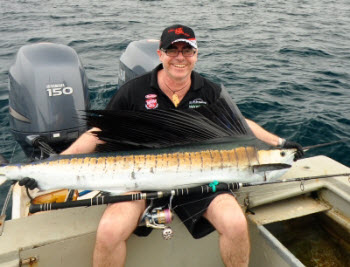
Not so fast Kiwi boy
I was really keen to get into these sailfish and started to rig my first lure in anticipation, this was also to be my first lesson of the day as Robson looked bemused as I put on a trusty treble hook at the rear and a nice strong double hook in the middle.
“Graeme,” said Robson. “I will show you shortly just what you need to be rigging.
"Remove the trebles and doubles as we aren’t after GT’s [giant trevally] here.” First lesson - don’t think what works at home will work elsewhere.
Lures rigged for billfish
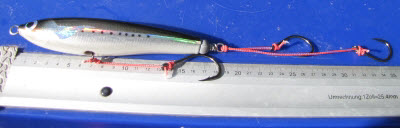
While choice of the lure, its colour and the action in which it moves through the water are important, the way in which the lure is rigged is paramount to success. There are two points of contact that each lure will be focused on. These are the bill and the soft flesh under the chin or in the corner of the mouth. The first is the long bill of the fish, so smaller gap hooks with shorter shanks are used. These are either specialist jigging hooks or live bait hooks and they are rigged on a long assist cord. The cords are attached from both attachment points. This was new to me and it made a lot of sense when explained. All billfish, whether they be a sailfish or a marlin, use their bills to either whack to stun their pray or simply to feel it out and see if it’s edible.
It’s this hunting action with its bill that Robson exploits. He uses two assist cords of different lengths attached to the rear fixing point of the lure, one at 100mm and the other at 160mm. These then have two single 5/0 hooks attached to them. The centre fix point also has an assist cord tied to it with another single 7/0 hook attached, the length of this cord is cut so the bend in the hook sits just prior to the end of the lure.
This is what happens and it has to be seen to be appreciated. The sailfish trail the lure as it’s worked back to the boat. If it likes what it sees it will accelerate and whack the lure with its bill and the two trailing hooks on the assist cords then either wrap around the bill, tangling and then setting as the fish veers off, or they lodged in the soft part of flesh just under the fishes chin and set. The reason for the smaller hooks started to make sense to me at this point because if they had been bigger, they would simply slide up the bill and slip off the end. Guys like Robson have been doing this for a long time now and has had a chance to fine tune the method both in the lengths of assist cords and how they are rigged.
So what about the single hook attached under the lure? Well this is for the fish that simply want to swallow the lure without testing it first and the reason why the hook is of a bigger gauge. Sailfish aren’t a big billfish; a big one in Rompin is around 40kg. We landed a range from 25kg to 37kg and the gear we used was tailored to suit fish of this size. The sailfish we encountered on the second day were what the locals called green fish, these were new to the area they were a lighter colour to the ones we had previously caught. Man they pulled hard and really put on a show with 30m tail walks and aerial flips which tested the rigs and gear.
Bringing home the lessons
I learnt much from this trip and it also taught me just how far we need to go before we fully come to grips with the potential of topwater casting of lures for big fish and also what needs to be done to unlock its full potential. It’s not just kingfish we can target, but nearly any species that swims, or can be coaxed to swim, near the surface. One thing that favoured us in Rompin was that the shallow water depth as it rarely over 20m which made attracting fish to the surface rather easy. I also learnt a lot about the history of topwater fishing in Southeast Asia and how it filtered down from Japan many years ago into the various network of Asian countries that had any sort of a coast line.
So how will this work on marlin down under and what sort of gear will be needed to subdue a fish three to four times bigger than a sailfish?
Topwater rods for marlin
For our marlin here we are going to need a rod that has a far more power than the little PE3 rod I used on the sailfish. A good amount of midsection power will be required and this needs to be combined with a strong parabolic butt section to soak up the fight.
Remembering the fact that you won’t be strapped into a game chair or have a full stand up harness to swing off, so the length of the rod is going to have to be shorter than most of the current 7' 8" to 8' 6" topwater rods we are seeing emerge here. A rod between 6' 9" and 7' 4" would be ideal, any longer and it will be painful for the angler instead of the fish.
You will also need to consider whether you intend to cast poppers or a stick baits as the two rods are very different as far as the tip action is concerned. A popper rod has a stiffer tip section giving a fast recovery to work the larger surface area of the popper through the water. While a stick bait rod is usually thinner in the tip as it doesn’t have to work such a large frontal surface when retrieving.
After consulting with Robson he is of the opinion that a specialist topwater rod is needed for the big species like marlin and giant tuna, one that can cast a stick bait between 60 grams and 130 grams.
The ideal rod also needs to be strong enough to hold 20 kilograms of drag. It also needs lift in the midsection but not too much so that it hurts the angler, it is also required to be parabolic and able to cast at least 60-70. That was one list of parameters for a blank and rod designer, but it’s done and been tested by local blank and rod designers Synit and a limited supply of these specialist big species topwater rods will be available for this game season by special order only.
Other rods that may fill the gap would be a heavy GT popper rod - the likes of a PE12 rated setup. Carpenter, Smith and HOTZ have several in this range.
Reels
It goes without saying a good spin reel will be needed and it will need to put out lots of consistent smooth drag in the 15kg to 20kg region. Reels in this class include the Shimano Stella 20,000 or 18,000 along with the Daiwa Saltiga 6500 series. You will need to be able to pack as much PE6 to PE8 braid as you can onto the spool, remembering you will also need three to five metres of 150 or 200lb fluorocarbon leader.
Lures
As far as brands and styles this will be a personal choice but for me it will be the El-Toro, Fisherman or Carpenter stick baits all the way. They have the design and testing put into them so are proven and have a great swimming action that you can easily mimic a wounded bait fish. Weight as mentioned would be 60 grams to 130 grams and either rear-weighted or mid-weighted. This weight range seems to represent the target size of the baitfish marlin are looking for.
Rigging
Trebles are a complete waste of time and after what I learnt in Rompin, the assist cord set up would be by far best way to rig the lure. I have rigged one using a Fisherman stick bait lure just the way Robson showed me, the length of the assist cords can be played around with to some degree. The only real difference is the hook size will be slightly bigger all round, given the bill size of a striped marlin is somewhat bigger than that of a sailfish. I have gone for a Mustard hoodlum live bait 9/0 for the rear hooks and the same but an 11/0 for the front. Both are strong but narrow enough to grip either the bill or the area under the bottom jaw.
The Method
There are a couple of options to getting success here in New Zealand. Firstly there is the off chance that you will come across a meat ball work up with marlin on the surface, therefore a casting rig will need to be set up at all times in anticipation. As our marlin lurk in deeper waters they will need to be coaxed to the surface. A better method would be to set out a few strings of teasers at various distances behind the boat. The first string needs to be close at around 20-30m, and then another string at around 50-80m. When a marlin is sighted among the string it’s a matter of slowing and casting the stick bait or popper back towards the target. The splash of the lure hitting the water will get its attention again so you don’t have to get it too close to the marlin, although the closer the better. Then it’s a matter of retrieve and repeat until a strike. If the strike doesn't come, continue to troll the lures and entice the pray to the rear of the boat again.
New Ground
This is new for us Kiwi’s but we should look at it a bit like pitch baiting, but with a stick bait. I have seen this method work so well on sailfish and marlin are no different apart from being a lot bigger and harder fighting, so the fun should be that much more exciting.
Over the next few summers I expect to target marlin and land them using this technique. It’s like all new things - practice, experiment a little and then perfect it.
Top Tips
 • Be prepared to target big species other than kingfish
• Rig the lures to match the species you are targeting
• Make sure your gear is of good quality because the action will be hot and extreme.
• Take note of what works and what doesn’t for future trips
 |
This article is reproduced with express permission of |
Fishing Reports Visit Reports
Manukau/West Coast Fishing Report - 15/10/26
Big spring snapper in 60 metres. The El Niño weather pattern isn’t going to be... Read More >
Rotorua Fishing Report - 15/10/26
Solid start to the season! The Rotorua lakes have all started the season well, and... Read More >
Tutukaka Fishing Report - 15/10/26
Big snapper in shallow. Things remain relatively quiet on the fishing front out of Tutukaka,... Read More >
Tauranga Fishing Report - 15/10/26
Bait and temperature on the rise. It’s been great to get out and see some... Read More >



Friday 23 October 2026
Major Bites
 - -
- - Minor Bites
 - -
- - Saturday 24 October 2026
Major Bites
 - -
- - Minor Bites
- -
Comments