
Stick-baits - targeting kingfish
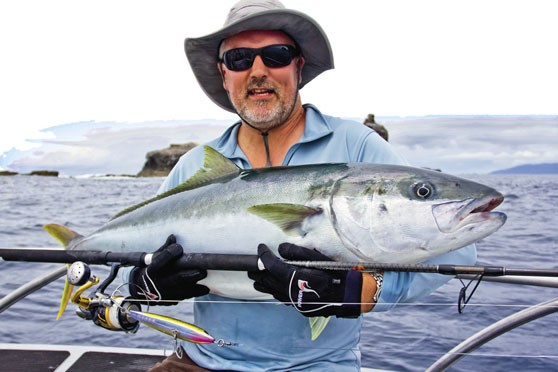
Tony Orton loves casting top-water lures for yellowtail kingfish – but some scenarios
demand specialized tactics to get a bite, as he explains...
Few sights are more awe-inspiring than watching thousands of trevally and kahawai feeding on the surface, their mouths wide open as they hoover up the tiny krill pushed to the top layer of the water column. They generally occur where deep, fast moving water meets structure – typically a point, island, seamount or rock – up and down the upper North Island’s coasts. Some days it seems you could jump out of the boat and walk on the backs of these fish. It also makes you think about what might be going on underneath such massive feeding schools, as these same baitfish-rich areas are also great locations for the mighty yellowtail kingfish.

One of the better ways to take advantageous of this scenario is through casting top-water lures. This form of fishing is not for everyone, often requiring patience, perseverance and hundreds of casts to raise and hook the target. However, if you stick at it, you’ll find this form of fishing very addictive, with those insane surface strikes making you want to keep coming back for more.
There are many reasons why kingfish might hunt higher in the water column, behaviour that puts the odds of a kingfish taking a well-presented stick-bait more in the angler’s favour. It could be a seasonal thing, where kingfish have moved into shallow water and are feeding and hunting around channel markers or structure. They could be feeding on squid or paper nautilus up near the surface at a certain time of the year, or perhaps a spring run of pilchards has seen a school pushed into a shallow bay, making them an easy meal for the kingfish shadowing them. Also, small packs of large kingfish roam the coastal edges and drop-offs searching for schools of baitfish in winter. All these situations can be exploited by a top-water fisherman casting a stick-bait, but as such scenarios are seasonal, it’s a big advantage to know the kings’ feeding patterns over the course of a year. However, simply remaining prepared and being ‘Johnny on the spot’ can still lead to a magical day where everything seems to work.
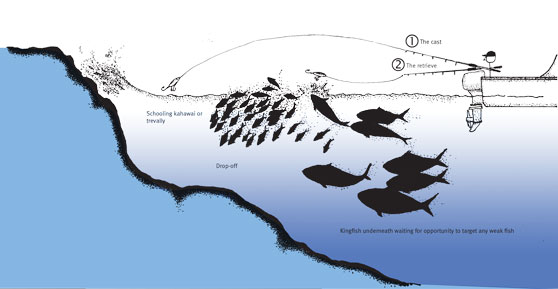
For me, as a charter skipper, it’s all about consistency and providing year-round top-water fishing. By far the most consistent scenario occurs while casting in and around surface-feeding trevally and kahawai – in fact, it has been so consistent we have caught kingfish every month of the year this way.
But I didn’t say it’s easy. I see it most days when on the water: a boat comes screaming up to a surface-feeding school, all excited, and the crew starts casting hoping for a kingfish. Three or four casts later they have not had a bite, so, thinking there are no fish around, they leave.
There’s no denying this can be a waiting game, but with all the commotion created by those surface-feeding fish, something big is bound to be waiting below for its opportunity to feed. So it’s up to you to look for signs that could trigger a bite.
One of the signs I look for is the direction and strength of the tide or current. If the current/tide is flowing onto a ledge or underwater structure, the stronger the current the greater the amount of water pushed into one area, causing the krill to be corralled into a tighter area, which in turn causes more frenzied feeding from the trevs and/or kahawai. Such behaviour can help to trigger a bite.
Watching the way the surface-feeding school is moving is also useful: normally a large school will move around in an orderly manner, scooping up everything on the surface, but once a large predator gets in the mix, the school becomes more flighty – it will change direction more often, the pack may split up, and you may see splashes from the trevally or kahawai as they try to evade nearby predators.
Also, watch what happens when the accompanying seabirds fly over the surface-feeding fish; see how they spook the school, often setting off a large collective splash in the direction the birds are flying. This in itself may be enough to spark a kingfish into biting.
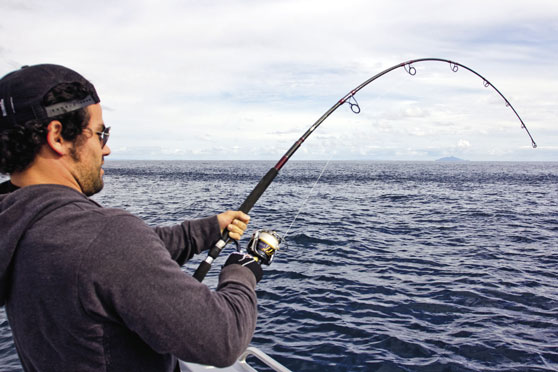
I always encourage my clients to cast just over the school and carefully work the lure through the pack of surface-feeding fish. I have lost count of how many times anglers thought they had snagged a trevally – until their rod buckled over and the reel started screaming. In other cases I have seen trevally or kahawai accidentally snagged, and within a second or two of the bite the surface-feeding school has split around the struggling, foul-hooked fish, and a pack of kingfish has attacked. Both examples prove that kingfish are waiting underneath for an opportunity to strike.
Another sign I look for is a surface school that splits into two or more schools. This, for me, is a sure sign a pack of kingfish has started hunting, getting more aggressive in their manner and pushing up under the surface school. Consequently, it’s a great time to get the casting rate up and work the fringes where the surface-feeding school has split. Casting into the gap between the two schools soon after they have split has resulted in many hook-ups for us.
Birds can tell you a lot about what is going on under the water, too. Watch the direction they are flying, as this is a great indication of where the next school of trevally or kahawai will pop up to the surface.
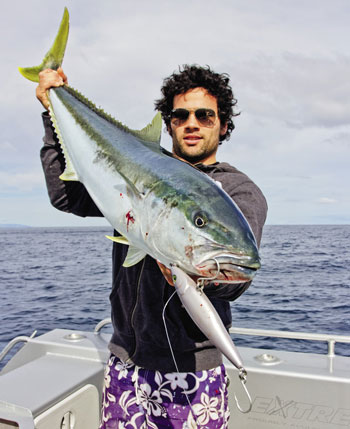 In all cases when participating in this type of fishing, one thing I try to minimize is the amount of boat noise. For example, once a school passes or goes down, we do not race over to another nearby school perhaps 100 or 200m away. Instead, we quietly cruise on over to the new school with the engines just in gear, while one or two of the anglers troll and work their top-water lures from the stern. You’d be surprised how many strikes occur when moving from A to B.
Another trick is to slow-troll one or two live baits – generally bridle-rigged or nose-hooked kahawai or jack mackerel – from the stern while other anglers continue top-water fishing from the bow. With the engines just in gear, it’s the perfect speed to troll ‘kingfish candy’ around the fringes of the surface schools. You can cover a lot of ground this way and the speed is slow enough to allow one or two anglers to keep on casting from the bow.
So, next time you see a school of surface-feeding fish, stop for a minute and look for signs of what may be going on underneath it. The big fish might not be biting right at that moment – but at some stage they probably will be!
|
|
This article is reproduced with permission of |

Fishing Reports Visit Reports
Outer Hauraki Gulf Fishing Report 17/09/26
Spring wind the handbrake. Spring is starting to make its presence felt in the outer... Read More >
Top of the South Fishing Report - 17/09/26
Early snapper in Tasman Bay. Well, spring is finally here, and the days are getting... Read More >
Bream Bay Fishing Report - 17/09/26
Good snapper catches reported. After Tangaroa turned off the fish tap for a month or... Read More >
Bay of Islands Fishing Report - 17/09/26
Pacific bluefin tuna for the lucky few. The last fortnight has seen more fishable days... Read More >


Friday 25 September 2026
Major Bites
 - -
- - Minor Bites
 - -
- - Saturday 26 September 2026
Major Bites
- - Minor Bites
- -
Comments