
Softbaits in shallow water

After endless easterly storms, I took the first opportunity to go fishing in ages one Friday morning in early February when the wind finally went around to the west.
There was quite a bit of left-over swell as I nosed out of Wairau Creek and headed across to Rangitoto Island. The water was quite dirty too, so I was curious whether the fish we’d been catching a couple of weeks earlier were still feeding on the northern side of Rangi. It’s usually a pretty consistent spot, but with the wind and rain we’d experienced, there was no telling.
Fortunately the usual drift produced a couple of nice snapper on soft plastics and subsequent drifts delivered consistent fishing, though it got progressively harder to stay in contact with my soft-bait in the worsening sea conditions. I already had enough snapper for my needs, so rather than get frustrated, I made decision to head back across the channel and get out of the wind, which had got steadily stronger as the morning wore on. The prospect of a bit of shelter and relatively flat seas was attractive.
When I got across the channel the tide was too low to re-enter Milford Marina, so I was stuck for an hour or two at least. Nothing for it: I’d have to do some more fishing.
East Coast Bays can fish very well at times and before the last bout of stormy weather, the area had been holding lots of bait, with kingfish, kahawai and snapper harassing the bait schools. On this particular morning, though, diving terns were nowhere to be seen and the sounder showed very little life. I cruised around for perhaps an hour trying this spot and that to no avail, before deciding to head in under the cliffs at Castor Bay out of the wind to fillet my catch.
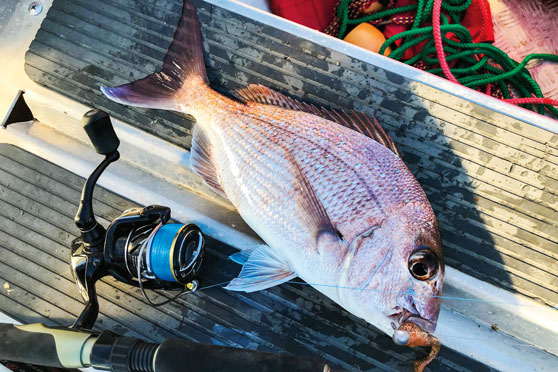
I’d only kept a couple of fish, so filleting didn’t take long, but I noticed there was quite a bit of wash against the cliffs. With time on my hands, I decided to try fishing in close for a while.
I rigged my lightest soft– bait rod with a four-inch soft– plastic on 1/8-ounce jighead and carefully nosed the boat inshore. I started fishing in three metres of water and to my great surprise hooked up first cast! It wasn’t a big fish, though perfectly legal, and I returned it, but it was the first of many caught during what turned out to be a very entertaining couple of hours.
I let the wind push the boat along the cliff face – it had conveniently gone northwest – casting into a couple of metres of water against the cliff and just behind the surf breaking onto narrow stretches of sand not yet covered by the tide. I didn’t get a bite every cast, but I certainly caught plenty of feisty little snapper. There were a few under-sized fish among them, but most were 30cm or larger with the best fish a more respectable 41cm model.
I motored back up the creek with a big smile on my face.
It had been so much fun, the next time I got out, a couple of weeks later after yet another nasty weather system, I planned to explore the possibilities further.
This session was a little different to my first: heavy rain and a big swell had discoloured the sea so I had to motor a bit further up the bays to find clean-ish water.
I explored under the cliffs some more, staying close to shore and working my way up the bays.
In the process I discovered lots of rocks and shallow reef systems I hadn’t realised were there – also patches of kelp scattered over otherwise sandy bottom. The big swell made navigation a bit hairy in close, but the snapper were still there.
Since the water was only three or four metres deep at the most, it was easy enough to see the bottom, which meant I could cast to particular areas – a clump of kelp or a sandy patch – systematically working over the best water.
Even better, I often saw the bites: sometimes it was just a flash on the edge of my vision, but a couple of times I clearly saw the fish attack my plastic. As was the case with my previous session, bites were savage, and while the fish were still on the small side, hooked on my light 2-4kg rod and 4kg line, the bigger ones could still be a handful.
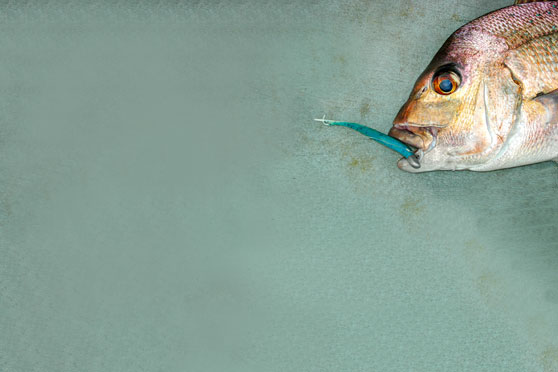
During the morning I don’t think I caught any snapper larger than 45cm, but the average size was probably 35cm and in two or three metres of water on light tackle, all of them were fun to catch, while the odd kahawai I caught in amongst them were even more of a handful.
I was back up the creek and on the trailer well before midday, having enjoyed a fun session catching fish in three metres of water only a hop, skip and a jump away from home. I doubt I used more than a few litres of fuel and, had I wanted a feed, my ultrashallow water session would have provided me with one as well.
Next time I’ll try the same approach with the kayak, just in case there are some bigger fish in there I may have spooked with the boat.
|
|
This article is reproduced with permission of |

Fishing Reports Visit Reports
Outer Hauraki Gulf Fishing Report 17/09/26
Spring wind the handbrake. Spring is starting to make its presence felt in the outer... Read More >
Top of the South Fishing Report - 17/09/26
Early snapper in Tasman Bay. Well, spring is finally here, and the days are getting... Read More >
Bream Bay Fishing Report - 17/09/26
Good snapper catches reported. After Tangaroa turned off the fish tap for a month or... Read More >
Bay of Islands Fishing Report - 17/09/26
Pacific bluefin tuna for the lucky few. The last fortnight has seen more fishable days... Read More >


Saturday 26 September 2026
Major Bites
 - -
- - Minor Bites
 - -
- - Sunday 27 September 2026
Major Bites
- Minor Bites
 - -
- -
Comments