
Softbaiting - why softbait size can make a difference

For a few sweet weeks every year, the inner Hauraki Gulf comes alive with huge baitfish schools and the creatures that want to eat them.
These baitfish can be juvenile pilchards, anchovies or whitebait, but all three have small size in common – which is why this scenario was often surprisingly unproductive for me until three or four years ago.
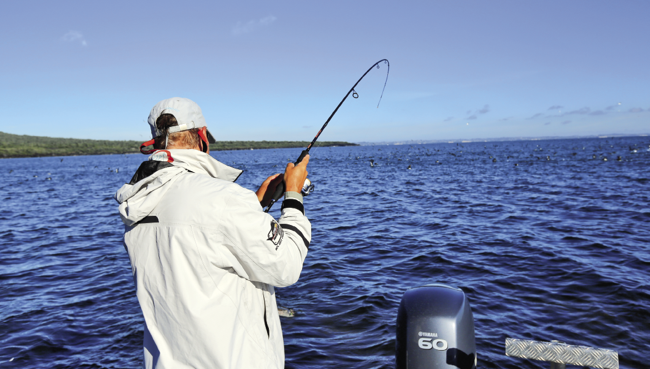
While not a trophy hunter per se, I get great pleasure from fighting larger fish, and am also a firm believer in the ‘big bait, big fish’ theory. Consequently, a sizeable soft-bait often dangles from my rod tip. Overall, this works well for me: I generally hook something pretty decent while accumulating a bag of more modest-sized snapper, and frequently my catch is supplemented by other worthwhile species such as trevally, john dory, gurnard, kahawai and kingfish.
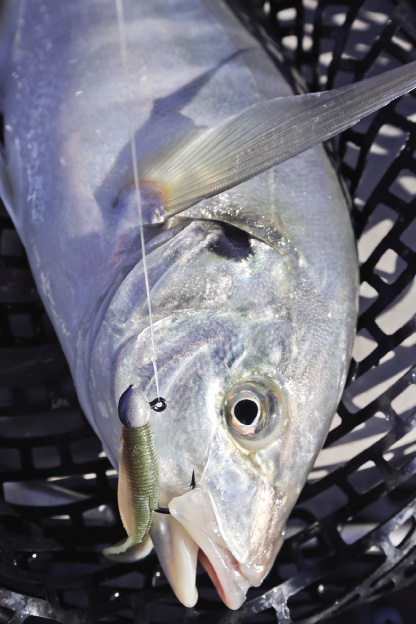
But not during the Gulf’s ‘anchovy run’ (even though, as already mentioned, the schools can actually comprise several small fish species).
The run usually takes place during late summer and early autumn, and there’s absolute carnage when it’s on, with the water boiling and erupting as hungry kahawai feed on thousands of tasty morsels, birds fluttering, whirling and diving like some demented snow storm or covering the surface in giant, squawking, squabbling carpets. Surprisingly though, the piscatorial predators below become very selective.
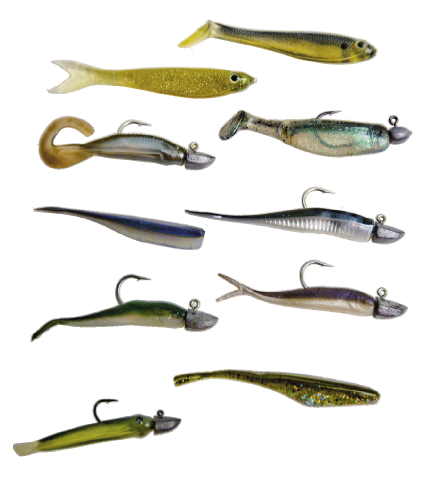
My big soft-plastic lures suddenly fail miserably – and it’s not just the 7-inch Gulps that get rejected either: even natural bait-coloured 5-inch jerk and paddle-tail offerings are ignored. But go down to a small, slim 3 or 4-inch soft-bait in pearly-grey/green colours and you’re back in business – and the fish that eat these lures can be surprisingly BIG, too!
Yes, this is a ‘match the hatch’ situation – a term coined by trout fishers for when trout become so focused on a specific aquatic insect at a precise phase of its life cycle that other potential prey items of a different size or colour are completely ignored. At such times, anglers must present the fish with something around the same size and colour as what they’re eating or the fishing can be frustratingly unproductive. Having said that, by following a few basic rules, not only is possible to get bites from highly selective fish, you may end up experiencing some of the most memorable fishing ever!
The ‘rules’
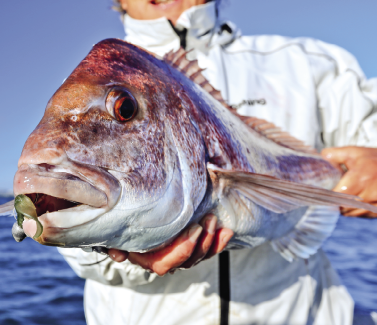 Reduce your terminal tackle: As you’re using very small soft-plastic lures, choose suitable lead-heads armed with smallish, short-shanked hooks. Minimal metal running along the soft-plastic’s length means plenty of lure movement, especially if your soft-plastic also has a wriggly grub or paddle tail.
The smaller hook size also makes it easier for a snapper to suck the whole package inside its mouth, making a solid hook-up more likely.
Beware of using hooks that are too small, though. Not only are some brands prone to bending out, the reduced gape gets less purchase, leading to more pulled hooks. A short-shanked 2/0–3/0 is a good compromise.
It may be a good idea to reduce your leader’s thickness/breaking strain, too – anything that helps your offering to look more natural will result in increased bites. Although I mostly use 2.5-3m of 20lb fluorocarbon (I still want to hang onto the occasional big snapper, trevally and kingfish hooked from amongst the mayhem!), I’m careful to choose a well-known brand that’s not too thick.
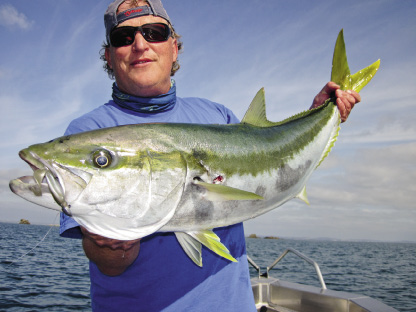 I use the well-proven Lefty Kreh loop knot to tie the lead-head on, as it doesn’t restrict the lure‘s movement as much as most others.
Whatever your own knot preference though, tie it just before fishing if possible, as most deteriorate in breaking strain over time. For similar reasons, avoid lifting even modest-sized fish aboard using just the leader: the wriggling fish stresses the knot and often causes it to fail unnecessarily. Instead, use a rubber-meshed net to boat your fish.
Fish the whole water column: In our area the anchovy-run activity occurs in depths ranging from just a metre to 20-metres plus. Yet, shallow or deep, the predatory species feeding on the small baitfish can be found throughout the area’s whole water column. And yes, even up near the surface, alongside the more expected kahawai and kingfish, you’ll sometimes find snapper smashing into baitfish schools, too (as well as prowling around deeper, waiting for injured fish – or parts of fish – to drift down to them). It’s therefore reasonably common to cast out into deepish water and get a bite just moments after your lure splashes down; after cursing about the ‘kahawai’ now zipping around on the end of your line, you find it’s actually a nice snapper when finally brought boatside!
 At the other end of the scale, we’ve attended work-ups in clear, reefy shallows that our small boats could barely float over, with snapper, trevally and kahawai crashing all around us. We could see 1-3kg snapper chasing our small lures!
Get that lure out: Whatever the scenario, try to get your lure well out to where the fish are feeding, or very recently have been feeding. Achieving plenty of casting distance is important, making it more likely your lure will end up amongst fish that are still feeding undisturbed, far away from your boat’s shadow and noise. Just as importantly, good casting distance allows your lure to sink and be erratically retrieved for longer afterwards. A 2.15m to 2.4m (7’to 7’10”) soft-plastic rod will do the job nicely, accompanied by a small, well-filled spinning reel holding 200m or more of 7-9kg (actual – not stated – breaking strain) braid.
Exactly where you should cast is determined by three basic criteria: where the bulk of the activity is occurring, the cast’s angle in relation to the drifting boat’s direction and speed, as well as the direction of the wind and current. Unfortunately, the strength of wind and current – or lack of it – are infinitely variable and largely determine what your lure does under the water. However, casting at various angles changes these dynamics and can make a big difference to your lure’s performance and success. Keep these aspects in mind when positioning the boat for the cast.
Boat placement strategies
Whatever you do, don’t charge into the work-up with engines roaring and spray going everywhere – no one will be happy with you and the activity will often cease. Instead, quietly motor ahead of the area of activity, before cutting the engine so the boat drifts or gets blown towards the work-up. This tactic allows plenty of fishing opportunities as the activity passes near, or under, your silent, stationary boat.
Try targeting the fringes of the work-up activity with your casts, rather than casting into its core. This tactic will reduce your chances of hooking a hard-fighting kahawai or tangling a bird in your line.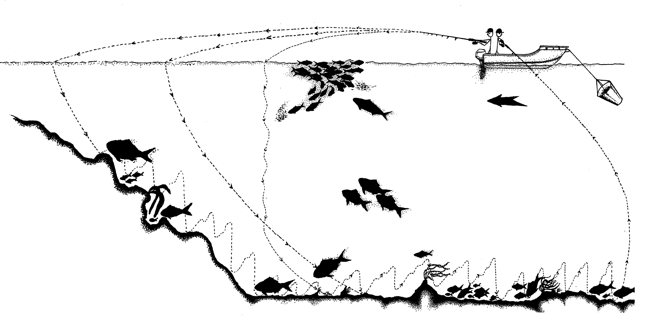
Deep water situations
Your chances for success should increase greatly – especially for snapper in deeper water – if you implement the following tactics…
Start by casting ahead of the boat’s drift direction (and with the wind too, preferably), as far as you can and at an angle that lets the lure swim downwards without creating too much extra slack line as it descends. A big belly in the line prevents good contact with the descending lure, so you’ll miss most of the bites on the way down (which can, believe it or not, produce as much as two-thirds of your catch!).
Once you’re happy with the casting angle, it’s time to get serious. In water deeper than 10 metres, it usually pays to start by whipping off one or two extra rod lengths of line from your reel so the lure initially sinks relatively freely. This also creates more distance between the lure and angler so a longer retrieve is possible afterwards.
Now close the reel’s bail-arm, wind in a bit of the line if necessary, and carefully watch any slack line remaining on the water – if it suddenly races away, strike! Bites generally happen when the lure’s deeper down though, after the bail has been closed to make the line nice and taut, and with the lure now swimming downward in a gentle arc thanks to its thin braid tether. If you’ve cast far enough in the right direction, and/or have let out some extra line, the lure should touch bottom eventually – but only if you haven’t hooked up already!
Watching the line at all times is critical to making the most of your opportunities; if you’re feeling the bites rather than noticing the line behaving strangely, you’re missing a LOT of fish! Unfortunately, you can’t beat experience for detecting anomalies in line-behaviour, but any time the line stays slack for longer than normal, or suddenly tightens in the wind, or jiggles around, wind in quickly and/or lift the rod. If extra weight is felt while doing this, firmly set the hook.
Should you miss out on ‘the drop’, it’s time to pin your hopes on the retrieve. Same as for the descent, much of what you can do with the lure is determined by your casting angle. For example, if the line bellies or sags badly after each jiggling uplift made with the rod, it’s likely that you and your lure are coming towards each other, reducing the potential retrieval distance and making contact with the lure difficult. This also makes it hard to work the lure effectively and feel bites. So again, experiment with various casting angles: if you can maintain a tight-ish line throughout the casting and retrieval process, you’ve in with a good chance.
If still struggling to maintain contact and detect bites, use a slightly heavier lead-head (typically around ¾-1oz) so the line cuts through the wind and water more effectively and stays straighter. But only if you HAVE to. Lighter lead-heads mean the little anchovy imitations sink through the water column more slowly, so remain visible to predators for longer. This sees them getting eaten by a variety of species, with prowling kingfish, john dory and trevally often joining the more usual kahawai and snapper.
Fishing the shallows
Shallow water situations (i.e. less than 10 metres) are much easier to manage. Simply engage the reel’s bail-arm immediately prior to splashdown, straightening the line so the wind can’t catch it too much and birds are less likely to become tangled (better still, quickly push the rod’s tip downwards so more line gets trapped underwater). Now wait until you see the line slackening, signalling that the lure has reached the bottom or a fish is biting it. Either way, quickly jiggle your rod tip up and/or wind smartly, and if some weight comes on, wind down, ensuring the rod stays bent throughout, before lifting the rod firmly to set the hook. But if nothing more happens, start lifting and jittering the lure back towards the boat.
Finally, if fishing over reefy ground, there’s no need to risk your lure by touching back down too often during the retrieval process. After all, in addition to any predatory fish feeding higher up in the water column, snapper will frequently race up two or three metres from the sea floor to grab your lure!
 |
This article is reproduced with permission of |
Fishing Reports Visit Reports
Outer Hauraki Gulf Fishing Report 17/09/26
Spring wind the handbrake. Spring is starting to make its presence felt in the outer... Read More >
Top of the South Fishing Report - 17/09/26
Early snapper in Tasman Bay. Well, spring is finally here, and the days are getting... Read More >
Bream Bay Fishing Report - 17/09/26
Good snapper catches reported. After Tangaroa turned off the fish tap for a month or... Read More >
Bay of Islands Fishing Report - 17/09/26
Pacific bluefin tuna for the lucky few. The last fortnight has seen more fishable days... Read More >


Friday 25 September 2026
Major Bites
 - -
- - Minor Bites
 - -
- - Saturday 26 September 2026
Major Bites
- - Minor Bites
- -
Comments