
Softbaiting the Wash
As the years go by and the seasons change, I find myself drawn to new ways to experience all that fishing has to offer. New species to chase and new techniques to learn keep the age-old pursuit of fish exciting. When I take a step back and examine the techniques I’m drawn to – such as flyfishing, gamefishing, and softbaiting – I notice a common theme: they are all very active forms of fishing. By ‘active forms of fishing’ I mean actively hunting the fish rather than waiting for them to come to you. This involves using elements like terrain, currents, and baitfish activity to solve the puzzle of where the fish of a lifetime might be hiding. Arguably, at the top of the list of the most active ways to fish in New Zealand is softbaiting the wash.
Fishing with softbaits has been popular in the American freshwater bass scene for more than 50 years. Surprisingly, some of these lures made their way to New Zealand shores in the early 1980s. Factors such as price and durability hindered their popularity here, and it wasn’t until the early 2000s, with the arrival of new light tackle and braid technology from Japan, that softbaiting began to see significant growth.
In its formative years, softbaiting was primarily reserved for fishing over the sand, likely due to the numerous lure-destroying species found in reef structures coupled with the fact that the technique is incredibly effective under the workups in the Hauraki Gulf. While both of these points still hold true today, the emergence of wash fishing has opened up a whole new world for anglers willing to roll up their sleeves and venture into tiger country.
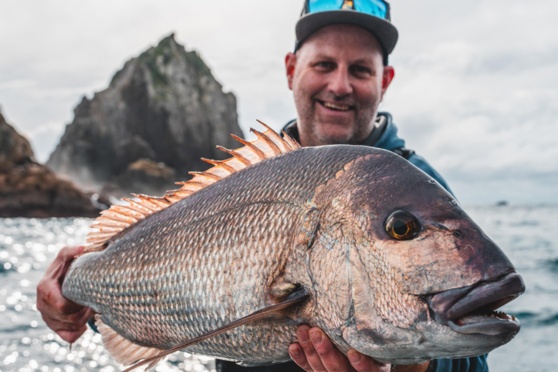
 Aaron Styles with a healthy specimen from Great Barrier Island.
It's important to note that wash fishing isn’t for everyone. As the name suggests, wash fishing involves casting lures into the wash formed by waves crashing against rocks, which can put both anglers and boats in potentially dangerous situations. Great care must be taken to assess the location you’re fishing, identify any hidden rocks that may not be on your charts, and ensure you have an exit strategy when the inevitable swell arrives. It’s a good idea to have someone on the helm during particularly ‘washy’ days, as it’s easy for an angler to become distracted by fishing and miss the approach of a swell.
The goal when wash fishing is to target areas where a surge creates wash, rather than an open ocean swell crashing against an exposed coastline. However, due to the unpredictable nature of the ocean, it’s always important to expect the unexpected. Wash serves several purposes: it stirs up nutrients that attract baitfish and provides a blanket of cover for snapper to hunt in. While it is a welcome addition when fishing in the shallows, it is not absolutely necessary. It would be remiss not to point out that I’ve also had fantastic fishing in the shallows on days when there was no wash at all. And, of course, fishing more sheltered waters is usually a safer option.
Snapper can be found in a variety of locations, and I am rarely surprised by where they show up. I have caught them in over 200 meters of water, many miles offshore while targeting deep-water critters, and in just 20 centimetres of water in the upper reaches of harbours. That said, I do have preferred terrains I target when wash fishing. While I’ve had good success softbaiting in depths greater than 35 meters, I prefer the shallows, particularly depths of 4 to 7 meters. This preference isn’t necessarily because I catch the most fish there, but because it’s where I have the most fun catching them. I’d choose a 12-pound snapper in 4 meters of water over a 20-pound snapper in 50 meters any day. There’s nothing more exciting to me than a shallow-water moocher taking a lure off the surface, and the ensuing fight often includes a genuine concern that the boat might hit the bottom!
.jpg) Snapper always fight hard when hooked in only a few metres of water.
Snapper always fight hard when hooked in only a few metres of water.
For many years, I targeted guts along the coast, which seemed to provide good cover for patrolling snapper, and I enjoyed success in these areas. While these spots are still worth exploring, in recent years, it’s the bouldery bays that really excite me. For me, the perfect recipe includes a large bay with a bouldery shoreline and a fishing ground full of submerged bommies and deeper channels running amongst them. A lazy surge on top, creating a consistent wash, completes the recipe and when I’m fortunate enough to find such an area, it certainly gets my attention. The most important thing to remember is to cover all available ground: cast at rocks, into guts, along weed lines, and cliff faces. Give yourself every chance to find where the fish you’re looking for might be hiding.
As with most hunting methods, there can be long periods of slow action. When fishing in the rocky shallows, you are typically targeting resident fish, and unless you are in a particularly productive area, fish are unlikely to be holed up in every nook and cranny. As previously mentioned, you are trying to find the fish rather than drag them to you with berley, so be prepared to cover some coastline to find what you’re looking for. This method of hunting along a shallow coastline also means there is a constant risk of spooking fish. Using an electric trolling motor, such as the Garmin Kraken, is an excellent way to minimise boat noise while you cover some ground. It also ensures you’re not relying on favourable winds and currents to set the right drift makes it easy to chase down fish in the shallows once you’ve hooked a good one. I also try to minimise noise on the boat when fishing in shallow areas, being careful not to bang too much against the hull and turning off the stereo while fishing, which can all help improve your chances of success.
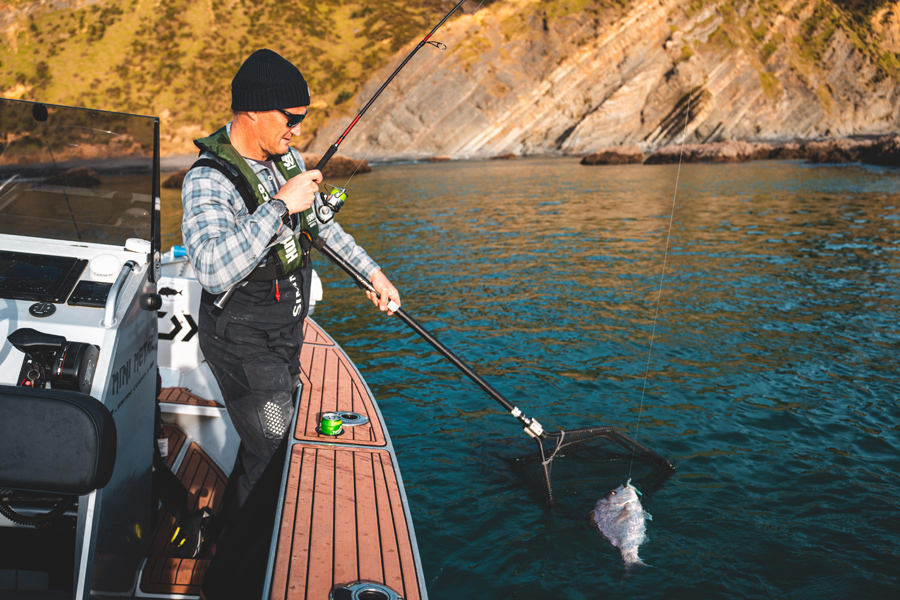 Shallow water softbaiting scenery can be spectacular.
The size and condition of fish you may encounter in the wash can be jaw-dropping. Almost all of the XOS snapper I’ve been lucky enough to land have come from the shallows. If you want a fighting chance of getting a photo with your trophy fish, you’ll need to come armed with suitable gear and tackle. Braided line is a must; I rarely fish with less than 30lb, eight-strand (x8) line and almost always match my braid with a 30lb fluorocarbon leader. There is an argument for using a lighter leader to get more bites, but I’ve found this to be of little consolation after being dusted by what could have been “the one."
I prefer a longer rod with a sensitive tip for improved casting and bite detection, but make sure it still has a grunty butt section with plenty of lifting power for when the fight gets tough. The Daiwa Commander ‘War Hammer’ is my rod of choice, matched with a Daiwa Saltiga 4000 – a reel that is comfortable to use all day and has a smooth drag that I often use to its fullest!
Reefs are home to toothy species that can quickly destroy expensive softbaits, but with improvements in lure technology and the emergence of more durable baits, it’s not uncommon for me to use only one or two baits throughout an entire day. All colours can work on their day; personally, I prefer more natural colours, with my favourite being a 7” Jerk Shad Bait Junkie in Baby Bass. You can thank me later!
.jpg) Although long rods with sensitive tips offers improved casting and bite detection, ensure they have a grunty butt section with plenty of lifting power.
Although long rods with sensitive tips offers improved casting and bite detection, ensure they have a grunty butt section with plenty of lifting power.
Choosing the right jighead weight and size is crucial. Match your hook size to your lure size – I use a 5/0 hook for 5” and 7” baits. Next, you need to determine the right weight. If you choose a jighead that’s too light, you won’t effectively fish the entire water column, resulting in fewer bites. If it’s too heavy, it will sink too fast and lead to lost gear. Various factors, including depth, sea conditions, and buoyancy of your bait, will influence the best weight to use. As a rule, I generally start with a 7” Bait Junkie (a buoyant bait) and a ½oz, 5/0 jighead for almost all scenarios. Be prepared to experiment with jigheads to determine what works best for you on any given day.
Wash fishing is an exhilarating way to hunt snapper. Hand-to-hand combat with hard-fighting fish in uncompromising terrain never gets old. We are fortunate in New Zealand to have thousands of miles of spectacular coastline, much of which is ideal for wash fishing. There is no better way to explore it than from the bow of a boat with a softbait combo in hand. Just be careful and remember that you’re often targeting big resident snapper. Keep this in mind when deciding whether or not to harvest your catch – my suggestion would be to enjoy the deeper school snapper at the dinner table.

August 2024 - Words and Images by Ben Brown
New Zealand Fishing News Magazine.
Copyright: NZ Fishing Media Ltd.
Re-publishing elsewhere is prohibited
Fishing Reports Visit Reports
Manukau/West Coast Fishing Report - 15/10/26
Big spring snapper in 60 metres. The El Niño weather pattern isn’t going to be... Read More >
Rotorua Fishing Report - 15/10/26
Solid start to the season! The Rotorua lakes have all started the season well, and... Read More >
Tutukaka Fishing Report - 15/10/26
Big snapper in shallow. Things remain relatively quiet on the fishing front out of Tutukaka,... Read More >
Tauranga Fishing Report - 15/10/26
Bait and temperature on the rise. It’s been great to get out and see some... Read More >


Tuesday 20 October 2026
Major Bites
 -
-  -
- Minor Bites
 - -
- - Wednesday 21 October 2026
Major Bites
 - -
- - Minor Bites
- -
Comments