
Softbaiting Secrets with Mark Kitteridge
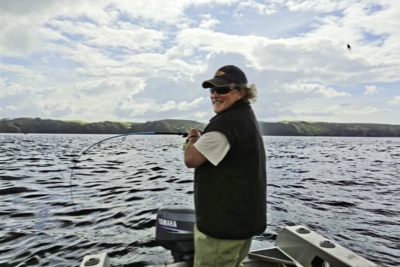 After all, I’m conscious that I have to perform acceptably or suffer the cutting jibes and constantly retold stories (often refined and greatly embellished) by the more fortunate angler – sometimes for years afterwards. That’s why I sometimes lie awake for hours at night working things through, or keep on fishing all day, even when things look hopeless.
But you don’t have to be so silly. The following aspects have been learned the hard way, out on the water with my equally competitive buddies, and should help make you a better soft-plastic fisherman:
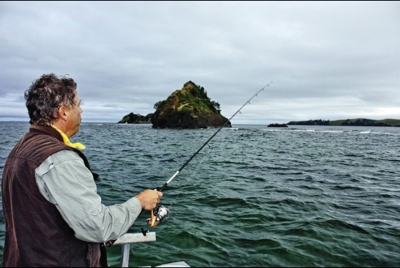 Use longer soft-plastic rods to increase success: To a certain extent, it’s a case of ‘the longer the better’ when casting and retrieving soft-plastic lures in depths up to 20 metres. That’s why 7-foot (2.13m) soft-plastic rods work pretty well, but a 7’6” (2.29m) model can be better still. I first came across a ReelRods soft-plastic rod this length about five years ago, when fellow NZFN staff member Peter Francis had one made for him. I loved it, so asked Kieron Olsen from ReelRods to make me two, and these have been my frontline weapons for several years now, offering great casting capabilities, effective line control and fish-hooking capabilities, as well as a decent amount of grunt to control and lift fish. However, I recently purchased a very modestly priced 8’ (2.44m) Wright and McGill rod from Go Fish!, and after replacing the double-footed guides for much lighter singles, it appears I’ve got a real weapon, with the extra rod length providing even more of the aforementioned advantages.
Small spinning reels rule: There are plenty of suitable reels out there, but the smaller spinning reels are the most effective and comfortable to use over long periods. Potential candidates should hold at least 200m of 9kg (20lb) braid (actual breaking strain, not the stated poundage, as these are often very different from each other) and have a smooth drag.
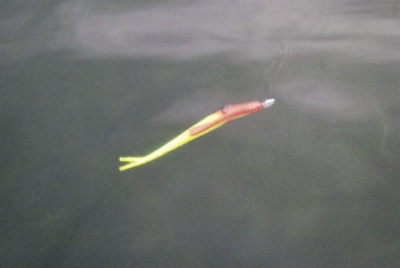
Use bright braid: Many of the bites from snapper will only register via line movement rather than on your rod tip. It’s therefore a big advantage to have a braided line that’s very brightly coloured so it’s easier to monitor. You’ll find that certain coloured braids stand out or fade into the background depending on the conditions at the time. Lots of glare on the water often requires fluoro pink or orange, while gloomy conditions may see chartreuse standing out better. Bright white is surprisingly versatile. So to remain effective throughout the day, it pays to have outfits filled with different coloured main lines.
Select the best possible lead-head weight for the circumstances: Basically, the weight is determined by the depth of water being fished, the current’s strength, the amount of wind present, the thickness of your line, and the soft-plastic lure’s size. As a rule of thumb, in calm conditions, I use: ¼ ounce in 1-3 metre depths; 3/8oz in 4-9 metres; ½oz in 8-15 metres; ¾oz (or 5/8oz) in 15-20 metres; and an ounce in anything deeper (keeping in mind this article is about casting for snapper rather than dragging for them). Add some wind to the equation though, and you should go up one lead-head weight, as this keeps the line tighter, which is important for detecting bites. However, you’ll need to retrieve slightly faster to keep the lure out of the weed and rocks. Otherwise, try replacing the soft-plastic tail with a larger one, which will help with casting distance, hold up more in the current (allowing slower retrieves if desired), and resist the forces of wind on the line better. But it’s not just about the head’s weight – the hook is also important, leading us to the next important aspect…
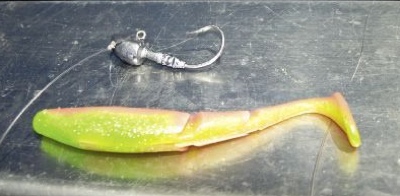 Use the right hook: Let me say right away that I haven’t used all the different lead-heads available in their various shapes and assorted hook types, so my apologies if others deserve to be here too, but aren’t. To be perfectly honest, I started using TT Nitro jig-heads because they were from the same source as Gulp!, and kept using them because they worked well. So I was initially disappointed when these heads started arriving with a different hook incorporated – one that was significantly thicker in gauge with a bright, shiny coating. Surely these would be easier to see and harder to set? But my fears proved unfounded, as they proved to be very durable and effective, especially in the 3/0 size. I was also sent some Mustads in the same size, which are even easier to set due to their fine gauge, but they can be bent when wrestling big snapper from shallow, foul territory with a hard-set drag. That said, they’re hard to beat in more forgiving conditions – just a sniff and snapper are hooked. Thirdly, because I’m a friend of Paul Senior, a fishing tackle importer, I’m using his relatively new Lightbulb jig-heads. So far these have been as good as any, and I also like the shorter shank, allowing even 4-inch (10cm) soft-baits to impart plenty of action. Nor does it hurt that the lead-head is covered in a UV-reflecting coating – this property’s proven to increase attractiveness in other aspects of fishing, so it’s probably an advantage here, too. The downsides? Same as the Nitro, I’ve had the hook crushed right in or sideways, but not out. I also find they lose sharpness more quickly than some other brands, although Paul says he’s sorting this issue out.
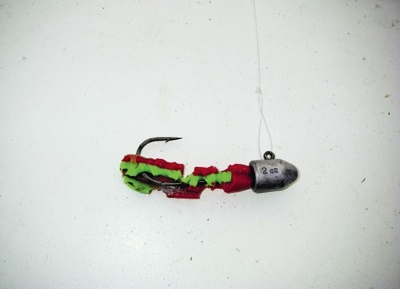 Soft-plastics that work: There are so many products available that will catch fish, but two brands continue to stand out for me – Gulp! and Z-man – for very different reasons. With Gulp!, it’s the flavour embedded in the product, making them fishy-shaped pieces of bait. As a result they’ll catch fish even when their attractive wriggly bits are chewed off and/or they’ve been soaking in water for hours. Gulp! also comes in a wide variety of fish-attracting shapes and colours that cover nearly every situation; I’m a big fan of the 7-inch (17.8cm) models, which can be cast impressive distances, offer greater visibility while sinking (especially in brighter hues), and tend to attract larger snapper. But Gulps are also relatively prone to damage, so if I want a soft-plastic to stay in one piece (i.e. when casting over areas inhabited by hungry, soft-bait-destroying bities such as leatherjackets and various wrasse, or if ‘dragging’ behind the boat, where lots of nibbling fish might be encountered before a decent fish comes along), I’ll change to a Z-man. Z-mans are stretchy and tough, so resist damage well – even the crushing jaws of snapper – and although the available range is nowhere near as extensive as Gulp’s, I generally haven’t found it wanting (just give me some 7-inch models too, please!). Z-man’s downsides? They are more likely to be pulled down off the lure-holder than Gulps; they’re so flexible the hook can catch the tail; and as the scent is washed off relatively quickly, a scent additive should be applied to get the best from them.
Search for the best leader: It’s always an advantage to use the lightest you can get away with. For me, because I often fish in rugged country inhabited by big snapper, I mostly use 20lb (9.1kg) Stren fluorocarbon, even though it’s relatively bulky (in comparison to some other brands) and probably over-tests by quite a bit. After all, a slightly thicker and stronger trace can be useful, providing extra abrasion resistance and enabling greater pulling power. But now I’m wavering: recently Paul started using the fluorocarbon he imports, which is much finer in gauge, and he started getting more bites. This trace material is also lighter – just 14lb or 6.5kg – a weight I’d generally thought too light for the conditions. But since John Eichelsheim uses this weight of trace successfully, too, I’m finally trying it myself. Sure enough, it has made a big difference when the going gets tough, although I’ve had to adjust my rather ‘uncompromising’ fighting style to a slightly gentler one – and I still worry about what will happen when I hook ‘the one’. Whatever the poundage of trace used though, three metres of it (more than many other anglers think necessary) is an advantage, because specialised trace material is much tougher than the thin braid mainline, providing added insurance amongst the rocks and weed, and the length allowing the re-tying of numerous knots before becoming too short. Which reminds me: don’t lift your fish out on the trace (unless it’s very small), as you’ll damage the loop or stress the knot, risking eventual breakage.
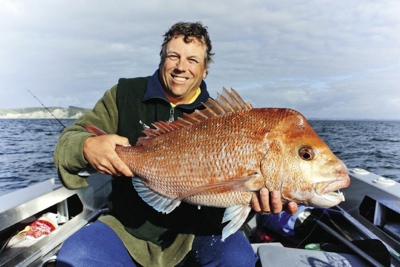 Use the best possible knots: For quite some time I’ve been able to exert more pressure than my friends (admittedly anecdotally) due to confidence in the knots I use (and, to a lesser extent, because of the heavy Stren trace mentioned earlier). I start by tying a short, 12-turn Bimini Twist double into my braid mainline, then attach the trace material with a 10-turn Yucatan variation (five turns up, five turns down), or, if the double’s broken, with a No-name knot. However, the latter is disturbingly variable in performance depending on the line brands and weights, so if it fails (generally by slowly slipping when pulled apart really hard), I use a 10-turn Albright instead. Indeed, this knot keeps its breaking strain so well over time and use, I’m considering making it my first option. The Albright’s only downside is its slightly bulkier form, but the relatively thin lines involved mean this is literally not a big issue. As for the knot joining the trace to the soft-plastic lead-head, it’s hard to go past a three-turn Lefty’s Loop knot, as it’s strong and durable, and allows the lure to retain maximum movement. The only trick involves tying the knot’s loop small enough to prevent the lead-head getting ‘collared’.
Concentrate on casting the best possible angles: I’ve found it generally pays to cast ahead or to the side of the drifting boat’s direction, then experiment to find the casting angles that allow the lure to descend relatively naturally whilst still maintaining reasonably direct contact with the lure. However, a headwind can make things interesting in tidal areas, sometimes causing the boat to hold up on the surface, while deeper down the lure is being pushed along faster by the current. In such situations you may actually need to cast behind the boat to get your soft-bait down to the bottom. Increasing the lead-head weight can also help to overcome this situation.
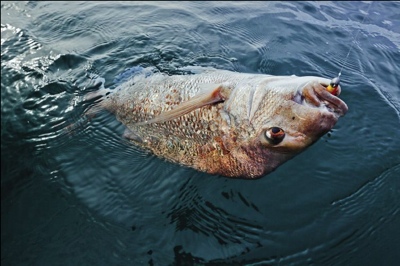
Focus on ‘the drop’: Whether you know it or not, most of the bites from the bigger snapper occur while the lure is descending or in the first few lifts and drops after reaching the bottom, especially when fishing in suitable territory of around 10-20 metres depth. I believe the snapper often detect our descending lures while still some way up, and will readily race over or upwards a considerable way to intercept them. (That’s why I often use very large and/or brightly coloured lures, as they stand out and attract maximum attention, or paddle-tailed soft-plastics that create plenty of disturbance while moving through the water.) So ensure the line stays fairly taut throughout the descent, especially in the lower part of the water column, even if this means winding in any extra slack lying on the water’s surface. At the same time, watch that bright braid like a hawk, and if anything unusual happens – i.e. the line suddenly slackens, slows, whips tighter or jiggles – either wind in quickly and/or execute an exaggerated couple of jiggling uplifts, and you’ll often find the rod loads up. These two options work better than full-blooded strikes, because if you miss with the former options, the lure remains in the strike zone, giving you another chance. Conversely, the latter response often whips the lure out of sight or makes the snapper wary.
Beware the light strike: Unfortunately, in this instance only the better soft-plastic fishers will be able to take advantage. It takes a long time to recognise the slight pressure registering on the rod that indicates a snapper has grabbed the lure and is racing towards you. Quick winding accompanied by strikes as the weight comes on will get these often big fish – but most anglers won’t even know they’re there.
So now I’m going fishing, and I intend to kick butt – not that I’m competitive of course!
 |
This article is reproduced with express permission of
written by Mark Kitteridge - 2013 Originally published in New Zealand Fishing News |
Fishing Reports Visit Reports
Outer Hauraki Gulf Fishing Report 17/09/26
Spring wind the handbrake. Spring is starting to make its presence felt in the outer... Read More >
Top of the South Fishing Report - 17/09/26
Early snapper in Tasman Bay. Well, spring is finally here, and the days are getting... Read More >
Bream Bay Fishing Report - 17/09/26
Good snapper catches reported. After Tangaroa turned off the fish tap for a month or... Read More >
Bay of Islands Fishing Report - 17/09/26
Pacific bluefin tuna for the lucky few. The last fortnight has seen more fishable days... Read More >


Saturday 26 September 2026
Major Bites
 - -
- - Minor Bites
 - -
- - Sunday 27 September 2026
Major Bites
- Minor Bites
 - -
- -
Comments