
Softbaiting Q&A: Tips from a pro - Part 2

In a previous article our resident, self-confessed, soft-bait obsessive Adam Royter started a Q&A feature on the subject. Some were simple questions, but information vital to this fishing process was covered. Now he has prepared more of the same…
What type of line should I use?
There’s a lot of lines out in the market place at the moment and some are great, while others should be avoided. How do you tell which one is best for you?
Braid is the common name for polyethylene fibre line. There are two distinct types – braided line and thermally-fused line. In short, standard braid is okay to fish with when it is over the 10lb line class, and thermally-fused is best fished with ‘under’ 10lb.
The reasons for this are that standard braid under 10lb will tangle on the cast and fused line is too stiff to fish over 10lb.
Berkley FireLine Ultra8 in 6lb, 8lb and 10lb is very good to spin with and any standard braid over 15lb will work fine with minimal casting hassles.
What’s the biggest difference between all the soft plastic materials?
There are three different materials available. Two are petrochemically -based PVC compounds used by most manufactures, and then there is the ‘plastic free’, biodegradable, organic-based polymer materials. In a nut shell, one is good for the environment and the others will eat through the dashboard of your car!
Which is which?
Berkley Gulp is the only 100% biodegradable soft-bait in the world. All other soft-baits have a petrochemical base and will be in the environment, if lost, for 200 to 600 years. So just think plastic bottle.
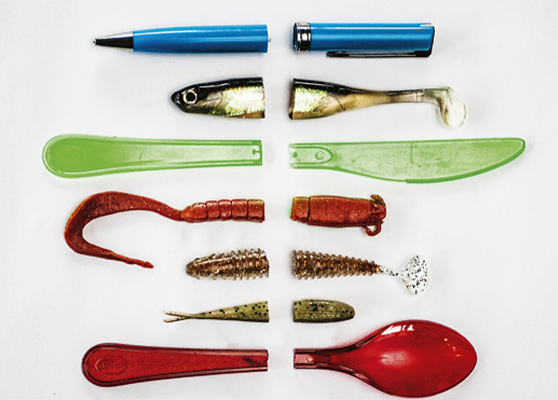
Plastic is plastic no matter what you do to it. Berkley Gulp! is not plastic but a natural plant based product that's earth friendly! Two of these are Gulp! - can you pick which ones!?
What’s the difference between the scents?
Scents can be an important part of why soft-baits work so well!
Some scents are just attractants. This type of scent simply puts into the water column a smell that is different only to the water itself! This smell is generally enough of a reason for a fish to investigate it
Then there are fish feeding stimulants. These are only available in a couple of soft-bait types – (Powerbait & Gulp). They work differently to attractants as they enter the fish’s brain via its nose and mouth and work directly with the chemoreceptors in the fish’s brain to tell it that what it’s smelling is food!
Whichever way you choose to do it, it’s well worth looking into the power of scents. If you don’t, everything you put into the water will smell either like plastic or humans – two things that fish hate!
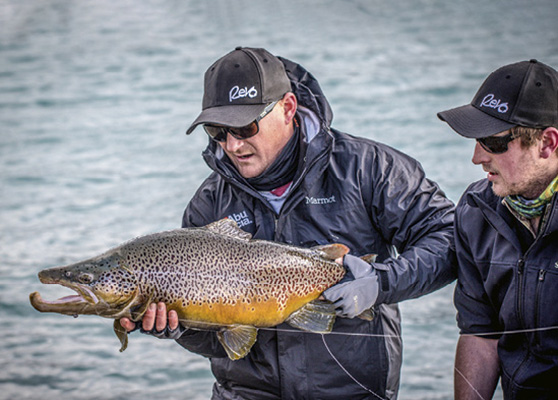
All fish have an amazing sense of smell, and trout are no exception. Hide your tracks by using softbaits with scents.
How much line do I need?
Needless to say, you should always have a full spool (no more than 90% if using braid)!
If you do a little homework on the fish species you’re likely to encounter, you’ll get an idea of their size and their ability to swim.
The power a fish can apply through its tail – particularly its ability to sustain this power – is the motion you’ll need to stop in order to catch the fish. You’re not fighting the ‘weight’ of the fish, you’re fighting its ‘ability’ to swim! Please read the previous line 10 times and then tell everyone you know! The weight of your line, the rating on your rod and the amount of drag pressure you apply have nothing to do with the size of the fish you catch. Fish don’t weigh anything in the water.
At the end of the day, you only have as much line on the spool as the reel can take. For the sake of casting efficiency and comfort, we tend to use small-to-medium sized reels relative to the species we intend on catching.
Keep in mind that you can fit a lot more braided line on the spool than nylon monofilament!
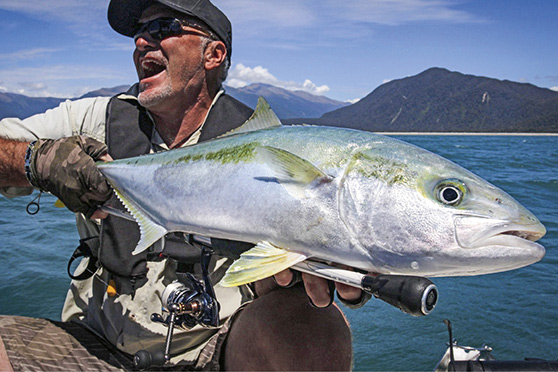
Haast kings are a real thing. Aaron Horrell had patience and just enough line on this 2kg spin outfit.
What do the different shaped jig heads do?
To be honest, not much! The shape of the lead section on a jig head has very little bearing on how your soft-bait will swim. The soft-bait tail is the driving force that dictates how your lure will react to your rod-tip movements.
Whether it be a stick-bait style or shad tail, the shape of the jig head has no real bearing. Don’t believe everything you read!
What weight leader should I use?
You should always use the lightest line you can get away with. The lighter the line, the more bites you’re going to get!
When fishing on open flats with nothing around but sand and water, you can use as light a leader as you like; there is nothing for the fish to cut the line on here! When coming up against an oyster and barnacle-encrusted tree snag with fish deep in its cover, you’re going to need some of the heavy stuff.
It’s a simple case of ‘horses for courses’! Look at where you have to pull your fish from or what you think they might hit on the way in.
Here is a rough guide to help you out. Braided line, also known as polyethylene line (PE), can be successfully tied to these mono leader weights:
Braided line weight Mono leader weight
4lb PE 2 to 8lb
6lb PE 4 to 12lb
10lb PE 6 to 20lb
15lb PE 10 to 30lb
20lb PE 20 to 60lb
What weight mainline should I use?
Again, use the lightest mainline that you can get away with! You can crack some seriously big fish with 6lb braid. For small to medium work (fresh water to inshore saltwater), use 4 or 10lb braid. For medium to heavy saltwater (inshore saltwater to offshore saltwater), use 10 to 30lb braid.
How good does the reel need to be?
Here are my top three things you need to have in a spinning reel to stop things going wrong:
1. Drag – the drag system must work smoothly throughout a range of pressures. An easy way to check this is to screw the drag knob up medium-tight and turn the spool with your hand. It needs to be able to tick over very slowly. If it jerks or stutters at this low pace, chances are you will need to do some major surgery to fix it or, worse still, it may never recover!
2. Physical weight – you’re going to cast between 300 and 500 times a day when soft-baiting. The reel is the heaviest part of your kit. Making it as physically light as possible will make a big difference to how your arms feel at the end of the day. If this doesn’t sound important, just wait until you own a super-light reel!
3. Gear box & bearings – it is as essential to have bearings in your reel, as it is to have them in the gearbox of your car. After all, they do pretty much the same thing: input and output rotating power
Ball races or ball bearings are what will stop your gears from wearing out. If you look at the figures below, you get a sense of what I mean.
An average length cast takes about 30 turns of the handle to retrieve. At 5.0:1 gear ratio (that’s rotor turns to handle turns), 30 handle turns equal 150 rotor revolutions. On a normal day’s lure casting, an angler will cast and retrieve around 400 casts. All this equals an amazing 12,000 handle turns and a whopping 60,000 rotor turns! If we calculate that again (if your calculator has enough room left) over a possible 40 days fishing a year, 2,400,000 will be the result. Two and a half million rotor turns per year! And you said the reel didn’t need all those bearings!
What should I keep my soft-baits in?
Most soft-baits come in a self-sealed bag – I would recommend keeping them in these bags. If you have a series of favourites that you use a lot, you can use one of many clear tackle boxes or soft bags with zip lock bags inside. As for Gulp (which comes in a liquid), you can store them in a clip-lock container that Plano Tackle manufacture.
What sort of fish can I catch with a soft-bait?
That’s a trick question right!! Well what can I say? More and more fish species are being caught on soft-baits every day. Chances are that if you have a target species in mind and it’s got just the smallest of nasty bones in its body (i.e. it’s a predatory fish), I think you’ve got a good chance to catch it on a soft-bait. The range of sizes, colours, shapes and scents is absolutely outstanding and I’m sure there’s a type of soft-bait that will suit any fish you want to try for.
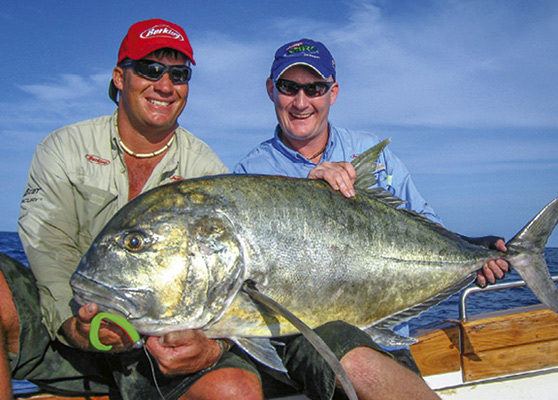
Tying good knots and having a good drag system helped in capturing this 25kg+ giant trevally.
All you need is time, patience, the right lure and a little luck. So whether it be freshwater or salt, the game is yours to play – and how you play it is up to you!
|
|
This article is reproduced with permission of |

Fishing Reports Visit Reports
Manukau/West Coast Fishing Report - 15/10/26
Big spring snapper in 60 metres. The El Niño weather pattern isn’t going to be... Read More >
Rotorua Fishing Report - 15/10/26
Solid start to the season! The Rotorua lakes have all started the season well, and... Read More >
Tutukaka Fishing Report - 15/10/26
Big snapper in shallow. Things remain relatively quiet on the fishing front out of Tutukaka,... Read More >
Tauranga Fishing Report - 15/10/26
Bait and temperature on the rise. It’s been great to get out and see some... Read More >


Saturday 17 October 2026
Major Bites
 -
-  -
- Minor Bites
 - -
- - Sunday 18 October 2026
Major Bites
- - Minor Bites
- -
Comments