
Softbaiting for Kingfish with Big Baits

While I definitely prefer the challenge of hooking kingfish on standard softbait gear, targeting them with heavier gear and big specialised softies has its place, too.
Why choose softbaits?
For me, the biggest attraction offered by going heavy-duty with softbaits for kings is the versatility they offer, as well as the fact that the slower pace generally required to work them suits me better than knife jigs now that I’m older and less fit!
Suitable tackle
As big softbaits can be utilised in so many very different ways, the gear used with them tends to vary widely, too.
Reels: Whatever the technique involved, most outfits incorporate spinning reels capable of holding around 300 metres of PE3-8 braided lines. However, I’ve also used freespool combinations with both jigging and casting and-retrieving techniques and enjoyed excellent results. Indeed, the fact the line unloads from the spool in a steady stream rather than in spiralling coils means that much better contact is maintained during the descent, enabling better bite detection and the ability for a faster response by the angler.
Most heavy-duty reels these days have relatively high line retrieval capabilities. That’s great, as a nippy retrieval speed definitely triggers kings into biting, whether performed horizontally or vertically.
Having said that though, reels possessing more modest line retrieval speeds are often fine for working large softbaits, as the ‘mechanical jigging’ actions can usually be performed at a slower pace and still attract plenty of bites. Such reels also tend to offer improved low-down cranking power, which can be helpful when trying to wrestle kingfish away from line-shredding reef structure. With those aspects in mind, I enjoy using high-quality reels with a large spool circumference and a more modest retrieval ratio, so the best of both worlds is provided (especially with overhead-type reels).
Rods: A standard jigging rod with 15-37kg capabilities will work fine when jigging, while a 7-8’6” stick-bait rod offering a similar line-weight range will sort out casting-and-retrieving duties.
Mainline: Nothing beats the appropriate poundage of braid for this job; it’s nice and thin so cuts through the water efficiently and the minimal stretch possessed means the ability to detect bites and set hooks is much more effective.
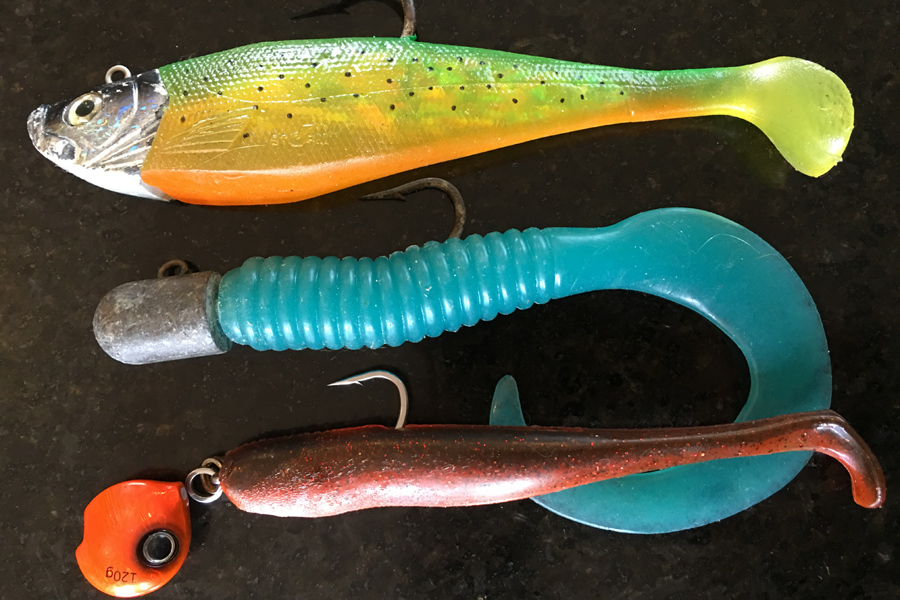 Three suitable softbait options for kingfish (top to bottom): Storm, Bozo and Z-man
Softbaits: The most important aspects to look for when looking for suitable candidates are: size, shape, material and colour. Softbaits from 9-12” (plus) tend to attract legal-sized kingfish. Jerk-shads and paddle-tails both work well on kingfish, but I prefer paddle-tails when fishing deep down and jerk-shads when casting and retrieving. More on that shortly.
A feeding kingfish is often a violent, savage event, so softbaits possessing an effective scent are not needed. However, having sufficient suppleness to move enticingly can make a massive difference. And I like some durability, too. Unlike the much more opportunistic snapper, kings do seem to prefer something that looks like a baitfish, rather than one that’s been shortened and chewed up by various ‘varmints’ beforehand.
Colour is always a contentious issue, but pink and pearl is a winner for me, as is ‘fusilier’ (bright green and blue), blue and pearl, and metallic silver and pearl (i.e. ‘Smoky Shad’, ‘Shiner’ etc). Somewhat surprisingly, even the trusty old snapper favourite ‘Bruised Banana’ (yellow and brown) has its days, but maybe that’s because it’s used so often.
Jig-heads: Choice tends to be determined by factors such as the need to suit the size of softbait used, your gear’s capabilities, the strength of the current and how deep it is. Basically, the jig-head’s weight needs to be enough to allow a fast descent and ascent if necessary, as getting that lure’s paddle-tail thrashing and sending out vibrations is important. Then upon getting the bite, the hook needs to be strong enough to put up with the power exerted by the rod and reel. So if using 24-37kg (50- 80lb) tackle, this usually equates to a 4-8oz jig-head armed with a strong 6/0-9/0 hook.
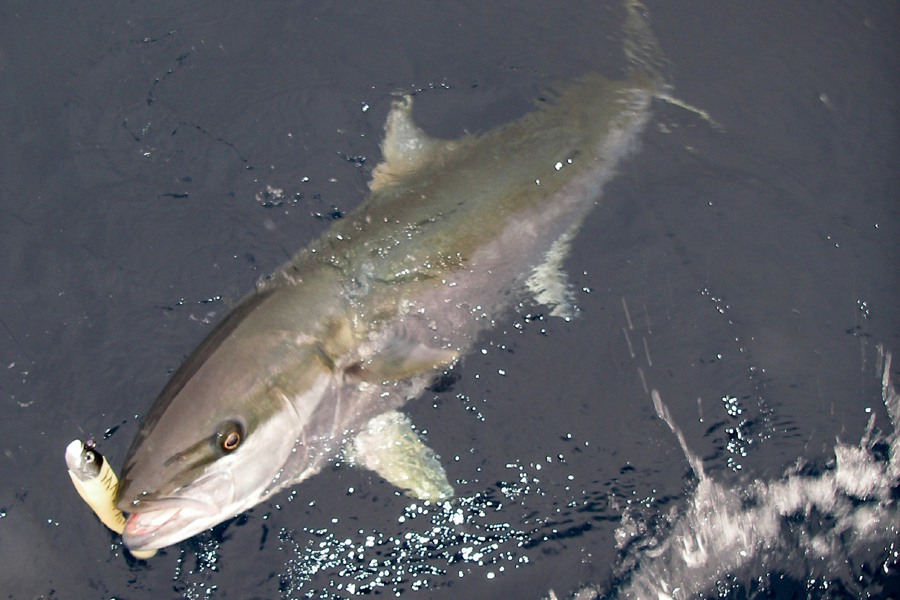 Kings do like the paddle-tail’s thrashing tail!
Deep down with softies
Kingfish are attracted to deepwater structures such as reefs and pins exposed to tidal current, especially if schools of trevally, kahawai, koheru or mackerel are also in the area. However, in this instance we’re more interested in the schools holding deeper down rather than those fizzing and feeding on the surface. Such scenarios are common in places such as the Mokohinau Islands, Ranfurly Bank, King Bank, and the Alderman Islands’ northern pins, but even Auckland’s Horn and Anchorite Rocks can provide good opportunities for big softbaits when presented deep down at times.
These locations often host particularly big specimens of our yellow-tailed friends, and as the currents are frequently strong and the ground very unforgiving, standard 24-37kg kingfish jigging tackle should be used, especially as the reasonably vertical jigging retrieve required also suits such gear.
Very heavy jig-heads around 6-8oz are needed to get down in such situations, especially if the softbaits involved are paddle-tails in the 9-12” range, as paddle-tails require more force to be dragged downwards – activating the thrashing tail in the process – than the more streamlined jerk-shads.
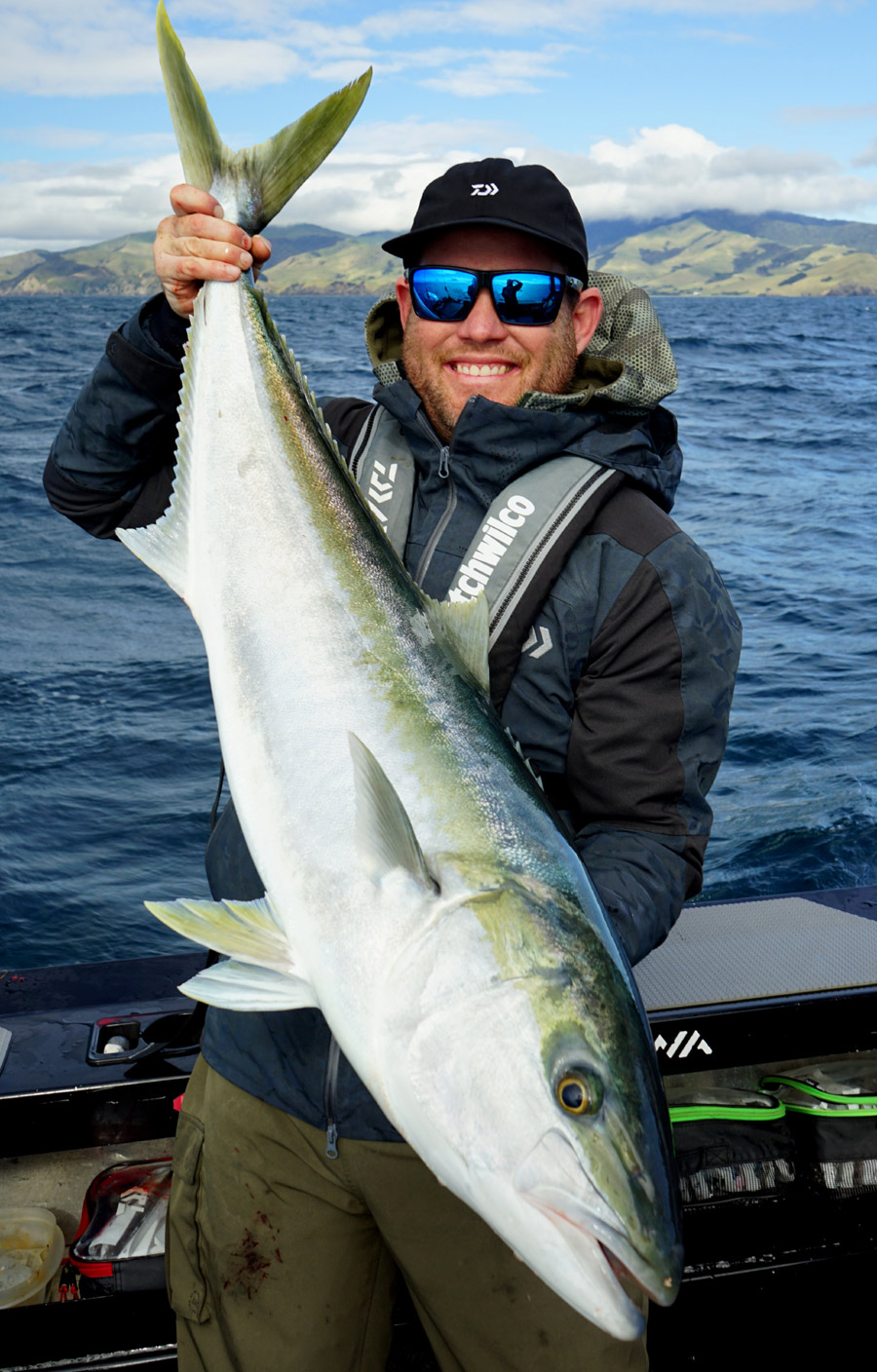 This 18kg king took a liking to a paddle-tailed Bait Junkie dropped into 65 metres of water.
It definitely pays to stay alert as the lure plummets, as kings really do like the look and vibrations produced by paddletails, so if there are sudden jerks, accelerations or slackenings during the descent, signalling a kingfish has intercepted the offering, quickly engage the reel and strike!
Otherwise, if the lure makes it to the bottom unscathed, it’s time to go to work. Same as when using metal knife jigs, a mechanical-jigging action usually does the job. But the good news is that the angler need not work as energetically, with just a moderate speed often producing strikes, thanks to the lure’s thrashing tail.
Another thing in the angler’s favour is that it’s not necessary to wind right back up to the surface; generally speaking, just one-third to halfway up the water column is enough – unless your fishfinder suggests otherwise! So upon reaching that point, stop (this can entice a bite too, prompting some fishos to leave it stationary for several seconds), then drop back down again, staying alert for slackenings or jerks in the line signalling a kingfish has grabbed the lure.
Repeat as necessary.
Casting and retrieving
Kings can also be found in the vicinity of surface-fizzing schools of kahawai, trevally and mackerel, as well as nearby very different types of harbour navigational devices, including poles.
.jpg)
A much younger Mark with a nice kingfish caught under a school of feeding trevally.
Obviously getting the softbait to these fish can be a bit of a trick, but having a 7’6”-8’6” stickbait rod with PE 3-8 capabilities offers an effective solution.
The other change is the type of softbait used. I find paddletails create too much drag when cast out and smashed into the water, leading to the tail becoming dislodged and no longer working on the retrieve. Although the application of Supa Glue can help with this problem, I just opt for the more streamlined jerk-shads which usually stay put.
If faced with a big, surface feeding school, it pays to cast well past it and out to one side or the other, or the baitfish may spook and dive. Next, I suggest letting the lure sink for various amounts of time before retrieving initially, because the kings often hold deeper down, waiting for an opportunity, and again, you don’t want to risk spooking the feeding baitfish. After all, they provide you with a good target.
The retrieval technique can come down to personal preference or what works on the day, but incorporating some retrieval speed and jerky rod movements, interspersed with several-second pauses, generally entice the bites.
As for the navigational devices, position the boat up current and to one side, so it’s possible to cast well past, allow the lure to drop, then execute an erratic retrieve back past it. Believe me, you will know within half a dozen casts whether anything is home!
As for skittering big softbaits across the surface or trolling them, we’ll leave those techniques for another day!

July 2024 - Mark Kitteridge
New Zealand Fishing News Magazine.
Copyright: NZ Fishing Media Ltd.
Re-publishing elsewhere is prohibited
Fishing Reports Visit Reports
Outer Hauraki Gulf Fishing Report 17/09/26
Spring wind the handbrake. Spring is starting to make its presence felt in the outer... Read More >
Top of the South Fishing Report - 17/09/26
Early snapper in Tasman Bay. Well, spring is finally here, and the days are getting... Read More >
Bream Bay Fishing Report - 17/09/26
Good snapper catches reported. After Tangaroa turned off the fish tap for a month or... Read More >
Bay of Islands Fishing Report - 17/09/26
Pacific bluefin tuna for the lucky few. The last fortnight has seen more fishable days... Read More >


Sunday 27 September 2026
Major Bites
 -
- Minor Bites
 -
-  -
- Monday 28 September 2026
Major Bites
- - Minor Bites
- -
Comments