
Soft-Baiting off the Rocks

Over the last few years, Nick Jones has rekindled his love affair with rock fishing, combining it with his passion for lure fishing. Over the next few issues, he will share with readers his thoughts on fishing a range of lures off the bricks.
In recent times, I have focused most of my rock-fishing efforts on throwing soft-baits and stick-baits around. It can be an extremely visual and rewarding way to fish, but also frustrating at times. Part 1 of this series focuses on fishing soft-baits from the rocks and provides a few pointers that could swing the odds in your favour.
Get the right gear
As with any type of fishing, having the right gear for the job makes a huge difference. The rocks are notoriously harsh on your fishing gear, with bumps, scratches and soakings all commonplace – so it’s worth spending a bit more and getting rods and reels that will last more than a few trips.
For soft-baiting, aim for a set that’s heavier and longer than your standard boat-based snapper soft-bait set. Longer rods give you better casting ability and help keep your line away from the rocks, and heavier mainline gives you more insurance in gnarly terrain. I’d recommend using a 4000-size reel that’s capable of holding a few hundred metres of 20-30lb braid, and an 8ft or longer rod rated at 6-10kg. It almost goes without saying but braided lines are crucial for working lures and setting hooks effectively.
Again, for terminal tackle, err on the heavier side of the ledger – 30-40lb fluorocarbon trace, solid jig-head hooks and good connections as you’ll likely be running some decent drags. A range of jig-head weights and sizes will give you flexibility for different currents, depths and soft-bait sizes.
And last but certainly not least, make sure you pack a decent pair of polarised goggles. Lenses specifically designed for shallow water or trout anglers really come into their own for not only identifying fish swimming below, but also seeing when a fish is homing in on your lure.
Pick the right spot
The best landbased lure fishing spots tend to be remote ledges that offer depth, current and decent water clarity. Think Northland, Coromandel, East Cape and offshore islands such as Great Barrier. These areas are where you want to head if you’re after consistent year-round kingfish action.
Although remote locations also tend to offer the best fishing for standard soft-bait quarry such as snapper, trevally and blue cod, these species can basically be caught anywhere at any time. Colder waters often offer your best chance at snagging a big snapper or trevally from the shore, whereas kings will show up inshore in far greater numbers during summer and autumn.
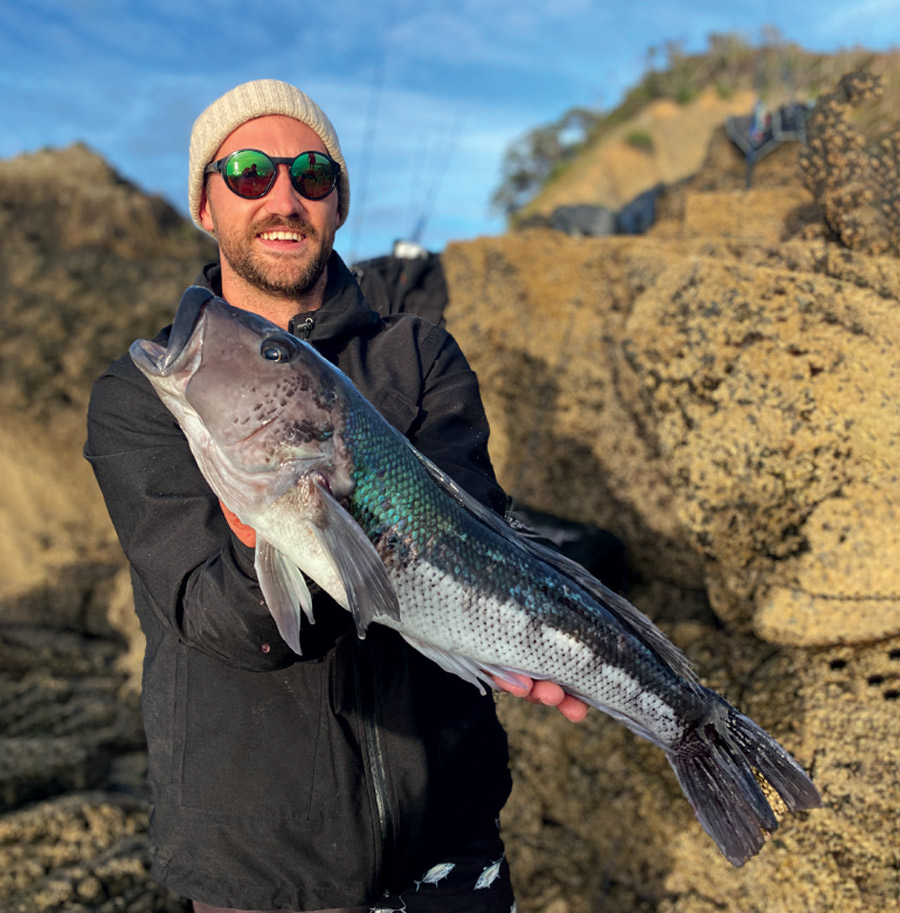
Big blue cod are partial to a twitching soft-bait and can be caught around the country.
Google Earth is a great tool to scope out rocky areas that have a lot of foul and gutters close to deep water or current. A bit of wash tends to help your chances and having the wind behind your back makes casting and working lures a breeze. And remember that lures primarily rely on visual predation, so murky inshore water can hinder your success.
Berley up or go exploring
Now, I know there might be a few lure-fishing purists who think of berleying as cheating – but it can be a real gamechanger off the rocks. Unlike boat anglers who can drift or change spots regularly to cover ground, landbased folk are confined to their chosen ledge. So, it makes sense to bring the fish to you and obviously, a good current flow can really help spread your oily attractant far and wide. A variety of NZ species become aggressive and cocky when you berley up a storm from the rocks – and watching big snapper, trevally and kingfish cruising around literally at your feet certainly gets the knees a bit weak! Salmon berley is excellent, and if you’re targeting trevally, a shellfish brew can be deadly.
Nevertheless, a more adventurous option is to explore a stretch of coastline with only your rod and a few lures in hand, casting at guts, points and bommies along the way. It is often the first cast in a likely area that will yield a fish so if you are not successful in the first few casts, it makes sense to keep moving. A stealthy approach is recommended as snapper like mooching around right in the shallows – stay low to the water, keep an eye on your shadow and you could even try wearing a ghillie suit.
Fool the fish
When fish are feeding in the berley trail, soft-plastics are extremely effective when simply lobbed out a few metres and sight-fished. If you can’t see any fish, then cast your lure out further – aiming for guts, current lines, back-eddies and underwater reef edges. A lot of strikes tend to happen on the drop, so stay in contact with your line watching for tell-tale twitches. Don’t be afraid to fish your soft-bait close to the bottom – sure you’ll end up losing some gear but many of the better snapper will stay deeper amongst the rocks and kelp. Light jig-heads can offer more hang-time in the strike zone, but if there is a big current running and deep water, half-oz heads make things a lot easier.
When targeting snapper, my favourite lures are 7-inch jerk-shads, curly-tailed grubs and crazy-legs style lures. These lures have an action built into their design. They are effective on the descent when fished in the classic twitch and drop method, as well as with a steady slow retrieve. All colours seem to work on snapper from the shore – although it pays to experiment on the day to see if the fish have any preferences. Trevally prefer smaller soft-baits (generally 5-inch or smaller) and duller colours (dark greens, browns, and pale yellows). The only issue with soft-baiting from the stones can be the hordes of pesky kahawai that sometimes make a nuisance of themselves – and they love swallowing those small softies!
Plan how to fight and land your quarry
If you hook a really big fish on soft-bait gear off the bricks, you’ll essentially be at the mercy of the fish and elements – at least at the start of the battle. Hopefully, after the first run your line has stayed free of the kelp and you can start gaining some line back. You can generally go a bit harder on snapper than trevally – too much pressure on the latter often pulls the hook out of their notoriously soft mouths. Kingfish aren’t opposed to smashing a soft-bait and taking you for a wild ride – this situation mainly ends in tears, but sometimes with patience and luck you can chase the fish around the rocks for 10 minutes and land your prize! Try to follow your fish and keep the line angle as high as possible to reduce the chances of getting reefed. Fighting fish with the rod held up above your head can give you a bit of extra height but unfortunately your mates will laugh at you.
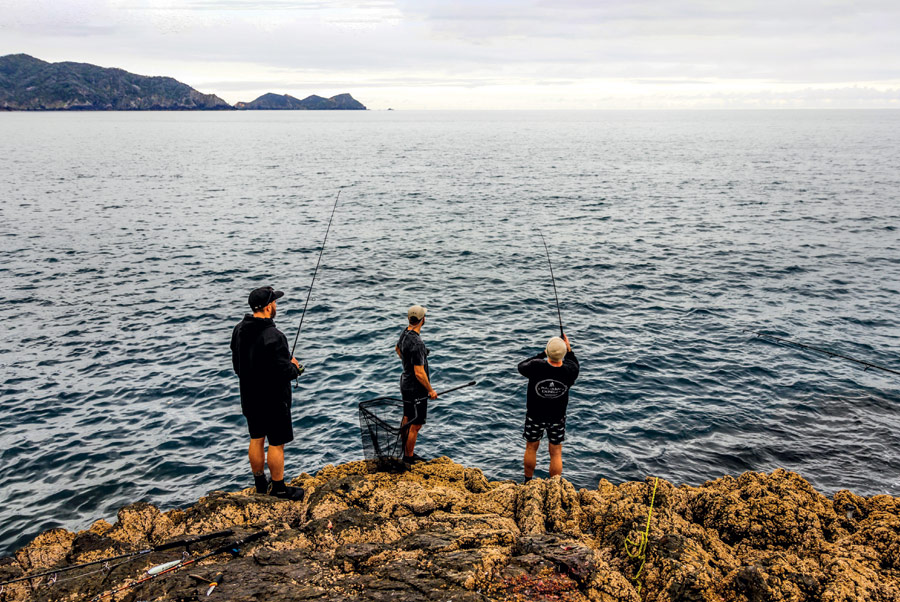
Hooked-up and keeping the line angle high.
A big net is great for landing fish from the rocks – especially if you’re in the middle of nowhere and don’t intend to keep any for the table. If you don’t carry a net than scope out a ‘landing pad’ where you can beach fish using the rise of a swell. Kings can be a real handful to land on soft-baiting gear, but it all adds to the fun.
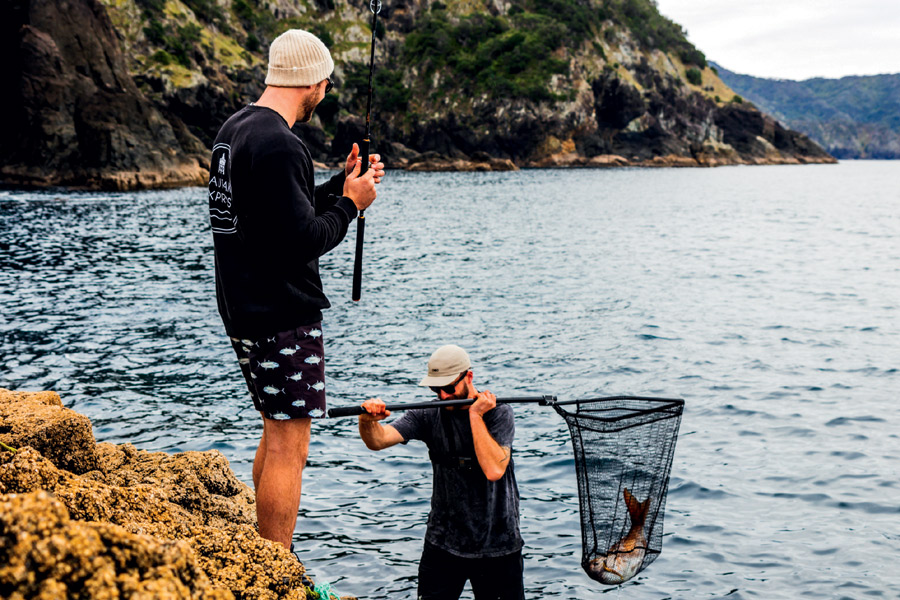
A big landing net is great for landing and releasing fish in good condition off the bricks.
Good luck out there and in the next part of this series we’ll look at topwater lure fishing from the rocks.
|
|

Fishing Reports Visit Reports
Manukau/West Coast Fishing Report - 15/10/26
Big spring snapper in 60 metres. The El Niño weather pattern isn’t going to be... Read More >
Rotorua Fishing Report - 15/10/26
Solid start to the season! The Rotorua lakes have all started the season well, and... Read More >
Tutukaka Fishing Report - 15/10/26
Big snapper in shallow. Things remain relatively quiet on the fishing front out of Tutukaka,... Read More >
Tauranga Fishing Report - 15/10/26
Bait and temperature on the rise. It’s been great to get out and see some... Read More >


Tuesday 27 October 2026
Major Bites
 - -
- - Minor Bites
 - -
- - Wednesday 28 October 2026
Major Bites
- - Minor Bites
- -
Comments