
Soft-Baiting from the Rocks

Using soft-baits on the bricks can be extremely effective. It’s stealthy, with no loud hull slap of a boat spooking fish in shallow water, and the thrilling battles on light gear are hard to beat.
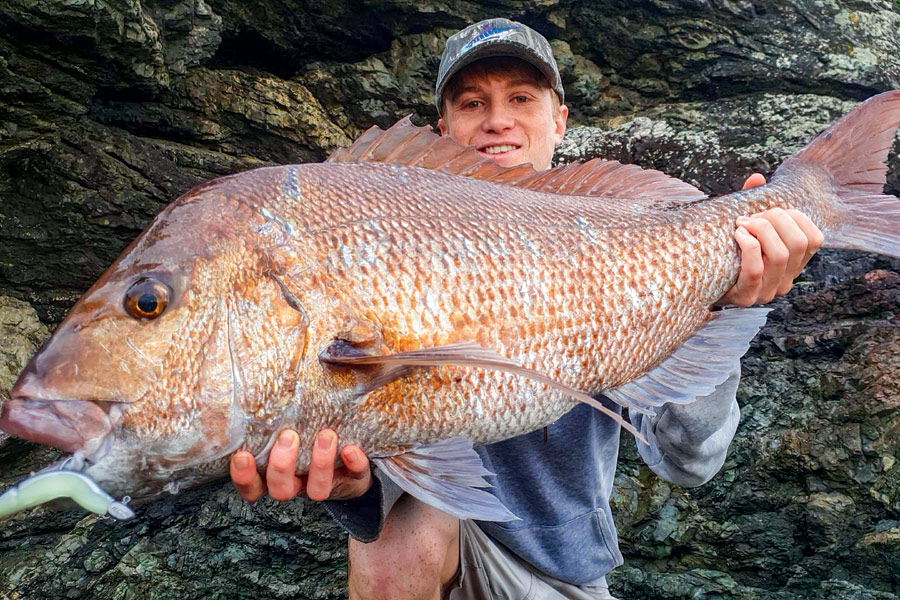
Landbased lure casting hooked me in the summer of 2019. I was out for a routine cast at my local hotspot looking for a feed of pannies when I witnessed a six kilo snapper fly in and smash my soft-bait on the surface. At the time I had never seen anything like it – strong headshakes and blistering runs followed as it weaved through the reef. Landing the fish with such a light leader was even more difficult.
Over the next few months, I spent hours at this same spot, landing a few similar sized fish and getting dusted by plenty more. Since that day I have put serious time into this method and I truly believe it can compete against the typical straylining approach.
Plenty of options
My absolute favourite characteristic of landbased soft-baiting is the sheer amount of options it gives you. Ditching the bait, berley and stationary nature of straylining opens up a wide range of spots many fishermen would never even consider. The ledges I look for are usually shallow, super reefy and often at times completely submerged at high tide. Straylining at these types of spots can be annoying on the best days, and infuriating on the worst. When you are casting soft-baits, you are not limited to the placement of your berley; instead, a mobile approach is taken. A long stretch of coast that you can walk along is the perfect country to soft-bait. The more different areas you can cover, the better. This offsets the advantage that berley has – rather than bringing the fish to you, you are seeking out the fish. Maybe it is just my inherent preference for lure fishing, but knowing that the fish you caught was feeding as a predator rather than as a scavenger has a strange satisfaction to it.
Ditch the berley
It’s very easy to bring the bait and berley as a ‘backup’, and end up using it by the end of the day. When I was starting out, I would often ditch the softies after a couple of casts with no takers, immediately switching back to bait and berley.
Having faith in the technique is vital. He who does the casts catches the fish, so leave the bait at home and be prepared to flick hundreds of casts out. It feels like you are wasting your time or doing something wrong until that first good fish comes along and then it’s all worth it.
Tackle and lures
Regular soft-baiting tackle will usually suffice, but a bit more strength can definitely be helpful. I use PE 2 braid paired with 20 or 25lb fluorocarbon leader. This pairing offers a nice middle ground for strength, castability and bite frequency. I have experimented with leaders up to 30lb, but noticed a reduction in bites, so I stick under 25lb now. I know of many anglers who soft-bait with 30lb fluorocarbon exclusively and are very successful, so take that as you will. Use what you are comfortable with and experiment until you find what works best for your area.
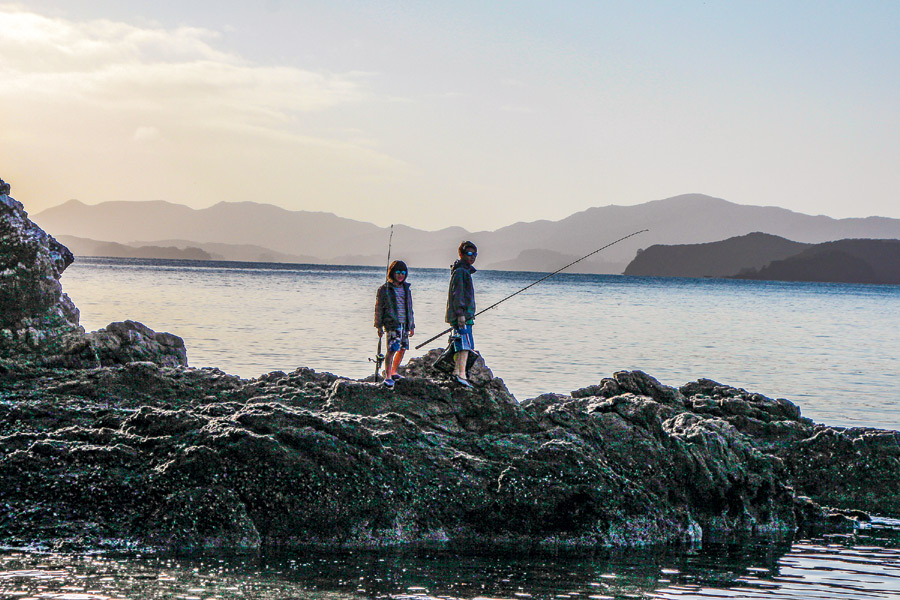
A graphite rod slightly longer and heavier than the norm is ideal. I use an eight foot rod rated for 15 kilos. This is typically heavier than what one would use while soft-baiting from the boat, but off the rocks I have found myself in multiple scenarios where I have been thankful for the extra power. Rods rated as low as 6-8 kilos will suffice; however, I would never go lower than that unless you are not expecting to catch anything bigger than a pannie.
Lastly, soft-bait choice. People have their theories about lure colour and what to pick when but I am not an expert on this, so I follow a different approach. I look through my soft-baits and pick a colour that looks lucky. I prefer 7” jerk shad tails, but often (especially in winter) downsizing to a 5” can mean the difference between a productive day and walking home empty handed. Curly tails are a must have. I find these baits work best when the fish are shy on the bite. If I don’t catch anything on my first choice of soft-bait, I switch, and so on. I’m not sure what the best baits are for the corresponding water colour, clarity, tide, and turbulence, but I do know that experimenting with colours/shapes and having a selection is absolutely vital.
Tight or loose drag?
A mistake I see a lot of people making – and one I made myself at the start – is instinctively and immediately tightening the drag once the line starts hissing out. It is the reality of light gear that you are not going to be able to stop a big fish in its tracks, and attempting to is almost always going to guarantee failure.
Often a lighter drag can be ideal. I came to this conclusion after getting decimated time and time again by the bigger models. I started to seriously wonder how I was supposed to land these brutes. Following a few suggestions from more experienced fishers than me, along with a healthy dose of internet-scouring, I came to the conclusion that I was running too-high a drag setting. It might seem counter-intuitive to fish a lighter drag in super-foul terrain (1-3m deep), but in practice it works surprisingly well. Where before I was locking up and causing the big moocher to head straight down and cut me off, a loose drag gives them room to run. In such shallow water, they tend to run, and run and run. Rather than getting their heads down and going straight into the rough stuff, they often ‘plane’ over it all, slicing through the midwater and keeping the all-important braid unhampered.
How to fight fish in shallow water
Make a battle plan before you start casting. Look for the highest point on your ledge that you can access. Getting up high while fighting big fish can be super helpful for keeping their heads out of the kelp. It also makes it easier to see what the fish is doing and adjust your tactics accordingly.
Moving around is key in these fights. Too many-a-fish I have lost and seen others lose due to the initial shock of that first steaming run locking you in place. As soon as that line starts hissing, start moving.
Snapper often run directly against the pressure they are feeling, so it can sometimes be possible to ‘steer’ the fish by changing the angle of the rod. When you are up high and you see your fish gunning it to the reef, rapidly swapping the angle of your rod can be enough to convince the fish to swim the other way.
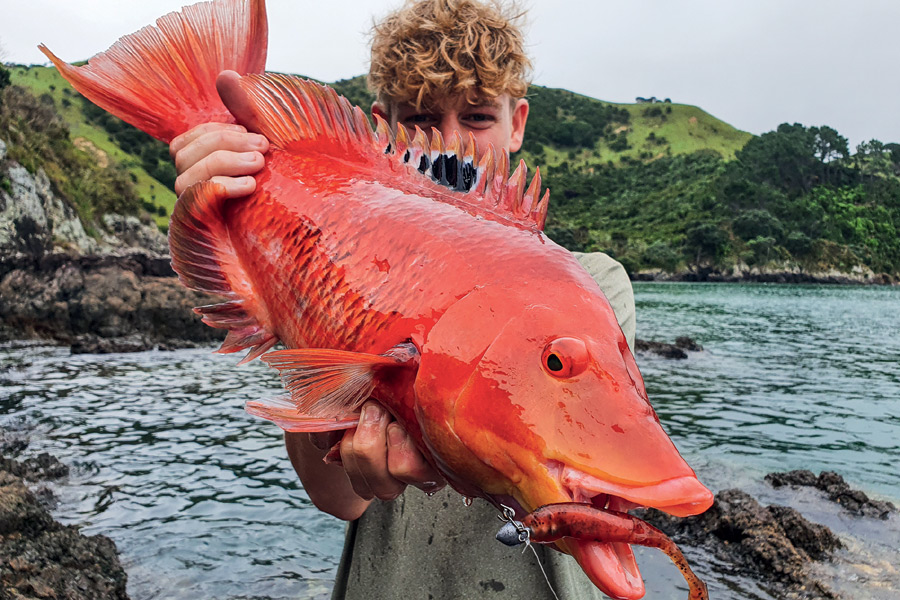
My next big success was an 8kg kelpie hooked at dusk. This fish provided me with the battle of a lifetime. The pathway leading to my tidally locked rock was slowly being flooded by an incoming tide, and I was soon going to be cut off from land. The fish took on the surface and screamed off, by chance veering away from the worst of the reef as snapper sometimes do. This fish fought all the way to the rocks, even taking me into the water once while I tried to land it without a net. Moments like this are burned into my brain, making for some of my favourite fishing memories.
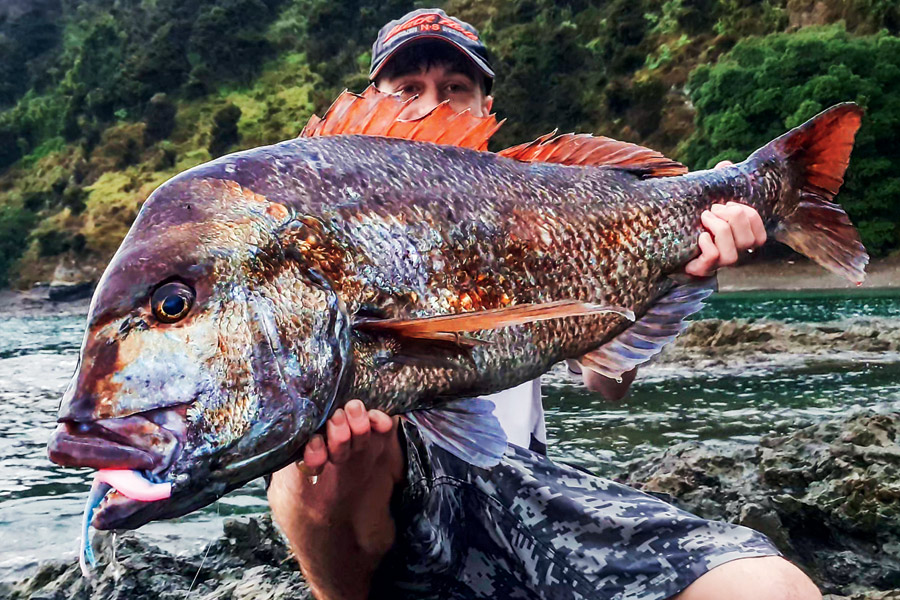
As winter rolled back around, I started putting in proper time on the bricks again, scouting out new spots and trying different techniques. These efforts culminated in my biggest snapper off the rocks to date, a perfect 20lb/9.1kg snapper, which was coloured like no other fish I had ever seen.
It was a true moocher, missing whole patches of scales that had regrown and come off again. Its fins were worn from decades of rubbing up against the rocks and its bare gill plate was exposed in some parts. This fish was followed up one month later by a fish of the exact same length and weight; however, it was in a much healthier condition. The latter fish put up a scrap so intense that I was sure it was a legal kingfish. These animals are different beasts in the shallows. Say goodbye to the ‘straight run’ they often commit to in the boat. Fish like this in these shallow depths will go all over the place, and will not stop fighting until either you win or they do.
Soft-baiting off the rocks is definitely an underrated method. Winter is the perfect time to head out to your local ledge (or scout out some new ones!), and go for a cast. The results will surprise you.
Fishing Reports Visit Reports
Outer Hauraki Gulf Fishing Report 17/09/26
Spring wind the handbrake. Spring is starting to make its presence felt in the outer... Read More >
Top of the South Fishing Report - 17/09/26
Early snapper in Tasman Bay. Well, spring is finally here, and the days are getting... Read More >
Bream Bay Fishing Report - 17/09/26
Good snapper catches reported. After Tangaroa turned off the fish tap for a month or... Read More >
Bay of Islands Fishing Report - 17/09/26
Pacific bluefin tuna for the lucky few. The last fortnight has seen more fishable days... Read More >


Saturday 26 September 2026
Major Bites
 - -
- - Minor Bites
 - -
- - Sunday 27 September 2026
Major Bites
- Minor Bites
 - -
- -
Comments