
Snapper on hard-bodied lures
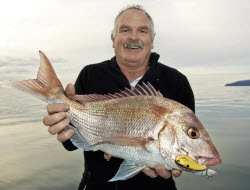 The first snapper I ever saw take a lure happily ate a Rapala CD Magnum that was cast and retrieved under a school of slimy mackerel. The next three casts produced similar results.
Those four fish really opened my eyes and changed the way I approached snapper fishing. In hindsight it was the revelation that started my quest to catch snapper on all things artificial.
The biggest lesson taken from that day (and the many more that followed) was that although snapper mostly scrounge for crustaceans and other food sources on reefy bottoms, they’re also very keen hunters of live prey and will happily feed very high in the water column, sometimes within metres of the surface. I quickly learnt that this soft spot for baitfish and the highly competitive nature of the species make it a perfect target for various lure styles.
Hard-body lures come in many different guises, such as bibbed minnows, lipless crank-baits and stick-baits. All three have very different characteristics and can be used to target snapper in a variety of different ways at varying water depths.
Bibbed minnows
This style of lure has a plastic or metal bib attached to its head; this controls the lure’s operating depth and has a large influence on its swimming action. Other features, such as inbuilt sonic rattles and high quality lifelike finishes, make the bibbed minnow an effective option for targeting snapper (more so than many would believe).
Trolling bibbed minnows
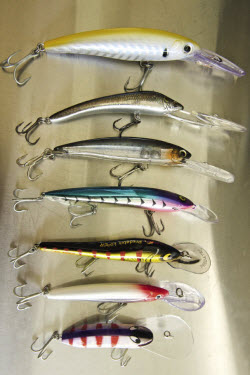 Catching snapper on bibbed minnows can be done by trolling or casting. In most situations trolling is the more productive technique, simply because the lure is at its maximum working depth and covering ground for longer periods of time.
Many lures will operate at depths down to around eight metres when trolled with thin-diameter super lines. I usually like to troll the edges of foul, channels and ramps that vary in depth from around nine to 15 metres. I run my lures out of the rod holders, with the longest corner set at around 30 metres and the other around 20m to avoid any tangles. A short flat-line quick-release clip rigged on the back corner of the boat can also be a useful way to get a bit of extra running depth out of your lures.
Quiet outboard motors are a definite advantage for this type of fishing, as big fish in shallow water can be very spooky at times, and stealth is one of the keys to success. (Consequently, kayak anglers have a huge advantage over powerboats when it comes to trolling for snapper in shallow water.) Periods of low light such as dawn and dusk or a heavily clouded sky will also help tip the scales in an angler’s favour when working these shallower areas.
Good quality electronics and a sound understanding of what’s on the screen is another important part of the trolling exercise. Look for bottom features with current pushing onto them, and schools of baitfish. The presence of small baitfish is the common denominator when it comes to consistently catching snapper on any type of lure. Nine times out of ten, if you find a good patch of bait, the big red fellas won’t be too far away.
Lures
I like to use lures that run deep with tight, narrow actions and a bit of body roll. Some of my favourites include: the Sebile Koolie Minnow; Maria’s Deep Snare; Halco Scorpion; Dr Evil; and Rapala X-Raps.
Downrigging
A downrigger allows your lure to be presented at much greater depths, and can be a deadly way to catch snapper over flatter-bottomed areas such as those found in the Hauraki Gulf. It’s a pretty simple exercise: check your fish-finder for depth, then set your downrigger ball so your lure runs around one to two metres off the bottom. You still need a lure that dives reasonably well though, as this allows the downrigger ball to stay well above the fish; snapper tend to get a little spooked by a massive ball of lead whistling through them.
Casting bibbed minnows
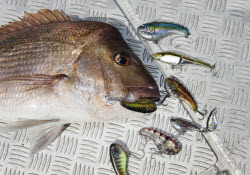 Casting bibbed minnows for snapper is a technique that works if you can get your lure in front of the fish. The problem with casting floating deep divers for snapper is that it takes around 75% of your retrieve distance to get your lure down to its optimum working depth, so this is where sinking models come into the game.
A sinking minnow can be counted down to depth vertically before beginning your retrieve. This puts the lure much deeper in the water column in the early stages of your retrieve, which is an important component of lure fishing for snapper, because 90% of the fish that attack a lure will do so as it is sinking or in the first 10% of the retrieve. This style of lure is really effective around bait schools and actively feeding fish.
I’ve also had plenty of success casting sinking models into washes and along shallow rocky shorelines. A stop-start series of short rips and pauses seems to be a killer retrieve in such areas.
Lipless crank-baits
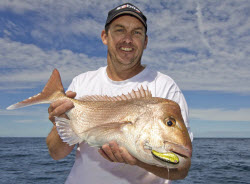 Lipless crank-baits are probably the most effective hard-body lure I’ve found for targeting snapper – for a couple of reasons. The first, and most important, is water column flexibility. Lipless cranks can be fished from the top to the bottom of the water column, much like a soft-plastic lure. The second reason they work so well is due to their vibrating action, which is tighter than an All Black scrum pack – and that’s what snapper love in a hard-body lure. From the time I have spent targeting snapper on all manner of hard-bodied lures, those with tight, fast actions have out-fished everything else I’ve tried so far.
The snapper’s habit of attacking a morsel that’s falling through the water column is another major chink in the species’ red, scaly armour, making them an easy target for a switched-on angler. Ask yourself how often your lure attracts a vicious bite on the drop when fishing with a soft-bait. Lipless crank-baits will often get attacked exactly the same way, and one of the most important characteristics of a good lipless crank-bait for targeting snapper is that it must sink upright and preferably have some swim action while sinking.
My favourite lipless crank-baits for snapper are the Sebile 66mm Fast Sink and 77mm Sinking Flat Shad. Both lures swim with a slight shimmy on the drop at a rate of around one and a half to two seconds per metre. With a full blooded cast in the direction of the drift, in good conditions, using a fine super line, these lures will take at least 40 seconds to reach the bottom in twenty metres. On many occasions the lure will get eaten long before it gets there.
Over the past twelve months I have put a lot of time on the water fishing with this style of lure, and sink rates have been a standout performance factor that can make a huge difference to results on the day. Believe it or not, fast is not always better: in cooler months when the fish are very passive and not really keen to move, slow is the go.
As water temperatures rise, schools of baitfish start to appear and the snapper are feeding well; they will readily attack a faster-sinking lure.
Once your lure is near the bottom, it’s simply a matter of varying retrieves until you start to get bites and work out a pattern on the day that’s effective. I generally start with slower, ‘two-hop’-style retrieves and speed them up a little, or get more aggressive with my rod lifts if I’m not getting results. Another good option is to burn the lure off the
bottom with a fast wind then slow roll it for a few metres, let the lure sink again, and repeat the process.
Like most other lures, lipless crank-baits are available with many different rattle systems built into them. Some are extremely loud, while others are more subtle. Some have no rattle at all and are known as ‘masks’. All work, but some produce better than others on snapper. I prefer lures with more subtle rattles and tight actions that swim well at very slow speeds. This allows the lure to swim strongly in the strike zone for the maximum distance and time, offering the angler optimal presentation flexibility.
Stick-baits
Stick-baits are very simple-looking lures that catch a multitude of different species with an enticing repertoire of surface antics.
One of the more recent and exciting additions to the world of lure fishing is the fast-sinking stick-bait. This style of lure comes in many sizes and weight combinations, and is deadly on a wide variety of species, including snapper.
Again, the ones to look for have a swimming action as they sink. One of my favourites is the 90mm, 28g Little Jack Seagaroid. It’s the perfect size to temp any hungry snapper and has a great action to tempt the lazy buggers.
This style of lure is something I think we’ll see developed and fished a lot more for species like snapper in the future.
Odds and sods
Other lures worth casting are types that many anglers would not generally consider as snapper options.
They include articulated hard-bodies, such as the Sebile Magic Swimmer in fast-sinking versions, which can be deadly when fished around bait schools. Also metal vibes/blades and tail spinners have been effective on snapper at times.
Pimping and tuning your lures
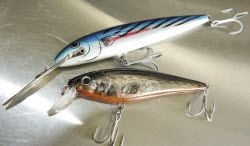 Hooks are one of the most vital components of any fishing lure. Some lures come fitted with good quality hooks, while others are ‘very average’. I do a lot of hook retrofitting to my lures for various reasons.
When it comes to trebles, I love Owner ST-41BC 2Xs – they have good structural strength, a wide gape and razor-sharp cutting points.
Big snapper have extremely powerful jaws and can make a mess of even the toughest lures and trebles. Many of the lures I use on snapper have been fitted with Decoy inline-eye jigging singles. These thin diameter ultra-strong hooks work well on big reds and can also be used to tune your lures. A single hook can weigh up to two-thirds less than the same size treble. By fitting singles to your lure, you can effectively slow its sink rate, which can make a huge difference. It may also enhance a lure’s action at slow speeds, as it has less weight swinging from it.
On the other hand, some lures are highly tuned pieces of kit that don’t like having their balance messed with. It’s simply a matter of playing, testing and fishing.
To increase a lure’s sink rate or reduce its buoyancy, you can wrap lead solder wire around the treble shanks or add adhesive lead strips or dots to the lure’s body. You have to keep things balanced and symmetrical, but little changes can mean the difference between catching fish or not.
I spend a lot of time experimenting and swimming lures in a pool before I use them. I look very closely at how they swim as they sink, the speed they sink, as well as other factors such as their action and their ability to operate vertically without tangling the leader. The more I do in between fishing trips, the more I’m learning, and my hard-body snapper repertoire is becoming more efficient with every trip.
Hard-body lures offer anglers many presentation options and can be amazingly productive at times. None of it’s really new – I just think that some of the latest generation lures are more suited to fishing the areas and depths that snapper are found in than ever before. Along the way, as snapper lure techniques have evolved, we have also developed a better understanding of the species’ personality and habits – things that make it such a superb lure target as well as a fantastic meal on the dinner plate.
Good luck and happy hard-body fishing!
 |
This article is reproduced with express permission of
written by Mark Phillips - 2012 Originally published in New Zealand Fishing News |
Fishing Reports Visit Reports
Manukau/West Coast Fishing Report - 15/10/26
Big spring snapper in 60 metres. The El Niño weather pattern isn’t going to be... Read More >
Rotorua Fishing Report - 15/10/26
Solid start to the season! The Rotorua lakes have all started the season well, and... Read More >
Tutukaka Fishing Report - 15/10/26
Big snapper in shallow. Things remain relatively quiet on the fishing front out of Tutukaka,... Read More >
Tauranga Fishing Report - 15/10/26
Bait and temperature on the rise. It’s been great to get out and see some... Read More >


Friday 16 October 2026
Major Bites
 - -
- - Minor Bites
 -
-  -
- Saturday 17 October 2026
Major Bites
-  -
- Minor Bites
- -
Comments