
Snapper Fishing - Finding Work-Ups

It’s all on! Get those lures and baits in quick!
Finding and fishing work-ups is my favourite way to catch snapper. A work-up is like a huge signpost amongst the vastness of the ocean saying: ‘there are fish down here’.
In such situations assorted marine life can be everywhere. Gannets race in from all directions, excited about having an easy meal, before whopping down into the water like fighter planes, often accompanied by excited dolphins charging and leaping around. Whales may be present too, and are just as keen to join in the action. Believe me, a keen, hungry whale is spectacular!
This frenzied mass of fish, birds and mammals often produces unforgettable experiences, so small wonder I can’t help putting the throttles down, turning the stereo up and hooting with excitement whenever I see such action ahead.
The sudden change in speed or direction sees those who are unprepared suddenly racing around the bucking deck trying to organise a weapon for battle – and they’ll need to be quick, as the first drop in the proximity of a work-up often attracts strikes while the lure is still descending and well away from the seafloor. Multiple hook-ups are common, so everyone ends up ducking under and over each other as they try to avoid their fast-peeling lines from touching, while gannets knife down all around, the dolphins jumping and crashing, and the odd whale coming through with a big whoosh. (A whale’s blowhole can provide an even bigger fright than Freddy Kruger at the Sunday night movies!)
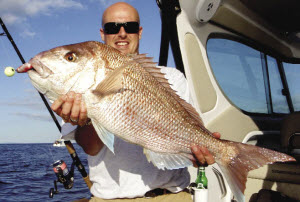 This adrenalin buzz keeps me coming back for more; I can’t get enough of work-up fishing, and over the years I have developed a few theories and techniques to help me find the work-ups.
The first thing to do is look for gannets. These birds go out every day in search of baitfish to feed on, so they are your eyes in the sky and will lead you to the action. It therefore makes sense to find out where the gannet colonies live, as this will be the constant starting point of their daily travels.
The three main colonies of gannets in the gulf form a triangle between Gannet Rock, the Happy Jacks and Great Barrier’s western side. I therefore head out through the Motuihe or Rangitoto Channel and cruise eastwards until I see flying or massed gannets. However, if I don’t see any heading east across the Firth of Thames, this leads me to believe they have not had to fly this far north, so I head south towards one of the colonies there instead. The gannets only travel as far as they need to go to find food.
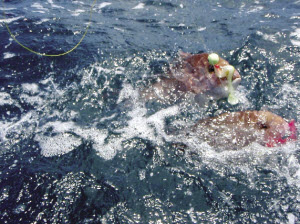 When we come across gannets, they will either be flying towards a work-up or flying home from one. Either way, this provides us with a direction towards likely work-up action, so be prepared to follow them, or to head in the opposite direction if they’re obviously returning to one of these three main colonies. Also, be aware that gannets seem to play ‘follow the leader’, with squadrons leaving the colony every so often in the same direction as the squadron before, so a short time spent in the vicinity of the colonies can be worthwhile.
However, not all my work-up finding success is the result of reading nature’s signs. Just as important to my chances is the network of keen fishos and friendly fellow charter skippers, as I frequently contact them via my cellphone and VHF radio. After all, the more of us out there looking, the greater the area covered and the more likely we will all get into some action.
When you reach the right area, it will be hard to miss, since work-ups will be ‘going off’ or large groups of gannets will be sitting around waiting for the next one to occur. And while the first scenario will obviously get your fishing attention, don’t neglect the latter situation either, as although the surface activity might have stopped, it can still be all on down below.
Because slack tide usually means rest time for the work-up participants, it pays to stick with the rafts of gannets through such periods, as once the tide starts to flow again, feeding normally recommences.
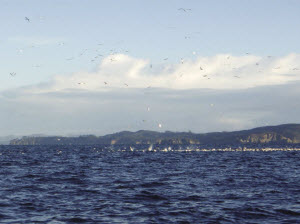 At other times you might have just missed the latest work-up, but with baitfish in the vicinity, chances are another will start up nearby, so when the gannets start heading off in the same direction – usually one by one initially, and then a mad rush – it pays to follow, even if you cannot see any evidence of a work-up happening. Believe me, the birds know.
When you find a work-up, SLOW DOWN! In the weekends I often see fishos zooming into the work-ups flat out, disturbing the action and often bringing it to an end. And if you see dolphins, stay away from them, as they love to come over for a play, which removes them from their role of rounding up the baitfish.
Also, keep in mind that the snapper cannot get there as quickly as the gannets; I try to imagine them lagging behind and trying to play catch-up all the time. That’s why it’s important not to disturb a new work-up; I will often just sit and watch for a while before moving in.
When I do move in, my initial strategy involves circling the work-up from afar – say 100m or so – and watching the sounder to see where the fish are holding. Generally this will be on one side of the work-up, and once you have figured which one, it tends to be the same for any other work-ups that occur in the area during that tide.
There is a theory about targeting the work-up’s ‘exhaust’, as some believe the snapper feed on the scraps found here. It involves fishing downcurrent of the work-up. However, I do not stick to this theory too much anymore, as I often find a different scenario. I believe the snapper often feed on baitfish in a manner similar to kahawai and kingfish. In fact, I have seen them below the boat darting around and feeding on perfectly healthy pilchards and anchovies.
When caught in such situations, these fish almost look like another breed of snapper. They are a light pink or orange in colour and have sharp teeth – unlike the snapper we find in our inshore fishery – which leads me to believe they don’t scavenge much on the seafloor and eat baitfish instead. Their bellies are often full of baitfish, and these fish seem to taste better, too.
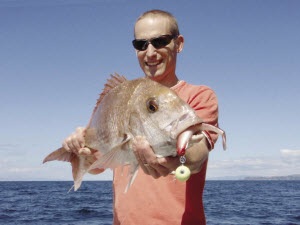 Catching these feeding snapper is usually quite easy, and most methods will work. However, I find slowly wafting a lightly-weighted bait down leads to catching the smaller fish, whereas a heavily-weighted soft-plastic or fast-moving jig attracts the bigger ones. Having a durable lure that gets down quickly is the way to go in these situations.
As already mentioned, multiple hook-ups are common in such situations, so when hooks get tangled in the landing net’s string mesh, it puts a real spanner in the works while other people are screaming for the net. However, this is no longer an issue for me as I now use one of the rubber-meshed nets that have recently arrived on the market. Unlike the traditional landing nets, hooks and rigs do not get caught or tangled in them, and they’re also much kinder on the fish, making them a sensible choice when catch-and-release fishing.
I have heard people say they were “very lucky” to come across a work-up when on their way out or coming home. And yes, in these situations it is luck, but this needn’t be the case; as you have read, there are techniques and methods that greatly increase your chances of finding one.
As captain of a charter boat, I can honestly say we find work-ups 80% of the time if looking for them. However, as with all skills, the more you do it, the better you become.
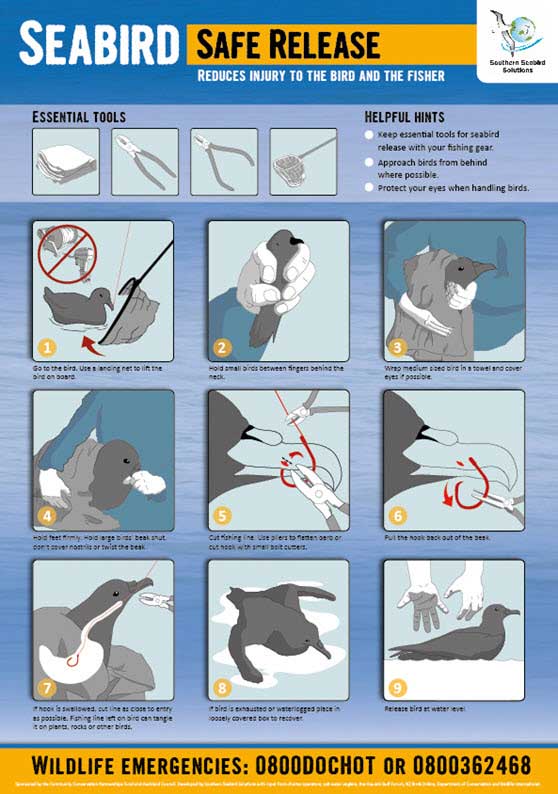
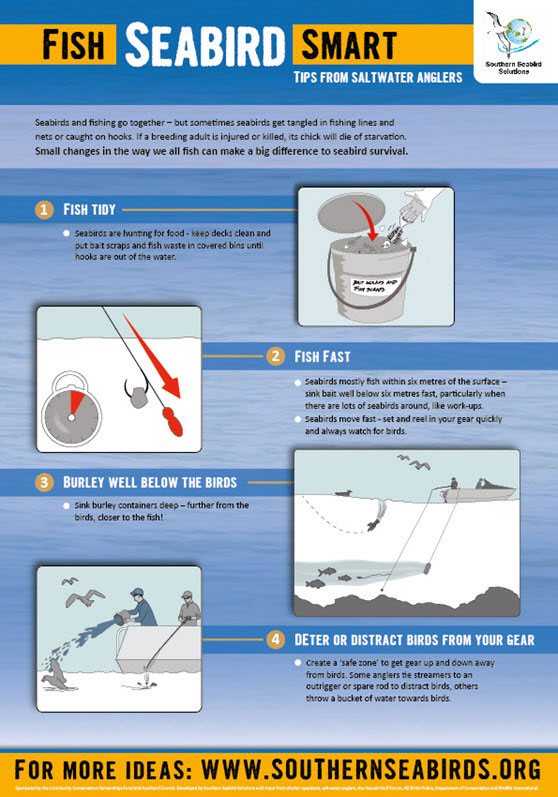
More info on New Zealand seabirds and what they contribute to our fishing at the Southern Seabirds website
 |
This article is reproduced with permission of |
Fishing Reports Visit Reports
Canterbury Fishing Report - 01/10/26
Freshwater season underway. Wow, it’s October already, and our freshwater season is underway, and the... Read More >
Top of the South Fishing Report - 01/10/26
Snapper about but not yet firing. It’s certainly nice to see daylight savings upon us... Read More >
Hauraki Gulf Fishing Report 01/10/26
Big reds in the shallows. The weather has made getting out on the water challenging... Read More >
Bay of Islands Fishing Report - 01/10/26
Snapper moving in. A few Pacific bluefin are still gracing the weigh stations with last... Read More >



Saturday 3 October 2026
Major Bites
 - -
- - Minor Bites
 - -
- - Sunday 4 October 2026
Major Bites
 - -
- - Minor Bites
 - -
- -
Comments