
Slow Trolling Livebaits for Kingfish
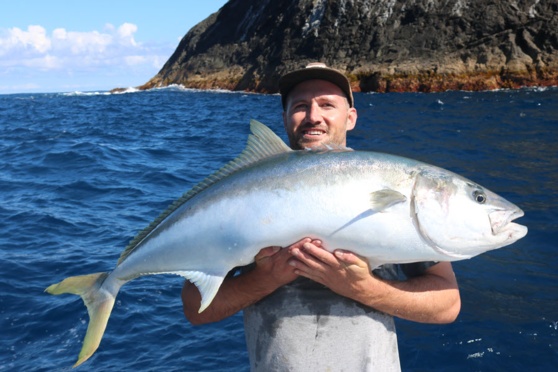
Picture this: your live well is full of tasty kingfish candy, you have just deployed a fresh jack mackerel live-bait and you’re now slowtrolling around a picturesque headland.
The jack mackerel you just deployed is now getting very anxious and swimming for its life when, all of a sudden, BANG! Your bait has been hit and swallowed, line is peeling off your reel at an alarming speed, and you’re hooked up!
Just writing this is getting me excited for my next kingfish mission! Slow-trolling for kingfish in shallow water has to be one of my favourite styles of fishing. Over the years we have learnt a lot of tricks from some of the best in the business and also from our own mistakes. Here are a few tips that may help you when slowtrolling live-baits for kingfish.
What bait is best?
To fish with live-bait, you need live baits. Pretty simple, really, but what bait is best?
English/blue/slimy mackerel, jack mackerel, trevally, koheru (kohe) and kahawai are all great baits, and everyone has their own favourite. We start every day by catching live-bait. Jack mackerel is our staple bait and seem to get bites consistently.
A good way to look at different kingfish live-baits is in the same way humans look at food.
Trevally or kahawai = a lamb roast, damn tasty, but you have to be hungry to eat it. However, when you are hungry, it’s as good as gone!
Jack mackerel = some chocolate, a peanut or a potato chip to a kingfish. You do not have to be hungry to eat one, and you will eat it at any time of the day.
Koheru or english mackerel = a steak and cheese pie after a late night and a few drinks. You will sell your left leg for one. When you see it, you have to have it!
The rig
Our live-baiting rig is simple. We run 80lb indicator braid (changes colour every 10m) so we can see exactly how far back our baits are. From there, we tie on a six-metre length of 100lb mono leader (using a PR knot). That then gets tied to a size 1 NT stainless steel swivel followed by a twometre 100lb Ocea fluorocarbon bite leader with a circle hook, attached via a loop knot or crimped loop. The loop to the circle hook gives the bait a better, more natural presentation.
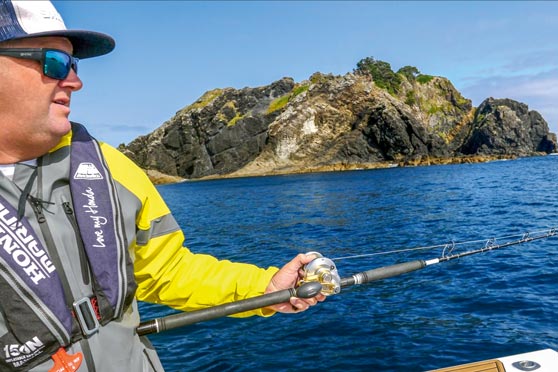
We use 8/0 or 9/0 hooks for jack mackerel, koheru and english mackerel; for larger baits like trevally and kahawai, we use 10/0 or 12/0 hooks.
Depending on the water depth, we have our bait anywhere from 15 – 25m back behind the boat. Indicator braid takes the guesswork out of knowing exactly how far the line is out.
How fast to troll?
We get asked this question a lot, and the simple answer is “as slow as possible”. One engine just in gear usually moves a trailer boat at about 1-1.5 knots. That’s fine – any faster than that, and the baits are not swimming naturally.
The introduction of electric trolling motors has helped us even more, as it is very easy to control the speed and direction of the vessel. If you are using a trolling motor, make sure you have a good game plan to turn and get back over the fish quickly once hooked up. When going down-sea or with stronger winds, the engines can be left out of gear to keep the speed down.
Get the bait down
Trevally, kahawai, koheru and english mackerel all swim down pretty well when slow trolling, but we have found that with jack mackerel, a three-ounce ball sinker is required to keep the smaller bait swimming deep and stop them rolling on the surface.

We slide the ball sinker on the mono leader, so it rests down on the swivel well away from the bait and hook. In the off-chance you get busted off, the weight will come free and will not be towed around by the kingfish.
Another accurate way of getting your slow-trolled bait to a predetermined depth is by using a downrigger.
Keep your rod in hand
On my charter boat, we make our guests keep their rod in hand at all times. The best technique is to hold the rod under the left arm, hand and fingers cupping the rod/reel and thumb on the spool to stop the line coming off. We always troll with the reel in free-spool using only just enough thumb pressure to stop the line peeling off. That way, if a kingfish hits the bait it can instantly be free-spooled back to help the fish swallow the bait.
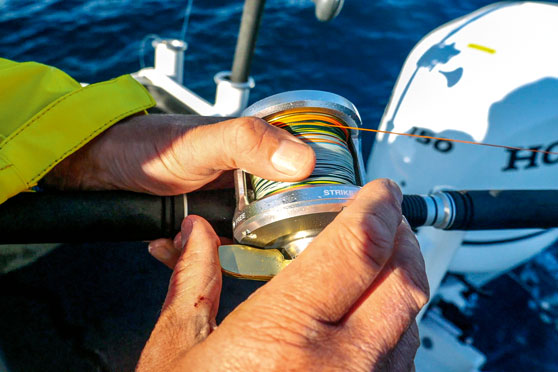
Having a rod in the rod holder with drag engaged almost always results in missed or undetected bites and lost baits. Also, having the rod in hand let’s you know when your live bait gets nervous and whether it’s worth making another pass.
Turn on the bait ball
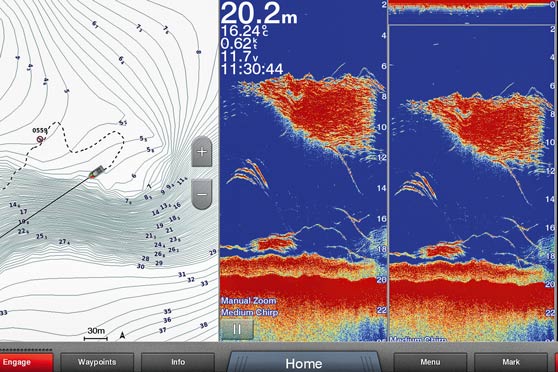
Just like marlin fishing, if you go over a tight-packed bait ball (as seen on the sounder screen) or surface-feeding bait, go into a turn around the school. Steering sharp on the bait ball allows your live-bait to drop down in the water column and puts it in the zone. Keeping the boat and bait in the feeding zone is one of the most important keys to success.
Set your drag mate!
Before you put your bait in the water, know exactly where your drag is set! On my boat, we run with 11-12kg of drag at strike. If the fish is still running hard at strike, we know exactly how much drag we have and how much more we can apply to try and slow the fish down.
The bite and the fight
Now we get down to the exciting part! How long do you feed a live-bait to a kingfish once you get the bite? I try and keep this pretty simple – my normal answer is “once you get maximum acceleration from the fish, take a deep breath and push the drag lever up”.
Once the kingfish has turned and is running away from you, slide the drag up and let the speed of the fish set or roll the hook into the kingfish’s mouth – DO NOT STRIKE!
Now the line is peeling off your reel at an alarming rate, so what do you do next? You do not need to be Einstein to work this out. Forty metres of line out in 20 metres of water with a kingfish ready to charge straight to the bottom and rub the line off is a tricky situation.
Knowing this, we have to stop the boat as soon as we set the hook and reverse back as quickly as possible to get the line vertical. While this is happening, clear any other baits. You only have seconds to get the line straight up and down to minimise the risk of the fish snagging you.
Pump and wind as quickly as you can to get line back fast because once the boat stops and the vertical pressure comes on, the fish will dive for the bottom. Every metre of line you’ve won back will help.
If you’re using a rod bucket, wait to get the rod into it until after the fish has made its first couple of runs.
Shallow water slow-trolling for kingfish requires a lot of teamwork and sometimes a little luck and a few tricks to drag these hard-fighting fish from the shallows. It’s no wonder we keep going back for more of this action!
|
|
This article is reproduced with permission of |

Fishing Reports Visit Reports
Manukau/West Coast Fishing Report - 15/10/26
Big spring snapper in 60 metres. The El Niño weather pattern isn’t going to be... Read More >
Rotorua Fishing Report - 15/10/26
Solid start to the season! The Rotorua lakes have all started the season well, and... Read More >
Tutukaka Fishing Report - 15/10/26
Big snapper in shallow. Things remain relatively quiet on the fishing front out of Tutukaka,... Read More >
Tauranga Fishing Report - 15/10/26
Bait and temperature on the rise. It’s been great to get out and see some... Read More >


Monday 19 October 2026
Major Bites
 - -
Minor Bites
 - -
Tuesday 20 October 2026
Major Bites
-  -
Minor Bites
- -
Comments