
Slow Trolling For Kingfish

Finn Henderson shares his tips for slow trolling for kingfish...
The key takeaway I have picked up from targeting kingfish under the wings of multiple veterans always seems to come back to one factor: quality bait. If you can put effort into catching baitfish (preferably koheru, jack mackerel, kahawai, or piper) and find them consistently, then your chances of catching Kingfish skyrocket. It comes back to that age-old saying – “find the bait, find the fish.” It even applies to us, how often have you seen a supermarket devoid of people?
Slow trolling is an excellent way to cover new ground and map out a reef system while actively fishing. It can help you understand where kingfish will feed in relation to how the current is moving onto or over a reef. Current can turn on the feeding switch for them and they use it to their advantage to ambush baitfish that get pushed up against the reef edge.
Gear to use
There will be times that you might get away with using average gear, but it normally ends in tears or heartbreak. With kingfish the saying “never bring a knife to a gunfight” rings loud time and time again. Rod and reel combos are prolific, and there are many suitable for tussling with kingfish; popping down to your local tackle store should see you pointed in the right direction. However, it’s what’s at the end of your line that is normally the most important.
The rig that we fish varies with the terrain and location, but for the most part, the specifics are the same. We use roughly 1.5m of trace: 130-150lb monofilament for heavy-duty areas like Mayor, White and the Mokohinaus; 80 - 100lb fluorocarbon for inshore areas like harbours and Hauraki Gulf. I prefer to use monofilament in the heavier trace as it is neater to tie with and fluorocarbon in the lighter weights for cagey fish. Remember, this is just a guideline from which to base your own options; you will soon figure out an equation that works for your certain scenario.
A high-quality HD swivel connects the trace to the leader and a hook is tied on via a uni or clinch knot to the other end. When choosing a hook, it is very important to match it to the size of the bait you are deploying rather than the size of fish you expect to catch – it all ties into bait presentation. Small high-quality hooks these days are built to withstand extremely high bending/breaking points, giving you much higher confidence when a small 5/0 hook is smacked into the jaw of a 15kg-plus kingfish.
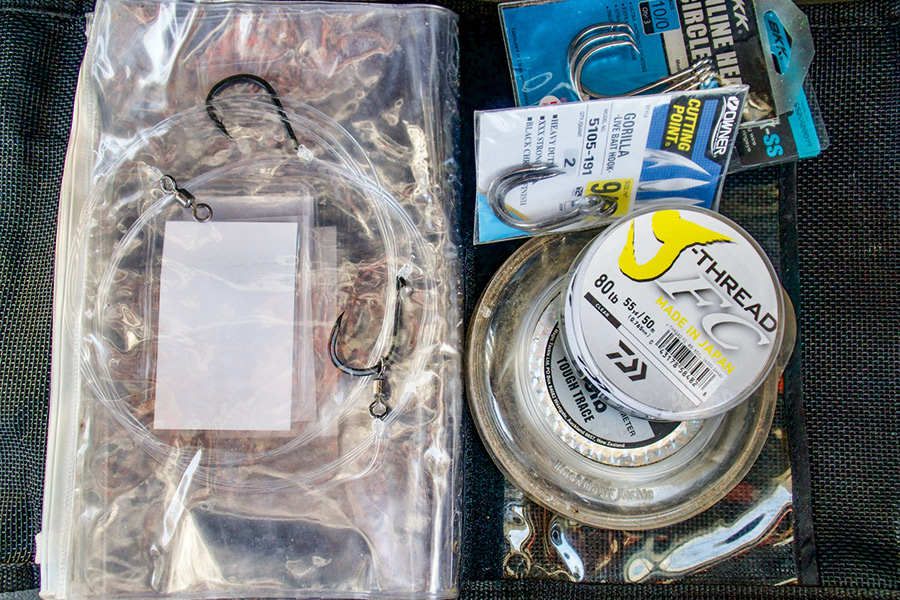
Finn's spares kit - traces and a selection of hooks ready to go.
Top baits
Two baits that we commonly use are koheru and jack mackerel, but many others will do the job. Koheru are the crème de la crème when it comes to livebaits; durable with a massive vibration factor and simply succulent lollipops that almost all predatory fish cannot resist. Towing them at roughly 2-3 knots is a suitable speed and allows them to swim naturally.
Jack mackerel are just as hardy and can be used in similar ways, however, they respond better to a slightly slower troll speed, bumping in and out of gear at roughly 1-2 knots. Before you deploy them at the desired position take note of how they swim boat side at the set speed. With all live baits if you notice them spinning or ’swerving’ then you are trolling too fast. In certain areas weight will be needed to get your bait in the zone. This generally depends on two factors; the size of your bait and the current. A general guideline we use is 0-2oz for 0 -20m and 4-6oz for 20-40m.
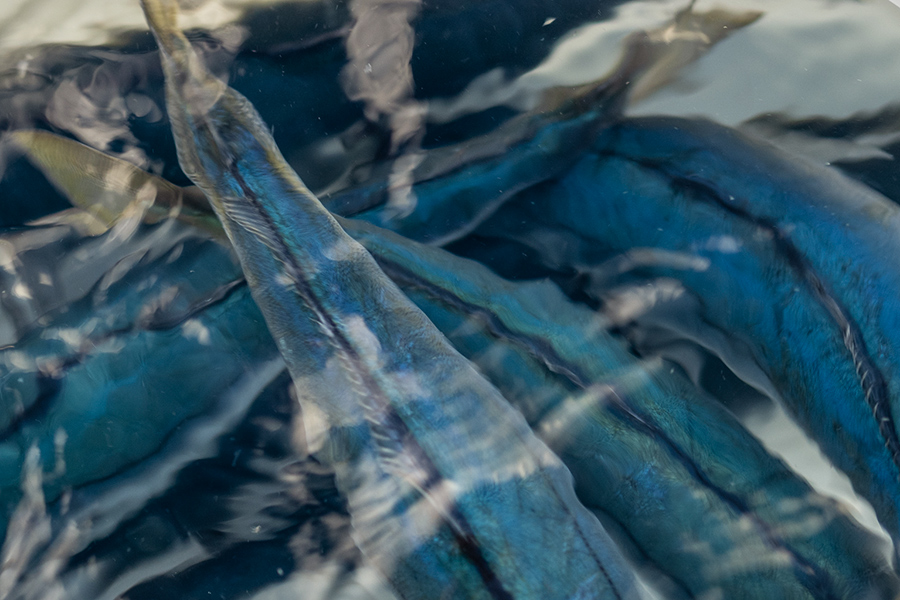
Koheru are the crème de la crème when it comes to livebaits.
The bite and fight
Reading the bite can be quite crucial. Let them eat for too long and you’ll find yourself disadvantaged after you just gave them a free 10-20m of line; too short and you probably won’t achieve a solid hook-up. Our general rule of thumb is a three-second countdown. Mind you, I have still seen some very fast and very slow three-second countdowns that still result in a hooked fish, but aiming for that period of time seems to give us the most consistent hook-up rates.
We like to fish our lever drag reels in free spool while slow trolling with our thumb pressed down slightly on the line to stop it from creeping out. If using a spin reel, we fish in freespool and hold the line between our fingers. After we feel the initial pull (more weight than your baitfish can pull), we count to three, slowly push the lever drag up to its desired pre-set position and hold on. If you are using circle hooks, try and avoid striking. The kingfish running away with your bait as you lock up should be sufficient to roll the hook into the corner of its mouth. Using J hooks is a slightly different process; strike after you count to three and be ready to wind. All too often we see people fumbling and trying to get comfortable after throwing a big strike in, all for the kingfish to spit the hook because it hasn’t been set properly. In all cases, your rod should not be in your gimble or tucked into your thigh UNTIL line is coming off the reel.
Watching the rod tip for the ‘eat’ is very important and a lot can be gauged from how it’s behaving. A slow docile tapping means the live bait is happy, not stressed and in good health. This normally changes as a kingfish moves into the vicinity or begins to shadow and the tapping will alter to a more distinct agitated vibration. When I see this happen, I slow down slightly or even pause to try and tempt the kingfish to have a go.
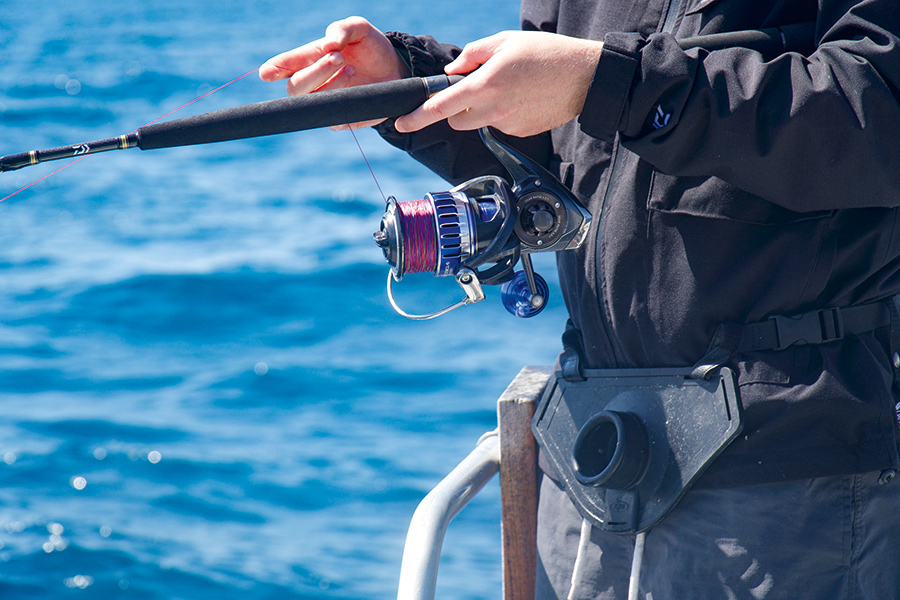
This is the position you want to be in before the strike - in freespool holding the line with your fingers.
When they eat, it’s normally one of two ways. One way is your live bait will start vibrating with panic, a couple ‘knocks’ will be transmitted up the line (this is the kingfish trying to turn your bait around to eat headfirst), followed by increasing weight and eventually and hopefully, pulling line off your reel. Secondly, they can come in hot and aggressive, giving your live bait virtually no time at all to react and ripping the line from underneath your thumb violently. In this case, try not to panic and employ the same three-second countdown – ideally, the result should be the same.
You now have line pouring off the reel and the drag is singing, so what next? Handy boat work can play an important role here. Backing down on your fish to decrease the angle and getting vertical can help immensely. Kingfish will do everything in their power to find the reef, so it’s only fair you try everything you have to stop them from reaching it. Use the rod to your advantage by lifting up and then winding down. Every metre counts during this type of fight so even if you are only getting half winds in between their bursts, you’re still winning.
When you get them away from the structure and closer to the boat, they often have a couple of dirty tricks up their sleeve. Commonly they look spent and then charge in one last rush underneath the boat. A way to counter this is to have your rod under your arm instead of in a gimble. This reduces the chance of high sticking and also changes the line angle, giving you a chance to gain control – just don’t let the line touch the boat!

Circle hooks help achieve solid hook-ups in the corner of the jaw.
The finer things
One critical factor that I have learnt from both veterans and experience is bait presentation. This means checking on your live bait regularly. If an area shows promise and your live bait is ‘nervous’ and then suddenly goes dull for the next minute, it’s normally for a reason. Check that the hook hasn’t rolled into the gills, or it hasn’t been knocked by looking at the fins for any damage.
These are all little details that will help dial in your game. Regularly hooking the gill plates can indicate that your hook is too large. If your bait is nervous often but never gets eaten, it can be worth decreasing your trace weight or swapping from monofilament to fluorocarbon. Even adjusting the weight slightly can put the bait in the right spot or present it more naturally enough to entice a strike. These little factors can be the difference between getting an eat from a cagey fish or just having it harass your live bait. Always be open to change and remember what worked yesterday will not necessarily work today.
Kingfish are dirty fighters and are fittingly called ‘hoodlums of the reef’ for a reason, don’t underestimate them. When it all comes together with a little technique, boat handling and successful angling, the results can be pretty epic; and some truly huge fish can grace the deck!
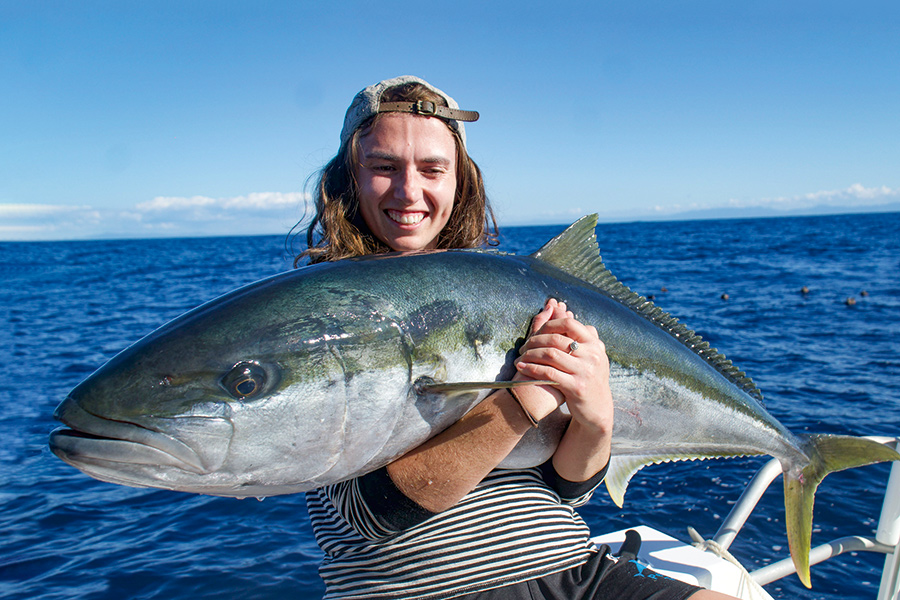
A solid reef hoodlum.

January 2023 - Finn Henderson
New Zealand Fishing News Magazine.
Copyright: NZ Fishing Media Ltd.
Re-publishing elsewhere is prohibited
Fishing Reports Visit Reports
Manukau/West Coast Fishing Report - 15/10/26
Big spring snapper in 60 metres. The El Niño weather pattern isn’t going to be... Read More >
Rotorua Fishing Report - 15/10/26
Solid start to the season! The Rotorua lakes have all started the season well, and... Read More >
Tutukaka Fishing Report - 15/10/26
Big snapper in shallow. Things remain relatively quiet on the fishing front out of Tutukaka,... Read More >
Tauranga Fishing Report - 15/10/26
Bait and temperature on the rise. It’s been great to get out and see some... Read More >


Friday 23 October 2026
Major Bites
 - -
- - Minor Bites
 - -
- - Saturday 24 October 2026
Major Bites
 - -
- - Minor Bites
- -
Comments