
Slide baiting live baits
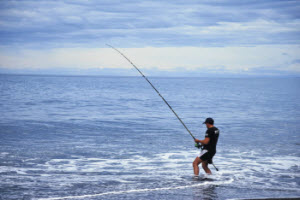 Slide-baiting is huge in other countries such as Hawaii and South Africa, and although some anglers have started to get into it here, it hasn’t really taken off yet.
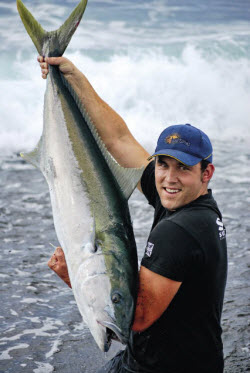
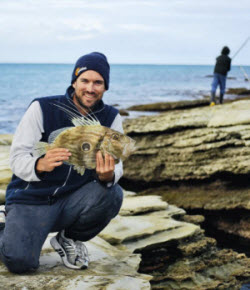
This fishing method targets a number of species from kingfish and john dory to big snapper and kahawai, with various clips and the current employed to slide dead or live baits down the mainline.
It can also be used to target large sharks, but I try to stay away from them (for those interested, there will be plenty of ideas you can use to target them, too).
This is my favourite way to fish, mainly because we encounter species that don’t usually take static baits fished on conventional surfcasting rigs.
Some of the most heart-pounding moments I’ve had behind a rod have been while slide-baiting in the surf. Watching big kings race in and smash the live baits at our feet is about as intense as it gets. Steadily cranking on the rod to take any slack out prior to feeling the weight of a hook-up really gets the blood pumping, and when the string starts to disappear afterwards, the adrenaline takes over.
However, slide-baiting is a huge topic, so to properly share most of the little tips and tricks I’ve picked up over the years, I’ll cover it in a series.
Selecting a reel
 Choosing a suitable reel is the first big decision to make. If chasing kingfish, 15kg line tends to be the minimum line weight (until you feel capable of going lighter), so with that in mind, the reel should hold at least 250 metres of it, although 300m is better. Big kingfish can take a lot of line, so it’s better to have too much line than not enough.
A reasonable quality reel is recommended, as rapid line loss while under tension creates a lot of heat and pressure that can damage cheaper models. Over the years I have seen a lot of reels turn into handlines during tough battles and some fantastic fish lost because of crappy gear, so don’t take chances.
The last thing to look at is the strength of the main shaft and handle. When the spool is fully extended (we’re talking spinning reels here) and line is being stripped off, incredible stress is placed on the shaft, potentially creating spool wobble in lesser reels. So if planning to chase kingfish with your current reels, check the tolerances to ensure there is not too much movement in components such as the handle, as well as in the spool when fully extended, as this is where faults usually occur when under a lot of pressure.
Choosing a rod
Height is a big advantage when slide-baiting, so anything in the 4.3-4.6m (14-15 feet) range will suit our conditions. Any longer than this and the rod becomes less effective when playing big fish. On the other side, a shorter rod doesn’t hold the line high enough, leaving it at the mercy of the swells and water movement, so there is a balance.
Keep in mind that heavier line than usual is being used, so the rod’s capabilities should match it; rods with a sloppy, parabolic action will still work, but the amount of pressure able to be applied to the fish will be limited when hooked up.
Proven rods for slide-baiting include the Kilwell Powerplay DIS222FX, along with other models by Offshore Rods and Anyfish Anywhere.
What line?
Choice of line is partly dictated by the reel you’re using. In all cases a decent line capacity is needed in case a big fish comes along, so for those looking to use existing gear with relatively small spools, braid will be your best option; due to its thin diameter (in comparison to nylon), a spool can hold a lot more. Personally, I’m a firm believer that mono is better, but not everyone can afford to go out and buy a new reel, so work with what you have and make the most of it.
As far as line poundage goes, 15kg tends to be ideal; if you go any heavier, valuable line capacity is lost. It’s fine to use lighter line too, but when you hook a big fish, you’re going to get your money’s worth!
If using braid, 24kg is a good starting point; even though most reels won’t have drag capabilities anywhere near being able to handle this, the extra line strength provides valuable insurance at times. Also, the heavier braids suit slide-baiting better, because if the diameter is too small, the sliders can tangle in the mainline.
Leaders
 If using heavier mono and fishing relatively clean areas with little foul, you can do without a leader. But if you have a lighter line, such as 10kg, then adding a leader would be advisable.
It always pays to use a leader with braid mainline, ensuring your mainline won’t cut through your leader/trace if there’s a tangle; your leader will stand up to abrasion and teeth better; and a little more valuable stretch is provided when playing fish in the waves.
When joining braid mainline to mono leaders, take a look at the ‘FG’ knot, as it works well. Mono-to-mono leaders are much easier to tie, as the materials are relatively compatible, so a back-to-back uni knot is sufficient.
Trace
Traces that are harder to see and thinner in diameter will always get more attention from fish. So when slide-baiting over open sand with no snags, use the lightest trace practical – 18-24kg should prove sufficient (especially if using fluorocarbon rather than nylon). Obviously in gnarly country you can’t avoid going for heavier traces to prevent bust-offs, but still keep them as thin as possible for the conditions. I find 30-40kg traces around wharves and reefs will usually do the job, but you may need even heavier sometimes, depending on the location.
Fluorocarbon trace is fantastic. This material is harder for fish to see and is much stiffer than monofilament trace line, which helps prevent tangles with your mainline. Black Magic fluorocarbon trace is outstanding and works well with this fishing method.
When connecting traces and heavy lines, crimping can work better than bulky knots; crimps are very strong and handle pressure incredibly well. If unsure of the strength of the crimps, it doesn't hurt to use two. Armour spring will keep your line in great condition.
You may also find crimping increases your hook-up rate. The hook is able to move more freely, so lets your live bait swim more naturally. Just remember to leave a bit of room for the hook to move when crimping it on.
Hooks
When using live baits, it’s not about using the biggest hook for the biggest fish, it’s more important to use a hook size that suits your live bait. As a basic guide, this might be anything from a 4/0 with yelloweyed mullet and piper to an 8/0 on a decent kahawai. For general slide-baiting, 5/0 hooks are a good all-rounder.
Hooks that are too small – especially if also badly positioned – risk getting buried in the live bait when striking, so tend to eventually pull. On the other hand, using hooks that are too big will either wear down your live bait too fast and kill it, or stick out so much a wary kingfish will take one look and move on.
I believe the colour of the hook is important, too. As your baits are often close to the surface when they get nailed, it pays to use black hooks without too much gloss. Bright silver hooks reflect the sunlight and can stick out like a beacon on the baits’ back. A discreet approach is always good. It may sound like a small thing and a bit pedantic, but all these little things add up to more successful fishing.
Swivels and sliders
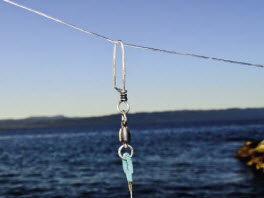
 The most important slide-baiting components are the swivels and slides. The first type is a coastlock swivel – just an ordinary, reasonable quality coastlock for sliding down your line. It is better to go a little heavier than usual when using them to slide live baits out; swivels in the 20kg bracket are very robust and can take a hammering when locked onto the sinker at the end.
The other option is to use proper sliders. You have two choices: weighted sliders and unweighted sliders. Each has its own advantages and disadvantages (which we will look at more closely in a future issue), but both have a split-ring that they run into and lock onto. Good quality sliders are available on the ‘net, but it pays to shop around before buying.
Sinkers
A break-out sand-gripper sinker should be used in most situations, whether fishing in harbours or over beaches. This type of sinker will hold the mainline tight and prevent any slack in the line, which can allow tangles. Use a sinker that suits your rod’s capabilities as well as the live bait’s size. In most cases a four or five-ounce sinker will be required.
Right-o, now that the technical stuff has been covered, keep an eye out for the next issue: we’ll take a look into baiting up the slides and the situations that suit slide-baiting for big fish.
 |
This article is reproduced with express permission of
written by Chad Prentice - 2013 Originally published in New Zealand Fishing News |
Fishing Reports Visit Reports
Outer Hauraki Gulf Fishing Report 17/09/26
Spring wind the handbrake. Spring is starting to make its presence felt in the outer... Read More >
Top of the South Fishing Report - 17/09/26
Early snapper in Tasman Bay. Well, spring is finally here, and the days are getting... Read More >
Bream Bay Fishing Report - 17/09/26
Good snapper catches reported. After Tangaroa turned off the fish tap for a month or... Read More >
Bay of Islands Fishing Report - 17/09/26
Pacific bluefin tuna for the lucky few. The last fortnight has seen more fishable days... Read More >



Friday 25 September 2026
Major Bites
 - -
- - Minor Bites
 - -
- - Saturday 26 September 2026
Major Bites
- - Minor Bites
- -
Comments