
Shallow water snapper tactics
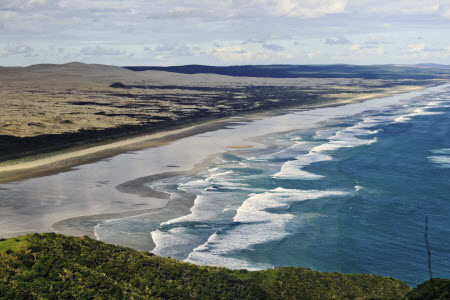 March is snapper time in the lower north, and as each weekend approached I monitored the weather and swell websites to see if it was worth driving north to the surf beaches of Manawatu and Wanganui.
Like most of the country we had a spectacular run of autumn weather, which presented me with opportunities to do exactly that. I picked my moments carefully because even moderate swells or onshore winds can make this shallow coast difficult or impossible to fish. And even when conditions are good, there is no guarantee of snapper success – they’re such fickle beasts! However, when this coast ‘turns on’, big bags of snapper and trophy-sized fish can be hauled out of the surf.
My first successful snapper hunt to the area this year saw me accompanied by Nathan Church. Nathan is a snapper aficionado from Melbourne, having spent his youth chasing them out of boats in Port Phillip Bay. Since moving to Wellington he’s shifted his efforts to surfcasting and proved a natural, but until this night he’d never landed a snapper from the shore. Arriving at the beach we surveyed the scene and Nathan remarked that it was a pretty shallow, barren-looking piece of coast. It’s a common observation for people getting into west coast surfcasting for the first time – I’ve heard others say the same about the Taranaki coast, Ninety Mile Beach and the South Island’s West Coast.
On this day we drove five kilometres up the beach, marking a spot or two. Beaches like this are characterised by systems of bars, channels and holes, and a good, basic strategy involves looking for darker, calmer patches, because these signal deeper water. Eventually we settled in front of a deep hole easily within casting distance and got to work. As the afternoon wore on, the tide dropped, draining the hole and causing us to wade out and cast into the water beyond, where a tight, deep channel lay. Channels are promising places to drop a line, as the currents running through generally bring fish past – but on this day all it brought past was weed. We persevered through dusk, but on dark realised we needed to move away as the weed had made fishing all but impossible.
Three kilometres down the beach we found waves breaking right on the shore with only blackness beyond, indicating a lack of tight channels and associated current. With this in mind I was confident we’d avoid the weed, but we’d only be fishing into 1-2m of water. It might not seem like much, but this is all the depth required to catch snapper in the dark, so we gave it a bash.
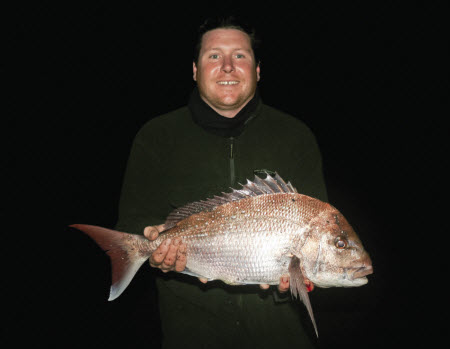
Five minutes in and my left-hand rod buckled over. I struck and nursed a 2kg snapper through the surf. Over the next hour we filled the chilly bin with snapper in the 1–3.5kg bracket. These fish were in close feeding on tuatua and clearly swimming in beats across our position – three times our rods went over like dominos from left to right. What started as a frustrating afternoon turned into a productive night, and Nathan was rightly pleased to get his first victims from the beach, including the biggest of the trip.
So what lessons have I learned from fishing in these shallow waters?
Day and night
 There is a huge difference between fishing day and night on shallow beaches. During the day you need to fish the deepest water you can find, and this may mean driving several kilometres of beach by quad or four-wheel-drive. Even then, bites are likely to be few and far between, though there are days when snapper will feed freely in daylight, normally when there is reasonable cloud cover. (Kontiki long-lines are popular at these beaches, but during daylight even they can struggle to catch snapper, and when they do, it’s often only their last few hooks that are successful, which can have been over two kilometres out to sea.)
As the light fades, the snapper move closer into shore, and under the cover of pitch darkness they will move into very shallow water indeed.
It is interesting how their behaviour varies though. On some nights they will hit baits hard and indiscriminately, on others they pick at baits very softly and regularly spit the hook.
Shellfish beds
On these beaches snapper enter the surf zone to feed on shellfish, including paddle crabs, and placing baits in amongst these food sources is a key to success. Paddle crabs are extremely mobile, difficult to locate, and steal bait, so I suggest focusing on fishing over shellfish beds!
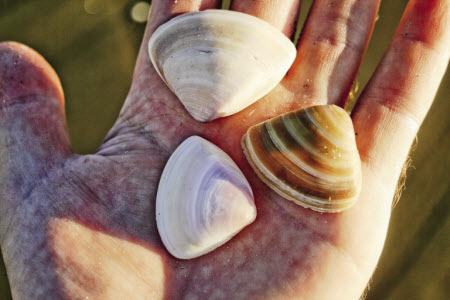
Tuatua is probably the most common west coast shellfish and a favourite of snapper. Tuatua break up in the surf and their beds can be located by looking for areas of broken shells. These are white and typically broken into bits about the size of a fingernail. Old time fishermen have told me that tuatua are so attractive to snapper that they will swim into water only inches deep to eat them! Whilst I would encourage you to ‘match the hatch’ by collecting fresh tuatua for bait before starting fishing, it usually isn’t necessary. My favourite snapper baits are pilchard and skipjack tuna, and snapper picking over shellfish beds are usually quite prepared to try them.
Patience
 Patience is a virtue, particularly for fisherman, but this is even truer of the shallow-water snapper fisherman. I spend at least as much time chasing gurnard and moki on deep water beaches, and this type of fishing usually produces at least a fish an hour, even if it’s not the target species you’re catching. By comparison, shallow-water snapper fishing tends to involve many hours of catching nothing. I believe this is directly related to the shallow water, which makes fish very sensitive to the effects of the moon and tide. It is important not to get dispirited by these long, lean periods, because they can be followed by a flurry of hungry fish – and occasionally a trophy red. Make sure you keep this in mind and work your rods hard – when the snapper do come past, you need to have two fresh baits sitting in the surf!
Changing channels
Shallow beaches are characterised by systems of bars and channels usually absent on deep beaches. Water moves through the channels and fish use them like roads to move in and around the surf. Food and weed also move through the channels on the current, and these are the places to drop baits. However, not every channel is created equal, because the weed that moves through them can collect on your line and make fishing impossible. This is particularly true of tight channels, which concentrate current. Other channels may not be easily accessible to fish or may not hold the food they are after. For this reason it pays to mark a handful of spots before starting fishing and to move from one to the next if you’re not having any luck.
Different tides create different opportunities
Many shallow surf beaches experience huge tides, particularly those on the west coast. In Taranaki for example, two-metre tides are standard. On the beach this means the water moves in and out long distances. The best high-tide spot on the beach may be the worst spot at low tide and vice versa. For example a deep, productive hole within easy casting distance at high tide may be bone dry at low tide. The successful surfcaster takes advantage of the opportunities presented at different stages of the tide. High tide often presents opportunities to fish deep water up close against the beach, whilst low tide often presents opportunities to wade onto distant bars and cast into deep water behind the breaking waves.
Just fish!
As mentioned above, your first outings to shallow water beaches will seem daunting. Typically there’s a lot of water to choose from and it can be hard to know where to start. My advice is to simply look for dark water and fish it. As you fish, you will see the effect the rising or falling tide has on your chosen spot and the mysteries of the beach will reveal themselves. If you don’t have any success, move to the next good looking spot you can find and repeat the process. With time on the beach you will start to recognise patterns and begin to make informed decisions – but perhaps most important of all, your confidence will rise when you begin catching fish. When this happens the beaches aren’t so daunting any longer.
Gear basics
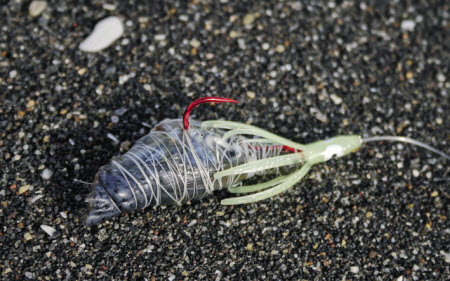 On top of all the above, I recommend arriving at the beach with the tools to put in a long cast – a long casting rod, long-cast clip-down rigs, waders or a wetsuit, and six-kilogram mainline on reels. You don’t always need a long cast to succeed on shallow beaches, but some days it is the difference between success and outright failure.
It also pays to use long traces and have some small hooks on hand, because shallow-water snapper can be very shy biters.
A long rod spike to keep your mainline clear of breaking surf is also a worthwhile investment.
These are things that I’ve covered in detail in previous articles, but are more relevant on shallow beaches than anywhere else.
Shallow water beaches are the most unlikely looking places to catch a fish, but there is much more to them than meets the eye. The systems of channels, bars, rips and holes shelter baitfish, shellfish beds and other food sources that attract fish in to feed. Some of the snapper that enter the surf zone are enormous and will navigate water less than a metre deep to feed.
The key for the surfcaster is to have a bait in these places when the snapper move through, which may be a matter of only a few minutes within a 24-hour period. You may also have to wait weeks for the right sea and weather conditions.
There is no shortcut to success in this type of fishing, but if I was to offer one piece of advice only, it would be to make sure you focus your effort in the dark hours, because catch rates can increase exponentially when the sun goes down.
 |
This article is reproduced with express permission of
written by Andy Macleod - 2013 Originally published in New Zealand Fishing News |
Fishing Reports Visit Reports
Raglan Fishing Report - 12/11/26
Big spring snapper. With the more settled weather over the last couple of weeks there’s... Read More >
Mercury Bay Fishing Report - 12/11/26
Snapper hit and miss. Most reports have been telling us it’s becoming more difficult to... Read More >
Northland Fishing Report - 12/11/26
The switch has been flicked on! Call it what you want, El Niño, global warming,... Read More >
Tauranga Fishing Report - 12/11/26
Snapper and kahawai in close. Again, we start on a positive note, with some nice... Read More >


Monday 16 November 2026
Major Bites
 -
 -
Minor Bites
 - -
Tuesday 17 November 2026
Major Bites
- - Minor Bites
- -
Comments