
Setting up for Surfcasting
So you want to have a go at surfcasting?
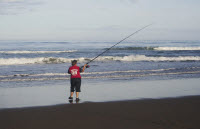 Well, it’s easy to get started and not too expensive, either.
The expense can come later, having made the decision that this method of fishing is for you – because it certainly isn’t for everyone. Catch rates can be depressingly low, with the fish sometimes eluding you for several trips.
As you may well be out in all weathers if you want to make a good go of it, purchasing some decent clothing will be worthwhile. Also, you’ll need some transport to and from the beaches, and preferably while on the beach as well. A 4x4 vehicle is the answer, or a 4x4 plus a quad-bike if you can afford it.
Camping out is part of the surfcasting fun, and you can take this to whatever level is desired. It could be a backpackable bivvy that you carry down the beach or a full-on family camp to use as a base. Like most sports, there are plenty of useful accessories, including torches, cookers, knives, a sleeping bag, tackle bags, backpacks and other good stuff.
The advantages of a club
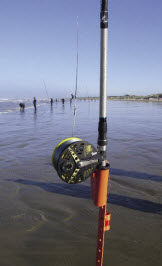 To start out with, however, I suggest you first join a fishing club in your area. You will likely find some like-minded people at their meetings, so a fishing buddy or two will often eventuate. Better still, you might even get invited out by one of the club’s experts. Also, a good club will have information nights, where invitational speakers deal with a range of subjects pertinent to surfcasting, including how to bait up and rig your gear for specific species and locations, or perhaps discuss fishing spots to try in various areas. And, for a bit of variety, fishing industry reps may sometimes be invited to reveal the latest advancements in tackle, or clubbies from other areas are asked to discuss their fishing areas – the possibilities are endless.
Then, of course, there is also the aspect that clubs are our mouthpiece at a political level, so require our support and input, thereby enabling us to have a say on things pertaining to surfcasting.
But, for many surfcasting exponents, it is the more practical aspects that appeal most, such as fishing contests – both serious and social get-togethers – as well as regular casting days, where you can learn so much more about this sport. (If interested in competition fishing, clubs usually hold both regional and national contests.)
As is already obvious, you’ll find your annual fee well spent if you take advantage of as many activities as possible.
Getting started
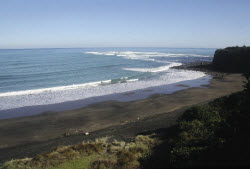 You will need basic gear, and I suggest you either get advice from someone who is into the sport, or else find a knowledgeable retailer you can trust and let him help set you up.
Your rod should be of graphite construction. IM6 is a great material for long-casting surf rods. There will be plenty of cheaper ones, but if you give them a wiggle, they will wiggle back at you. As for the IM6 graphite models, they tend to be much crisper in feel, so snap back into shape soon after being wiggled – a characteristic that provides the basis to achieving good casting distance.
Your rod should be 4.1m (13ft 6in) to 4.42m (14ft 6in) in length – any longer and you will be fighting it during the cast, unable to generate enough speed through the air to cast a long way. Any shorter and you may have trouble generating enough power through the rod on the cast.
A matching reel will hold 250-300m of 0.35mm monofilament (nylon) and vary in cost from $30 to $600. Spend the most you can afford, although those around $200 to $300 should last reasonably well with some care and maintenance. I suggest you find one possessing a metal body and a waterproof drag.
A few accessories complete the kit. Buy some made-up rigs, including long-cast, extreme distance, and two-hook ledger rigs (you can get spare traces in a variety of styles to suit these rigs, so ask about this when buying them).
Sinkers need to match your rod to achieve the best casts. Generally 4 or 5oz will do, but cast both to find which one suits you better. You will also need shock leaders, such as those made by Virivas, Ultima or Daiwa. These are tapered and give strength and durability at the casting end of the line. (You can also use a length of heavy nylon, but it is not as user-friendly.)
A good tackle bag is well worth the investment. A soft-sided bag with plastic trays inside works well and is easy to carry.
If covering more distance, then a backpack is required. Don’t get one too big or you will be tempted to fill it up with unnecessary equipment. However, make sure you buy a decent headlamp for fishing at night, or if you end up staying out later than you planned.
Footwear is up to you. Do you want to get wet or not? If staying dry is important to your enjoyment, then gumboots or waders will do the job for you – but be aware that waders are potentially hazardous should you be knocked over in the surf. A pair of body waders should therefore have a belt cinched firmly around the midriff – and wear a Sospender or something similar.
However, if not too worried and plan on doing a lot of walking with your fishing, then simply invest in a good pair of tramping boots.
As well as all that, there will be bait to consider. A small freezer in the garage will save some problems. Then you can stockpile good baits as they become available.
You will also need a good rod stand or two. I like a tall, heavy, high-vis stand – such as the bright-yellow Tackle Tactics two-piece – when fishing near the truck, but also have a few lightweight Jarvis Walker ones for times when I am walking any distance to my fishing spot and have to carry them.
That’s about it – you’re ready for action. So some final tips: Concentrate your efforts around the change of light both morning and evening. A big moon in the sky makes fish wary. Tides are less important than the time of day, and a wind before daylight blows all day. Of course there are many more, but learning such things is all part of the process as you strive to become a proficient surfcaster.
 |
This article is reproduced with permission of |
Fishing Reports Visit Reports
Outer Hauraki Gulf Fishing Report 17/09/26
Spring wind the handbrake. Spring is starting to make its presence felt in the outer... Read More >
Top of the South Fishing Report - 17/09/26
Early snapper in Tasman Bay. Well, spring is finally here, and the days are getting... Read More >
Bream Bay Fishing Report - 17/09/26
Good snapper catches reported. After Tangaroa turned off the fish tap for a month or... Read More >
Bay of Islands Fishing Report - 17/09/26
Pacific bluefin tuna for the lucky few. The last fortnight has seen more fishable days... Read More >


Friday 25 September 2026
Major Bites
 - -
- - Minor Bites
 - -
- - Saturday 26 September 2026
Major Bites
- - Minor Bites
- -
Comments