
Selecting hooks
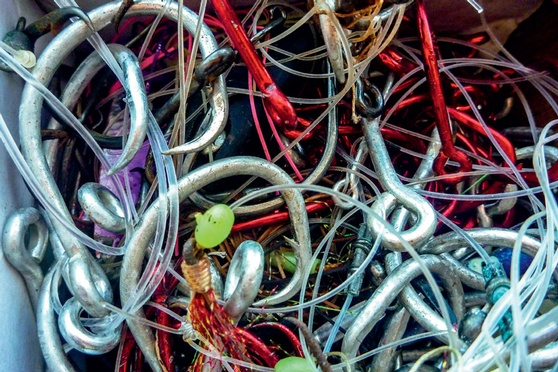
Around the mid-1980s the first Japanese chemically-sharpened hooks came onto the New Zealand market and they were something of a revelation. They were needle-sharp straight out of the packet, resulting in improved fishing results for the great unwashed who had never bothered sharpening the relatively blunt out of the box European-made hooks of the time.
Further improvements in metallurgy, tempering, hook design and manufacturing processes have resulted in strong, but increasingly fine-wire hooks with smaller barbs which are much easier to set. European manufacturers were forced to bring out their own versions and these days we are spoilt for choice when shopping for hooks.
Circles, beaks and J hooks

Although there are many thousands of types, patterns and sizes of hooks, for simplicity let us divide them into three basic types: circles (recurves), ‘J’ hooks and one called, variously, suicide, beak, or octopus by various makers.
Classic circle hooks have a short shank and a point that faces back towards the shank. They work by rotation: the fish takes the baited hook into its mouth, and as pressure is applied to the line (either by the fish swimming off or the angler pulling steadily on the line) the hook is pulled from its mouth. As soon as the shank starts to come clear of the mouth, the hook rotates rapidly and (usually) rolls around the jawbone. This rotation works best if the shank is not too much longer than the point.
The other end of the scale is represented by the standard European style ‘J’ hook which has the point running parallel to the shank. They are usually set into the fish with a straight spear-like thrust, delivered by the angler striking with the rod or handline after the bite is detected.
When this style of hook is used for bait fishing, if the hook is not struck home by the angler, the fish will often spit it out without becoming hooked, or swallow it and become deep-hooked, making unhooking difficult, and releasing the fish in a healthy state near-impossible.
The third hook design, which is quite popular in this country, is about halfway between the two just mentioned. Variously called the suicide, beak, or octopus hook, depending on the maker’s preference, this design has the point curved back towards the shank, but not as extremely as the circle. Rather the point is aimed towards the eye of the hook.
Straight and offset
There are many variations in these basic types of hook. They may have either straight or offset points, where the point is bent out at an angle from the line of the shank. Offset hooks are further split into either ‘kirbed’ or ‘reversed’, depending which way the bend is made.
Offset hooks are partly made that way so that they are easier to bait up. They are also to more likely to self-hook fish, sometimes deeply if you are not tending your rod. ‘Straight’ hooks, by contrast, have the point in line with the shank.
Then there are many different sizes, a range of different metal finishes, up-eye, straight-eye, down-eye, flatted-shank, differing thicknesses of wire the hook is made from, different point profiles, different metals…
So, with all this complexity, how can an angler sort out the type of hook they should be using? I can’t give you details of every hook available – that would be an impossible task – but at least I can tell you the types of hooks I prefer for common types of domestic fishing, and why.
First, some general principles:
- Buy quality hooks. I have encountered ‘mystery brand’ hooks from large discount stores that looked thick and strong but could be bent open with my fingers. Stick to respected brands.
- Check the eye closure. If there is a gap, your line can slip through or be cut by a sharp edge.
- Buy strong hooks. Strength is often more a case of good metallurgy than thickness. Flatted shanks can also help make a hook stronger as they thicken the hook in one plane, making it harder for the fish to bend open in that plane. But also remember that thicker hooks are harder to set.
- Try and get hooks with a good corrosion-resistant finish. Some finishes are slick, aiding penetration.
- Don’t be scared of stainless-steel hooks. There is a lot of talk about stainless hooks being bad because when left in a fish they do not ‘rust out’. I have caught plenty of fish carrying standard plated steel hooks from previous encounters and they take a long time to corrode out of fish, too. And I don’t believe hooks ‘rusting out’ of fish is a great thing either. Some scientific papers have found that when hooks are left in fish, their heavy-metal plating (tin, cadmium, etc) gets into the fish’s blood-stream causing heavy metal poisoning. Stainless steel, on the other hand, is inert, which is why it is used in surgical procedures on humans and left in the body.
- Don’t use hooks that are too small for purpose. Small hooks will catch a lot of under-sized fish and unwanted bottom species.
So, these things being said, here are the styles of hooks that I prefer for some of the common types of saltwater fishing encountered in New Zealand waters. Given that some manufacturers seem to use different sizing systems, I will also give the size of the gap (gape) between point and shank.
Bottom fishing and stray-lining for small-to-medium fish such as gurnard, tarakihi, blue cod, kahawai, ‘pannie’ snapper etc: 4/0 to 6/0 circle hooks (gape 10-12mm) with in-line points. For gurnard and terakihi, I find the 4/0 size works better; 6/0 is a better choice for blue cod and ‘pannie’ snapper, resulting in less deep-hooking and hooking under-sized fish. I like hooks with smallish eyes as I am seldom using heavy leaders for this work and often pull the hook eye right through the bait when rigging it.
Circle hooks have many advantages:
- They are virtually self-hooking, making them ideal for fishing deep water and untended gear, be it rod-and-reel, or longline.
- Once the hook is in, it is difficult for a fish to dislodge, even when the line is slack.
- Nearly all hook-ups with non-offset circle hooks are in the jaw of the fish, which causes little damage. This allows you to release undersized fish and undesirable species, and any other fish you might want to let go.
- They snag the bottom less often.
For these hooks to work well, anglers need to alter their tactics. The big whiz-bang strikes used with conventional ‘J’ hooks are counter-productive with circle hooks, often pulling the hook from the fish’s mouth without a hook-up. What is required, once the fish has taken the hook, is a firm, steady tightening of the line.
Untended rods should be left with a firmly-set drag, not in free-spool. If an angler is holding the rod, they must restrain themselves, and let the fish load the rod. Then a firm, steady (but not violent) lift will make sure the hook is well set.
Bait fishing for big snapper: ’big’ can mean different things to different people, but it is surprising how big a bait even a modest-sized snapper can take. I don’t usually target monster moochers, as I mostly fish for the table these days, but I find using cut baits like whole or half jack mackerel or mullet (depending on size) is a good way of avoiding little fish and catching better-than-average pannies. I normally rig using a two-hook rig with an 8/0 circle at the top and a beak of the same size below it.
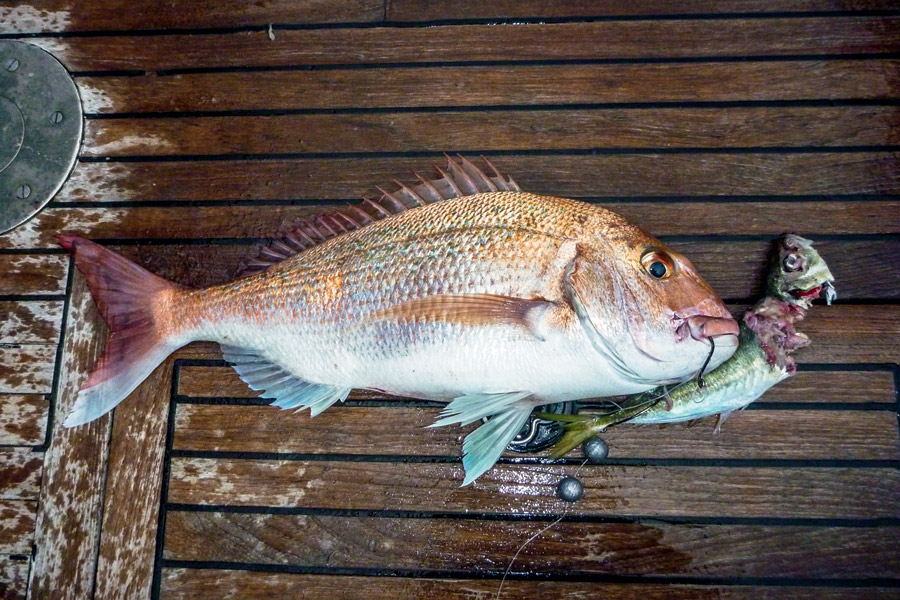
Deep bottom fishing for larger fish: Deep-water species such as hapuku, bass, bluenose, gemfish etc. seldom survive release because of barotrauma. This is why there is no minimum size-limit for these species.
For this reason, offset circle hooks are my choice here. These hooks need to have strong, heavy shanks. If fished on a ledger rig with two or more branch lines, the angler may often get a double hook-up of strong fish that are pulling against each-other.
This demands not only a strong hook, but also a strong leader material, which in turn requires a hook-eye large enough for two thicknesses of the trace. I tend towards a heavy wire 8/0 medium-sized hook (about 13mm gape) which I find will take a decent fish easily and gives better results on fish that have been under pressure. It will also pick up a useful by-catch of things like smaller bluenose and king tarakihi. Don’t choke the hook gape with too much bait.
Live baiting for kingfish or yellowfin tuna: here the hook size is dictated by the size of the baitfish and can vary widely, the hook gape being about as wide as the bait-fish’s head. As the target fish are big and powerful, my preference is for a strong beak hook built on heavy wire, with a medium-length shank. If they are well made, even small hooks can stand up to bigger fish.
If you use a hook with an offset point, be sure to rig the bait so that the point rises up off the baitfish’s back when the eye is swivelled back down towards its tail. This is so the point is clear of the baitfish, for a good hook-up on the predator.
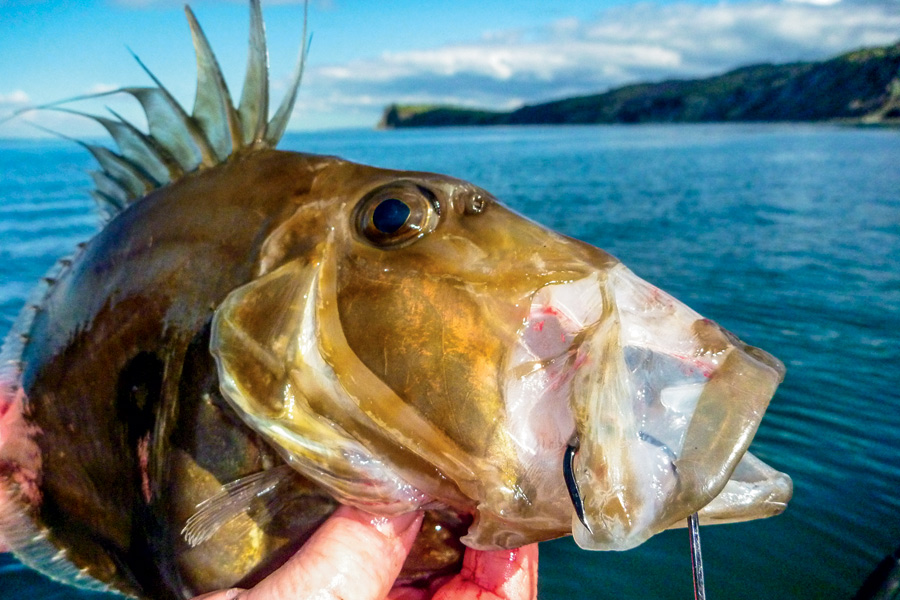
Live-baiting dory, snapper: small live-baits will produce a wide range of predatory species. Snapper and john dory are common inshore examples. Neither species are super-strong fighters and my choice of hook is a standard off-set beak hook in a size 6/0 to 9/0 (16-18mm gap), depending on baitfish size. This should give a decent hook clearance from the bait to allow a good hook-up; see the rigging advice in the previous section. Should a kingie grab the live-bait, you should still have a good chance of landing it if you are careful and patient.
Trolling small lures: when targeting fish like kahawai, modest kingfish, skipjack, or albacore with trolled lures, a range of lures are used. Lures can be rigged with a range of hook types including single hooks, double ‘claw’ hooks, trebles, or a combination of the above. The one thing they have in common is that they need to have straight, not offset, points. This is to avoid making the lure spin as it travels, twisting the line. To a lesser extent this also applies to casting lures.
Trolling big game lures: we are talking marlin and skirted lures here. The hooks I prefer are stainless steel (easier to prevent the skirts getting rust stains and to keep the hooks sharp) of a reasonable gauge in case the wireman ends up in a decent stoush on the leader.
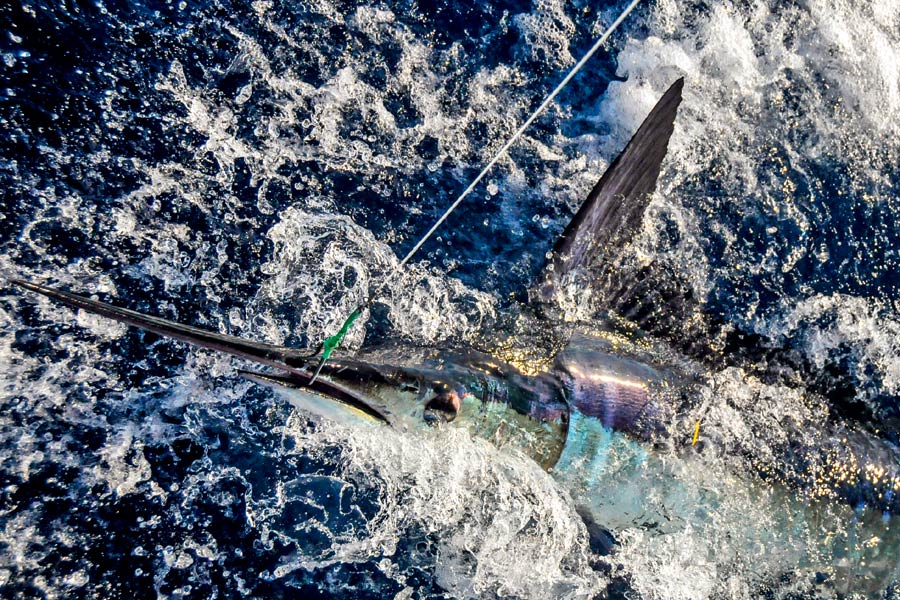
For striped marlin lures in New Zealand, I have settled on a single hook rig for effectiveness and crew safety. The gape should be slightly larger than the lure head’s maximum diameter. Obviously, the bit about having a straight, not offset, hook point to help keep the lure stable also applies here. For a stripie rig, I like a hook where the point angles in towards the eye. The use of J hooks on lures is fine here, as fish are mouth-hooked by a trolled lure.
Trolling big game baits: back in the mid-1990s our regular marlin fishing crew came up against a moral dilemma. Bait fishing, (live-baits and pitch-baits) were out-fishing lures by a very wide margin on billfish, but we were tagging and releasing the bulk of our fish, so we needed a method of ensuring mouth hook-ups with bait. Our skipper, Bruce Martin, suggested circle hooks. Unheard of for marlin fishing at that time, we successfully trialled them in 1995, and in successive seasons their use on marlin became more common, with jaw hook-ups and successful releases the rule. By the end of that decade some Australian and American crews were also using circle hooks regularly and these days non-offset circle hooks are mandatory for billfish baiting in IGFA-sanctioned tournament and record use here and overseas.
Kiwi stripies have their eyes close to their jaw hinges, so a large hook may interfere with the looking gear. About a 10/0 (16mm gape) is about right for the average fish.
|
|

Fishing Reports Visit Reports
Outer Hauraki Gulf Fishing Report 17/09/26
Spring wind the handbrake. Spring is starting to make its presence felt in the outer... Read More >
Top of the South Fishing Report - 17/09/26
Early snapper in Tasman Bay. Well, spring is finally here, and the days are getting... Read More >
Bream Bay Fishing Report - 17/09/26
Good snapper catches reported. After Tangaroa turned off the fish tap for a month or... Read More >
Bay of Islands Fishing Report - 17/09/26
Pacific bluefin tuna for the lucky few. The last fortnight has seen more fishable days... Read More >


Friday 25 September 2026
Major Bites
 - -
- - Minor Bites
 - -
- - Saturday 26 September 2026
Major Bites
- - Minor Bites
- -
Comments