
Scent Matters
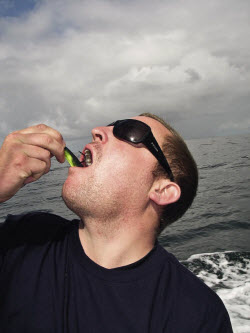 Not for soft-baiters though, who still engage in a lively debate about the primary triggers that seduce fish into biting these lures. Some say it is colour or shape, while others maintain the main trigger is the movement that the fisherman imparts with his rod. Perhaps the most unresolved aspect of this debate is whether or not scent makes soft-baits more attractive to fish.
Scent can be added to soft-baits in several ways, including: being built in during manufacture; absorbed while floating in a jar containing scented liquid; or applied as a paste at the time of use.
Quite understandably, the actual scent-producing ingredients generally remain closely-guarded company secrets. Sport fishing thrives on secrets, so hinting about magic potions, secret sauces, pheromones or other irresistible attack triggers can only enhance the market appeal of soft-baits to fishermen. But, as they say, it takes two to tango, and this brings the fish into the equation.
Nostrils are not prominent features on a fish’s head. In fact, in some species they are so small that they are hard to find. Yet despite this, who has not heard that sharks can detect a drop of blood a mile away or that ocean-roaming salmon do not only remember, but also, years later, home in on the distinctive scent of the river they were born in? I don’t know about the shark story, but the annual spawning run of salmon is beyond dispute.
As a keen trout angler I saw many examples that convinced me trout can detect the scent of a bare-legged angler wading in a river. I clearly recall an incident on the Ruakituri River, where Bill Nikl and I stood in the middle of a shallow but fast riffle looking for trout in an upstream run. Downstream our bare legs created distinctive V-shaped wedges of calmer water. We were just about to go on, when out of the corner of my eye I spotted a large brownie crossing this riffle some 10-15 metres below us. We both watched as the big fish confidently finned across at a good clip until it reached the first V of calmer water. Here it briefly stopped, turned, and bolted back to the safety of the deep run it came from. Bill and I looked at each other in amazement, and concluded that the only thing that could have alerted this fish was our scent.
Over the years I have seen trout become alarmed in similar circumstances, when only scent could have been the logical explanation. With fish, scent recognition may not happen in the same way as with land mammals, but who cares how they do it? The smart thing is not to leave it out of your fishing equation.
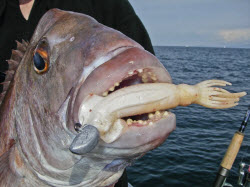 As a bait and berley user, I am a firm believer that scent matters. Yet until quite recently, I found it difficult to believe that scented soft-baits worked better than unscented ones. What had me doubting was not the scent per se, but more about how and how much scent soft-baits offer, given the way they are actively fished through huge columns of new water. I just could not reason that a small soft-bait would exude enough scent to attract fish from afar under these circumstances. Imagine for a moment how diluted this scent would become after only a few casts. To be honest, I still can’t get my head around this, despite a growing body of evidence to the contrary.
My first revelation came a few years back when my Austrian-based brother came on a visit. His arrival coincided with our annual kayak fishing trip to Papa Aroha on the Coromandel. Now my brother is not an angler, and to make matters worse he had never sat in a kayak either, which quickly showed, as he dipped out when just paddling around in the creek pool at the camp. Luckily he is not a quitter, battling on until he sussed out how to stay upright.
Pete, the camp manager, sold him a packet of Gulp! Lime Tigers, and after a quick session on how to position one onto a jig hook, we launched to go for a fish.
Having just received a complementary box full of soft-baits by another much-promoted brand, I was quietly confident of showing my brother how the experts do it.
After providing brief instructions on how to cast with the spinning outfit, I watched him flick an aimless cast that landed not too far from his kayak. He then began to awkwardly reel in the line. However, just as I was about to paddle over and give him a few more pointers, my brother’s rod tip pulled down and he was into his first snapper. He repeated this shortly after, catching two more.
Realising that I had some serious catching up to do, I skewered on a sample of my new acquisition, and launched it with a huge cast well ahead of my drifting kayak. Well, to cut this longish story short, over the next couple of hours I jigged, flicked, bounced and danced my jig, going through my whole repertoire of soft-bait tricks for the grand total of two fish. In contrast my brother landed eight and lost several more.
Needless to say, after such an embarrassing display of incompetence, my mana was badly tarnished. And since my brother was still whipping my butt by day four, I swallowed my pride and bought a packet of Lime Tigers. My fortune quickly changed after that, and by the end of our trip I even managed to out-fish my brother, who was still catching his share of fish by just flicking his jig out and reeling in without imparting any other movement.
Throughout our stay I kept asking myself why the Lime Tigers had so convincingly out-fished a whole box full of this new brand of pheromone-scented soft baits. By closely examining both samples, I found the Gulp! to be a little more pliable, and concluded that this and not scent was the reason for their success. Although this episode happened quite a number of years ago, the question of what really prompts fish to attack a soft-bait lure has never been far from my mind.
Over the years I have fished with just about every brand of soft-bait available in this country, and much as I hate to say this (I am one of the original ‘Gulp! 400x More Scent’ sceptics), I am now convinced that Berkley’s scented lures generate a significantly higher strike rate. And before you think that this apparent endorsement sounds a bit ‘fishy’, let me assure you that I have no connection with Berkley or its New Zealand agents.
Last year’s jigging experiment with random-sized cubes of natural bait was an eye-opener, and showed just how big a role scent plays in fishing success. So on our latest trip north I was determined to continue along the scent route, and took along a lunchbox full of soft-bait-sized sections of tough octopus tentacles. However, the occy bits proved a major disappointment, because after only a couple of casts they collected so much water in their membranes that they resembled a small, water-filled plastic bag. Reluctantly I gave them a mass burial at sea.
All was not lost though, as very early in the trip I fluked onto a work-up from which I extracted five kahawai. Instead of cubing them, as I normally do, I cut them into strips to more closely resemble jerk-shad tails. By heavily binding these to my jig heads with Bait Elastic, I managed to keep them on longer. Yet despite this extra protection, it only took a nibble or two for most of the meat to be torn off, leaving just a few shreds sticking out from among the elastic fastenings. Yet the snapper still hit those bouncing bait scraps with undiminished enthusiasm. I found that scented Gulp! baits could hold their own, but that the strike rate slowed markedly when I tried baits from other brands.
This week-long experiment convinced me that scent is a very important component of a soft-bait’s ‘bite sequence’. My guess is that this sequence starts with lure movement and ‘noise’ attracting fish first, after which scent acts as the final trigger for a strike.
I am one of those fishos who keeps digging for the big ‘why and how’ in everything I do, including the role of scent in soft-baits. None of my experiments have been conducted along scientific lines, but they have nevertheless strongly persuaded me that scent is a tempting ingredient that entices more fish to strike. And isn’t that what most of us really care about?
 |
This article is reproduced with express permission of
written by Herb Spannagl- 2011 Originally published in New Zealand Fishing News |
Fishing Reports Visit Reports
Outer Hauraki Gulf Fishing Report 17/09/26
Spring wind the handbrake. Spring is starting to make its presence felt in the outer... Read More >
Top of the South Fishing Report - 17/09/26
Early snapper in Tasman Bay. Well, spring is finally here, and the days are getting... Read More >
Bream Bay Fishing Report - 17/09/26
Good snapper catches reported. After Tangaroa turned off the fish tap for a month or... Read More >
Bay of Islands Fishing Report - 17/09/26
Pacific bluefin tuna for the lucky few. The last fortnight has seen more fishable days... Read More >



Friday 25 September 2026
Major Bites
 - -
- - Minor Bites
 - -
- - Saturday 26 September 2026
Major Bites
- - Minor Bites
- -
Comments