
Saltwater Fly Techniques - Fly Selection
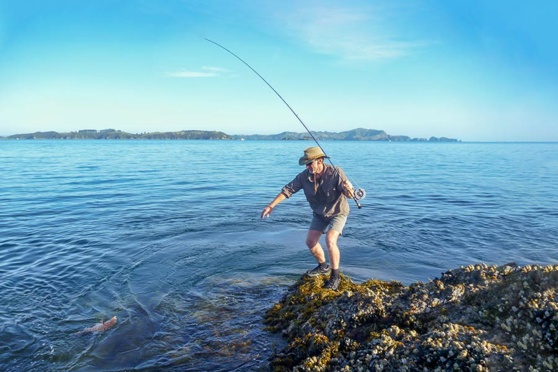
Stealth is very important when fishing artificial lures and flies off the rocks, but so is being seen suggests veteran saltfly exponent Craig Worthington…
The fish need to be able to see your soft-bait or fly, but they don’t want to see you. Consequently, something of a ‘Catch 22’ develops. There needs to be enough water clarity for the fish to get a visual fix on what you’re offering, but that same water clarity can expose your presence to the fish.
The best landbased lure and fly fishers proceed cautiously along coastal rocks while checking the water clarity as they go. If the water is badly stirred up, infused with a thick algae bloom or is just plain brown, then it’s barely worth fishing. Some degree of water clarity is essential to a rock based lure fisher’s success.
I have re-learnt this lesson many times over the years. Whereas a bait fisher might relish the dirty brown water left behind after a storm, a lure or fly fisher needs to wait a day or so for that soft, slightly transparent, ‘green’ water to return.
Light the key
Similarly, darkness is no good for lure fishers in the salt. Bait fishers can fish successfully right through the night, while lure or fly fishers generally need to pack up as soon as the sun goes down. Even trevally over the sand stop biting my fly gear once the sun is totally gone. They bite right up until that last glimmer of light fades from the western horizon, but are very quiet after that. That’s when I go home. And that’s fine by me. I don’t like night fishing anyway!
However, the flip side is that lure fishers and fly fishers may have considerable advantages over bait fishers when the water is clear (which is most of the time). I have gone fishing, and caught fish, in clear water conditions that many bait fishers would regard as being not worth the effort.
It even amazed me the first time I did it. Bait fishing was fairly ingrained in my soul in my younger years and the first time I went out for a walk with my fly rod in bright sunshine I figured it was simply for the exercise and a bit of casting practice. I hadn’t really expected to catch anything. The water conditions were pristine and clear and the sea was flat – just about the worst conditions that any ‘died in the wool’ rock fishing bait fisher would ever think of fishing in.
Staggered I was then when a nice snapper came flying out of the kelp to smash my fly. On subsequent trips, I went on to prove it wasn’t a one-off fluke either. Predatory fish can only be predators, I learnt, if they can see their prey (in this case your lure or fly) in sunlight.
‘Pure-fly’ trophy
The day I caught my biggest snapper off the rocks on ‘pure-fly’ (fly fishing without any bait or berley nearby), I had left before dawn and had fished the wee sparrow-fart hours at daybreak intently. There was dark water everywhere early on, and it didn’t do me any good. The big fish didn’t strike until 8am when the sun was firmly in the sky. I wondered later whether the visual appeal of a sun beam lighting up my big fly as it sunk down between kelp-covered bombies had been enough to encourage that snapper to bite. All I know is that it worked.
Thus I converted from thinking like a landbased bait fisher to thinking like a landbased lure/fly fisherman. It didn’t come easily. I still had this urge to go fishing off the rocks after a bit of weather had blown on through, but most of the time I would find myself confronted with water that was brown and turbid.
Tying on a bright and highly coloured fly would help in this situation. Even a strongly contrasting mix of black and bright colours were said to be good in dirty water. But the reality is that they only help a little bit. In this situation waiting for the dirty storm water to clear a bit is the best thing for a fly fisher to do.
The soft-bait pros have a few more options. They can switch to bright lures as well as ones that vibrate more and send out ‘eat me’ signals in the soupy water. Shad tailed soft-baits are good in this regard, as is any lure that has a heavy vibrating action on the retrieve.
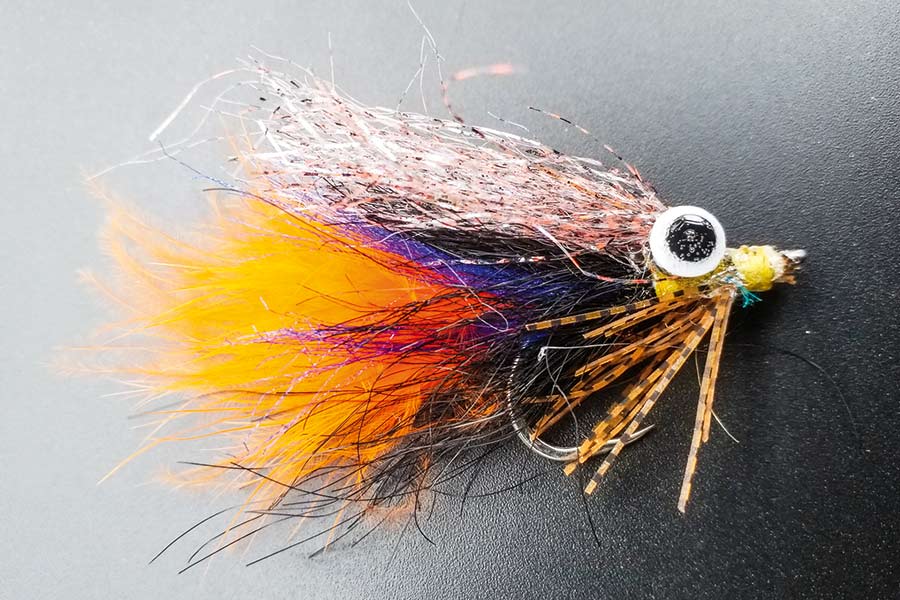
Bright flies with highly contrasting colours are good for dirty water.
When the opposite situation occurs and the water is crystal clear, fish can actually see your lure or fly from a long way off. In these conditions I tend to work the coast at a fairly fast pace, sending just two or three quick casts into any likely hole I can see while keeping my body profile away from the water’s edge as much as possible.
I like to cast well forward into water I have not been near, staying low at all times. The fish can be sitting right in close in these calm conditions and it pays to work the extremely close water first before searching further out. Then creep along the rocks and do another cast forward. Don’t attack the water from a position where the sun is shining directly on you and reflecting your image back into the water.
I was recently fishing like this along a kelpy rock shelf on one of the Bay of Islands many islands when a snapper appeared directly below and behind me. I had cast twenty five metres along the rock face in completely the opposite direction of where the snapper had appeared and was left wondering how to retrieve the fly and re-cast back to the fish without spooking it. It was a difficult situation. Sometimes freezing is all you can do when a free-swimmer appears at your feet.
In this case I didn’t really know what to do, but luckily the snapper lit up, powered off in the direction my flyline was pointing and nailed the fly on the way. It had obviously seen the fly clearly through twenty five metres of water and had let rip with an aggressive predatory response from that distance. It was impressive to see and I was very happy to hook that fish. It had been fortunate that I hadn’t spooked the fish beforehand as I crept along the ledge.
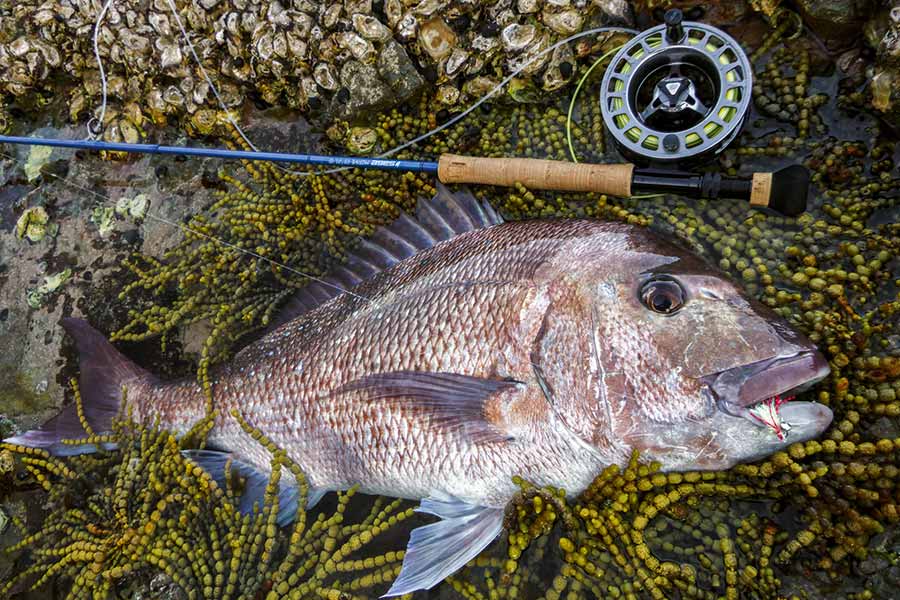
Craig's best snapper taken 'pure-fly' off the rocks was caught with the sun in the sky at eight o'clock in the morning in clear water conditions.
‘Rules’ made to be broken
Sometimes, there are situations where you can’t guess what the fish can see and how clear the water really is. We had a decent flood in June that spewed heaps of floodwater out into the sea, but Ben and Jack were still keen to get out in the Stabi and throw some soft-baits around. The weather had cleared, but I looked at all the brown water pouring out of the rivers and declared that “the fish weren’t going to be able to see anything in that muck.”
They proved me wrong. Out of very brown water they pulled some beauty snapper in the middle of a cold winter’s day. I had to eat humble pie. I realised later that the brown water was of course sitting in the freshwater/flood run-off layer on top. The saltwater underneath was undoubtedly clear. It was a good lesson that trying to figure out what the water clarity is below the surface is not always as simple as it seems.
I’m pleased to say though that much later on Jack had a couple of bad sessions in dirty water at his new ‘red-hot’ rock fishing spot. Some mega-swells had just passed through and the water close to the rocks was distinctly brown. He was skunked completely.
This was a complete turn-around from the great fishing he had been experiencing there in previous weeks. I felt somewhat vindicated. It was proof once again that water clarity is an issue for those of us who like to toss artificials at snapper from the shore.
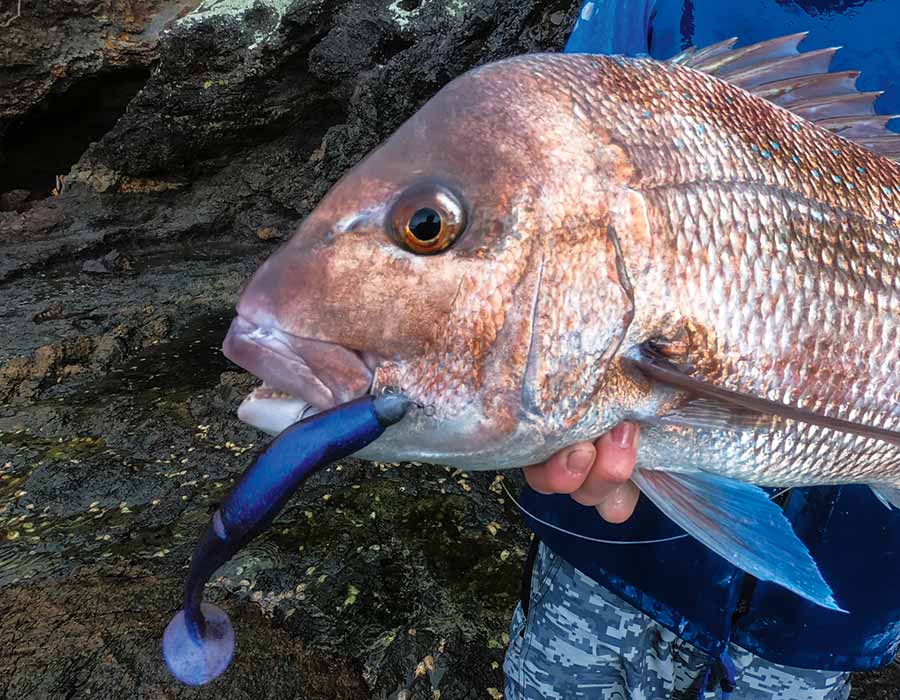
Big vibrating paddle tails can help fish detect your soft-bait in dirty water.

December 2021 -Craig Worthington
New Zealand Fishing News Magazine.
Copyright: NZ Fishing Media Ltd.
Re-publishing elsewhere is prohibited
Fishing Reports Visit Reports
Outer Hauraki Gulf Fishing Report 17/09/26
Spring wind the handbrake. Spring is starting to make its presence felt in the outer... Read More >
Top of the South Fishing Report - 17/09/26
Early snapper in Tasman Bay. Well, spring is finally here, and the days are getting... Read More >
Bream Bay Fishing Report - 17/09/26
Good snapper catches reported. After Tangaroa turned off the fish tap for a month or... Read More >
Bay of Islands Fishing Report - 17/09/26
Pacific bluefin tuna for the lucky few. The last fortnight has seen more fishable days... Read More >



Friday 25 September 2026
Major Bites
 - -
- - Minor Bites
 - -
- - Saturday 26 September 2026
Major Bites
- - Minor Bites
- -
Comments