
Rigging Soft-Baits

Jigheads, jighead, jigheads! That’s it! Adam Royter suggests the total sum of what anglers know about rigging soft-baits is 90 percent jigheads. He investigates why this is so and asks if there are any other rig types anglers can employ to do the job better.
For the most part, jigheads hit the nail on the head as far as ease of use and effectiveness is concerned. They’re a one-knot option that takes care of two elements – weight and hook. Have you ever snagged a jighead? I’ll answer that for you – yes! Do you wish there was a way to rig soft-baits so they were virtually snag-less? Of course.
Not all the rigs below are going to suit everything you do down to the ground. However, what they will do is give you an idea of what’s possible and provide you with some valuable knowledge for future reference.
Let’s begin!
Weedless Worm Rig
Let me say this now: a lot of the names and tech coming up are from the USA. This is simply because they invented it, and fishing tackle has crazy names, so don’t shoot the messenger.
We start our tour with one of the most popular rigging styles, outside of the jighead, in the world. This rig style uses the soft-bait itself to cover or hide the hook point, thus making it ‘weedless’ or snag-less.
It uses a particular shaped hook to accomplish this – one that has the eye directly in-line with the hook point, leaving you with a natural and un-kinked soft-bait when it’s applied to the hook.
The original shaped hook had what is known as a ‘Z’ bend at the eye, and this is the point where the soft-bait is towed from. There have since been dozens of variations created, some of which do a better job of holding soft-baits than others.
As the name suggests, this rigging style is designed to stop weeds and other rubbish collecting in the hook gape. It’s also efficient at stopping it getting caught up in bankside grass and trees!
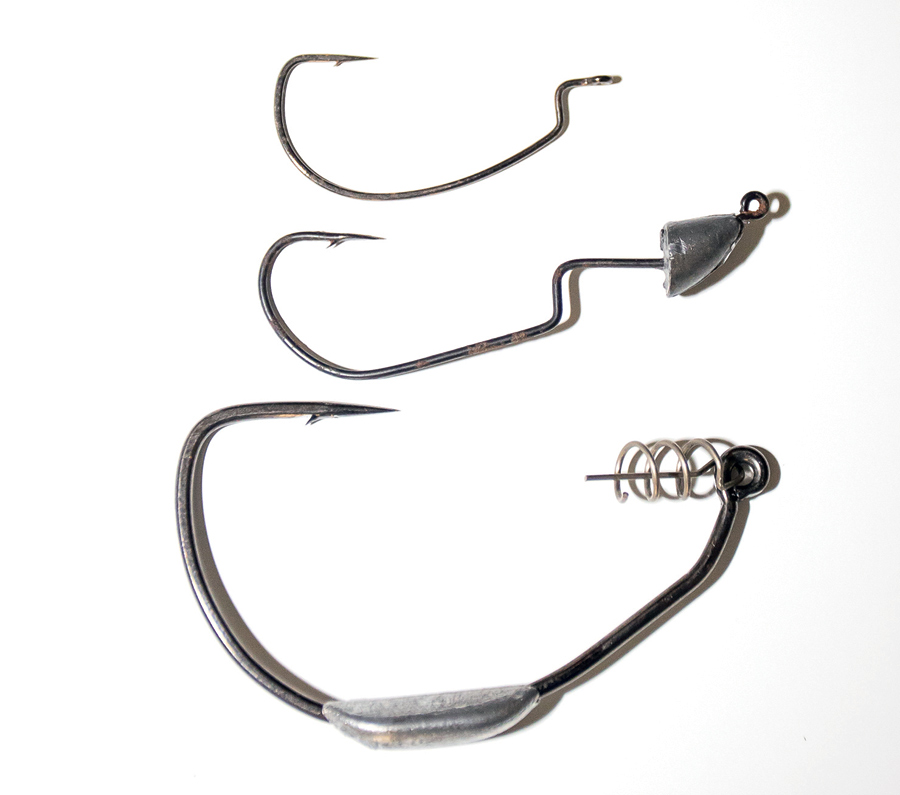
Three worm hook options from unweighted to weighted. Note the screw in system on the bottom hook as well as the keel weight to keep the tail swimming in an upright position – ideal for weedless rigging.
Shot Rig
Both a quick fix and an actual rig, the name gives this one away as it uses a ubiquitous piece of tackle and is simple in format, but incredibly useful.
The rig comprises of one hook and one or more split-shot. That’s all there is to it. However, where you place your shot will change everything!
If you’ve run out of jigheads or you can’t find what you’re looking for, a hook and some weight are all you need. But let’s break this down a little further.
The hook needs to have the ability to hold on to the soft-bait. It can be either a weedless worm style or have a bait keeper on its shank (remember the old-style bait hooks that have two slices on the shank?). This way, your soft-bait won’t slide back down to the bend as you are casting at breakneck speeds.
The shot can be crimped either right at the eye or anywhere forward of that up to about 30cm. If you crimp your shot about 10cm ahead of the hook, you’ll get a ‘disconnecting retrieve’; that is, your weight will take the brunt of your retrieve motion, while the soft-bait follows behind. As this happens, the soft-bait will take on about 50% of the aggressive movement and turn the rest into wonderful little glides and rolls. Because the soft-bait has no direct connection to the shot, it is practically weightless. Keep in mind that shot only come up to a size of SSG, so this is a rig for the lighter end of the spectrum.
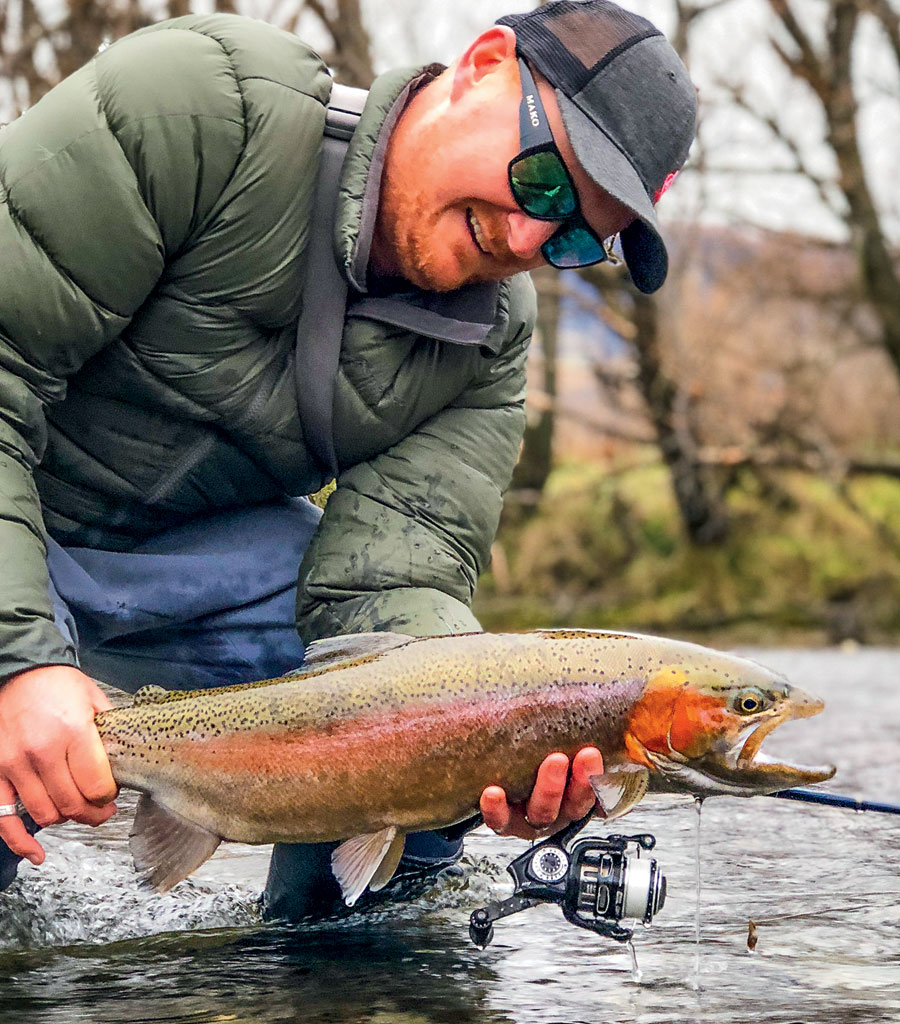
Soft-baits have applications in both salt and freshwater scenarios.
Dropshot Rig
The name ‘dropshot’ might sound very familiar to a lot of you that have been soft-baiting for a while. It was the name of a trendy Berkley soft-bait rod when all this kicked off some years ago. But its name comes from a technique famous in the USA for catching largemouth bass, created to keep the soft-bait off the bottom and allow it to be fished weightless. Ideally fished from a boat, this rig will keep your hooks away from foul on the bottom and possibly give your soft-bait the best action it’s ever had!
It’s very reminiscent of the Paternoster rig in the way that it has a sinker at the bottom, and a hook off the side some several centimetres up the line. The big difference is that if you use the standard Paternoster rig, the 90-degree trace line that comes off the side will inevitably get hideously tangled up. So, to remedy this, a palomar knot is used which connects the hook to the mainline, giving you no tangle issues while still retaining plenty of line strength.
It’s a crazy looking rig, but it works great. I think more people need to use this for fish like snapper, as losing the odd sinker isn’t as bad as losing your soft-bait and hook as well.
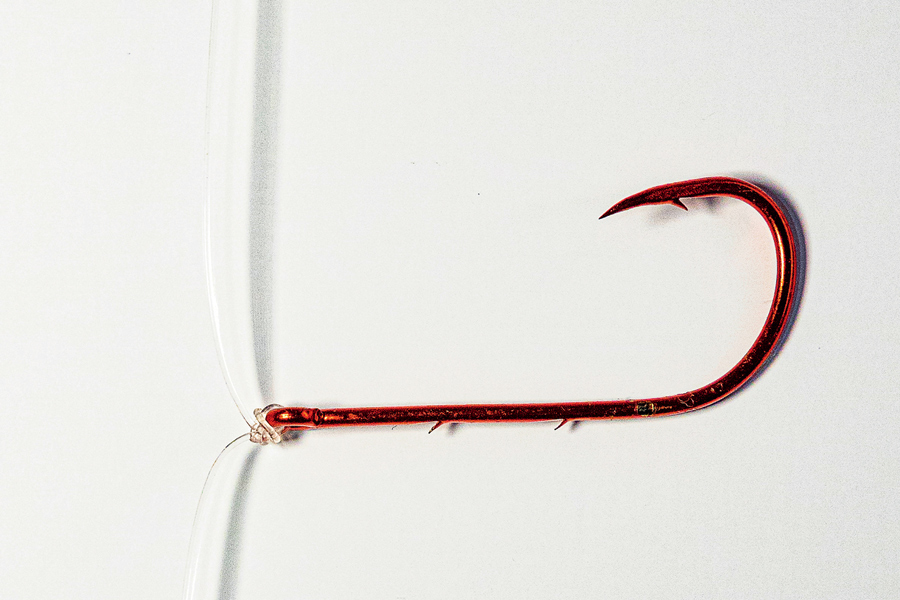
A palomar knot is used to attached the hook when rigging up drop shot style.
Elevator Rig
Originally known as the Captain’s Rig (coined by Michael Guest in honour of the man that pioneered it, Aussie angler Mark ‘Captain’ Phillips), this rig has two unique properties.
Firstly, and most importantly, it separates the weight from the hook and therefore prevents lateral water-resistance as it’s dropping. This is key to getting soft-baits down deep, quickly. A standard jighead will start to flatten out in profile, creating considerable water resistance the deeper you go.
Secondly, the weight is connected via a split ring and can be changed out to almost any weight you like (think 1oz to 12oz). So, it’s very handy for fast, deep drops – hence the name Elevator Rig!
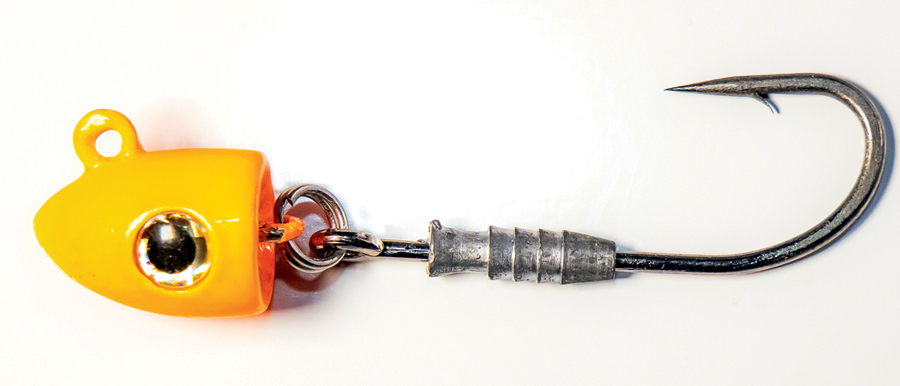
The elevator rig is ideal for deep water situations. The weight can be changed quickly with pair of split ring pliers.
Jighead Shapes
Before you all get your knickers in a knot, I thought this to be a poignant time to run you through something that is not talked about much but is a necessary discussion point. Yes, there are different shapes of jigheads. The reason: you can’t go around copying everyone else’s design! So, they make them all look different. That’s where the rubber comes right off the road and flies over the cliff (if you get my janky metaphor)!
The thing is, if you’re going to design something different, you need a point of difference – right? The bottom line is that all these dozens of different shapes don’t do a thing to change the way your soft-bait swims. “Yeah, but what about the?” No! No! NO! Just no. This a simple case of don’t believe everything you read. Only approx. 10% of the world’s jig heads can make your soft-bait act differently in the water and 9% of them make it stand up off the bottom.
That being said (here comes the disclaimer), all jigheads look different and therefore should have different hydrodynamics – and they do. But as soon as you put a soft-bait behind them, the soft-bait becomes 95% of the hydrodynamic surface and takes control of the swimming action.
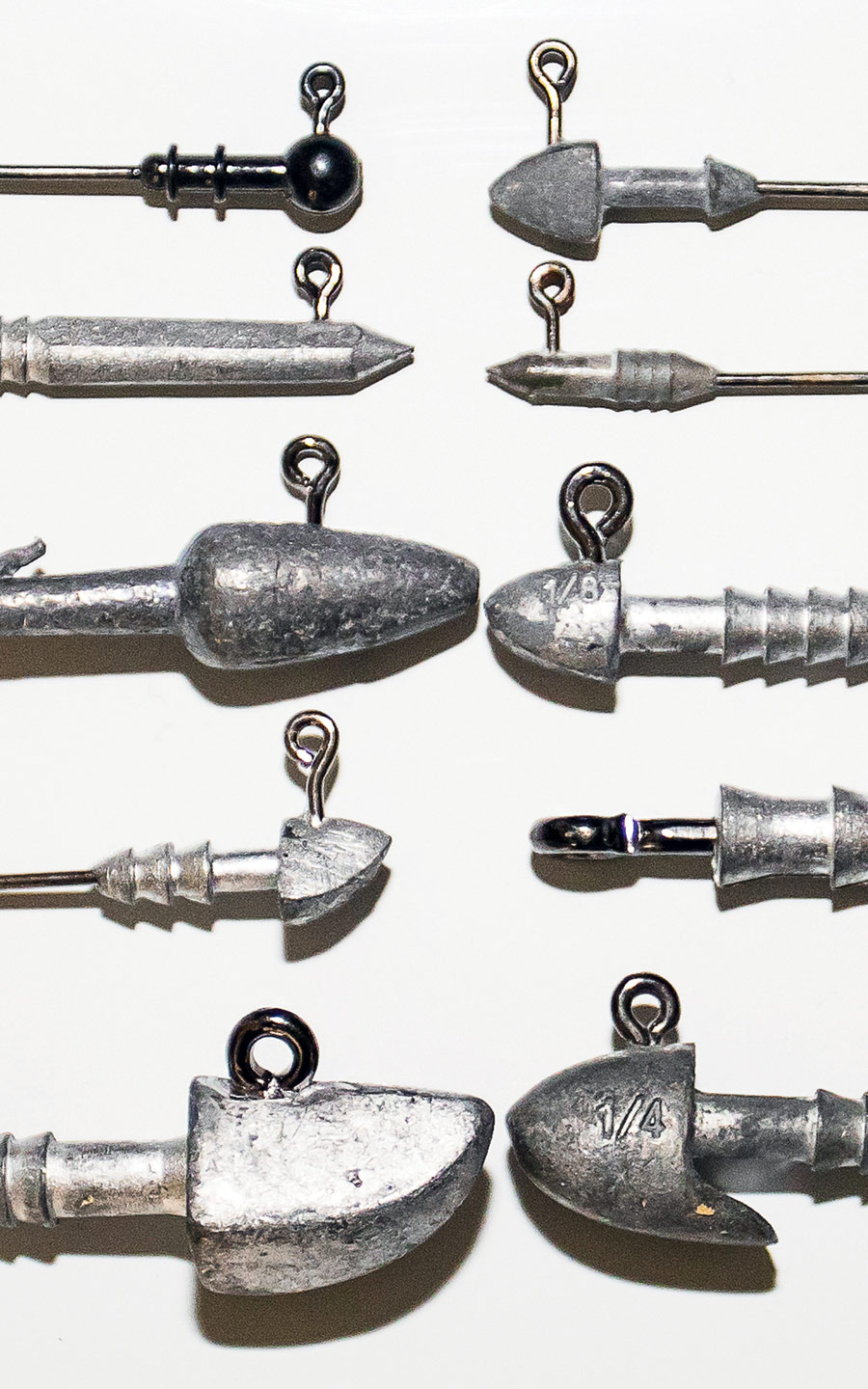
There is no shortage of options when it comes to jigheads.
So, in closing, you are far better off learning to rig your soft-baits properly for correct swimming actions then choosing a different shaped jighead.
Obviously, there are many more rigging styles around the world than the three laid out here. But after fishing these and trying almost all the others, these are the most useable and effective for the types of fishing we have in NZ.
There is plenty of video content available online for all these rigs. Sure, you’ll need to pick your way through them all and in some cases break out the dictionary/thesaurus to work out what is being explained, but it’s worth the effort!

February - 2021 - Adam Royter
New Zealand Fishing News Magazine.
Copyright: NZ Fishing Media Ltd.
Re-publishing elsewhere is prohibited
Fishing Reports Visit Reports
Outer Hauraki Gulf Fishing Report 17/09/26
Spring wind the handbrake. Spring is starting to make its presence felt in the outer... Read More >
Top of the South Fishing Report - 17/09/26
Early snapper in Tasman Bay. Well, spring is finally here, and the days are getting... Read More >
Bream Bay Fishing Report - 17/09/26
Good snapper catches reported. After Tangaroa turned off the fish tap for a month or... Read More >
Bay of Islands Fishing Report - 17/09/26
Pacific bluefin tuna for the lucky few. The last fortnight has seen more fishable days... Read More >



Friday 25 September 2026
Major Bites
 - -
- - Minor Bites
 - -
- - Saturday 26 September 2026
Major Bites
- - Minor Bites
- -
Comments