
Retrieving Lures

As far as Mark Kitteridge is concerned, one of the most attractive aspects of lure-fishing is the need for constant activity. After all, he suggests, if the lure isn’t moving, it’s less likely to look alive and attract predatory attention.
However, this generalisation is only true to a certain extent. Sometimes pauses in the retrieve or periods of lure inactivity can be essential for attracting bites, so many lure-fishing techniques involve this aspect.
To understand why pauses work so well, watch an injured baitfish. Instead of having a relatively steady, regular swimming motion, mortally wounded fish tend to dart erratically forward a bit before slowly falling, perhaps jiggling spasmodically as they do so. To any predator observing such activity, this equates to an easy meal and usually serves to galvanise them into feeding mode.
So how are pauses utilised in some of the more popular lure-fishing techniques? The following are some examples…
Soft-baiting
Soft-baiting can provide the perfect way for anglers to impart various lure actions that attract predatory attention, then entice them into biting. This is particularly true of long, slim soft-baits with limited inherent action, such as jerk shads, with their full potential only being realised if anglers can make them move in a realistic way.
Although they are a bit harder to manipulate effectively, jerk-shad type soft-baits are unbeatable when it comes to imitating ‘dying baitfish’ movements. This is best done with lighter jig-heads around 3/8-5/8oz, and generally involves erratic rod and/or reel winding movements that cause the lure to dart around in short, sharp movements, before the angler abruptly stops winding and drops the rod, enabling the lure to waft slowly downwards.
This lack of movement signals to predators that it’s a good opportunity to bite, so anglers should remain vigilant at this time. Bites can be subtle, with just the line staying slack for longer than it should do, or jerking or jiggling around. At other times there will be no mistaking what’s happened – your rod will wrench down and the reel may start howling!
Pauses also work well when dragging soft-baits along the sea floor behind a drifting boat. Although bites can occur as your soft-baits grub and bounce along the bottom, it definitely pays to occasionally let out a little extra line so your lure is left motionless on the ground; then, as the lure comes tight again and starts to move off, or just a few seconds later, whack – you’re on, so be ready to react!
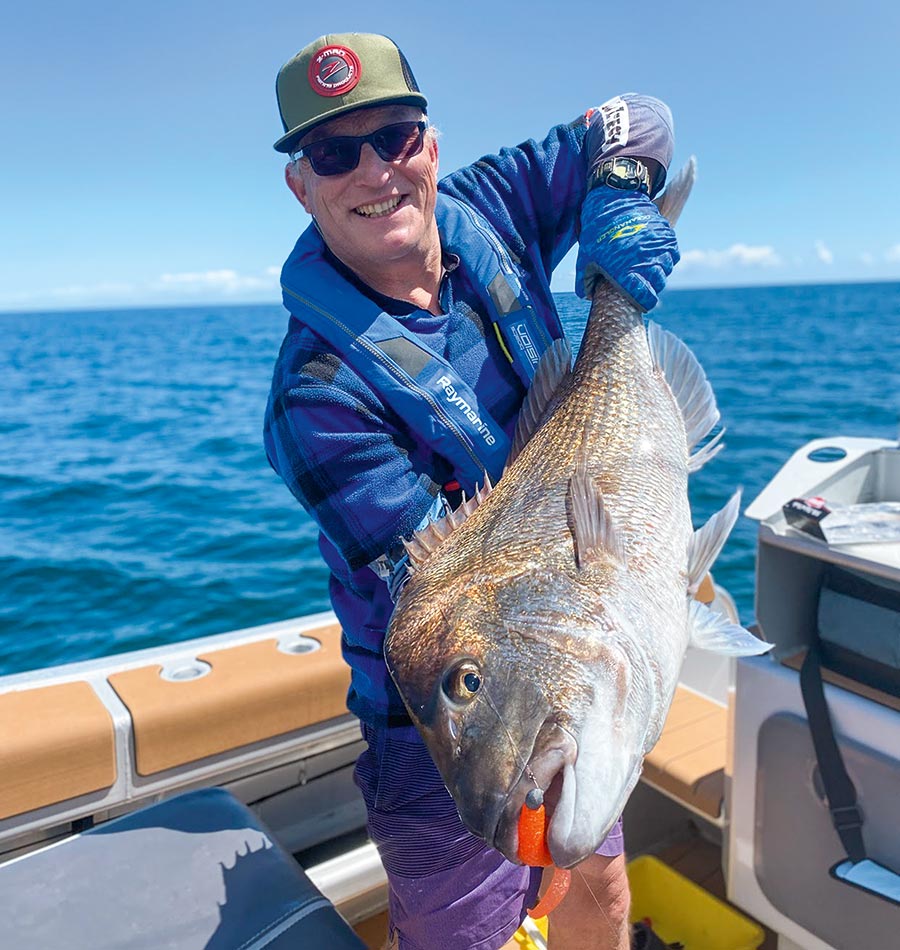
This nice snapper grabbed a Z-Man Doormatador as it slowly descended on a very light jig-head. Sometimes doing nothing is the best course of action!
Stick-baiting
Stick-baiting also hinges on successfully imitating dying baitfish movements. To get this effect, just the right speed and length of rod sweep must be imparted to the stick-bait, followed by a brief pause before making another rod sweep.
Different shapes and brands of stick-baits often require specific movements, so if using an unfamiliar lure, it pays to experiment to see how it responds to various rod actions first. In all cases though, keep your rod angling downwards, which helps the lure to bite into the water and stay under the surface.
Personally, I try to get my lure to splash as it dips below, do a nice flashy wobble as the rod hauls it along, then, while slowly winding my rod back into position out front, have it bob back up to the surface, its nose just protruding. It is generally during this brief period of inactivity that kingfish (or giant trevally or yellowfin!) smash it hard in an explosion of foam!
Popper fishing
Pauses also play a critical role when fishing poppers – noisy blooper/chugger types in particular. These lures usually have a concave face to displace as much water as possible with every firm, sideways rip of the rod, which again is best done with the rod angling downwards so the lure is less likely to fly clear of the water.
The foaming crashes of water produced by these lures imitate aggressive feeding activity, drawing any nearby predators in for a look. Then, upon responding to the dinner gong, they see a motionless, apparently mortally-wounded baitfish sitting amidst still roiling waters. CRASH! The pause has worked again!
However, it can be worthwhile trying out different pause lengths, which are generally created as the angler winds the rod back into the forward position after each rod rip. Sometimes just a brief pause is best – two or three seconds, say – and at others, longer ones work better – up to five or six seconds – with the disturbed water being allowed to settle before another bloop is made.
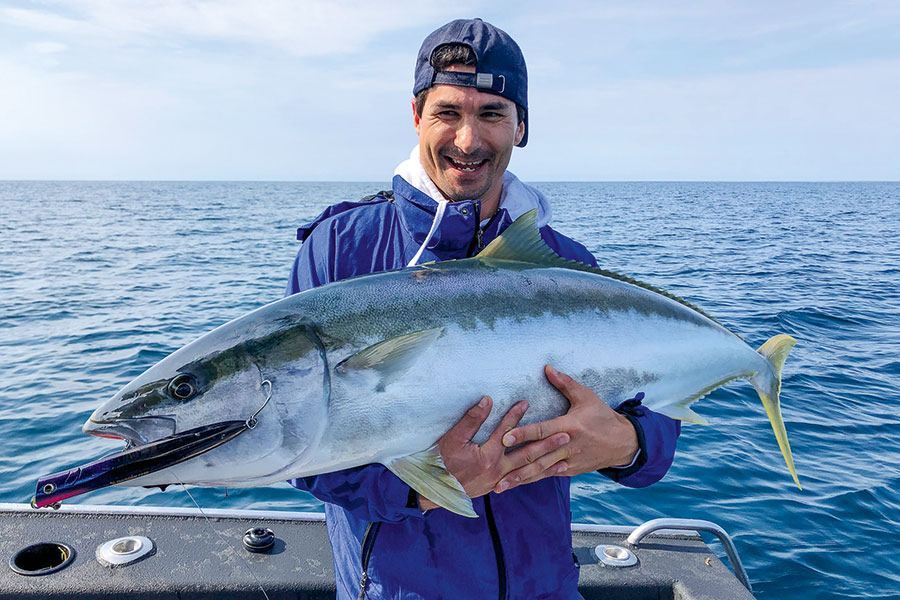
The concave-faced Duckdive poppers splashy retrieve attracted this nice 23kg kingfish in for a look, but it was the pause that proved too hard to resist!
Squid jigging
Squid are surprisingly aggressive predators so they respond in much the same way to the sight of wounded or dying baitfish.
To achieve this effect, squid jigs are typically cast out into sheltered, weedy bays around three to eight metres deep, allowed to sink to the desired depth, and are then brought in with a series of upward angling, successive (typically two to three) whips of the rod, which serve to hop the jig erratically. After each two- to three-whip rod movements, the lure is allowed to naturally descend while the rod is slowly moved back into position. The squid invariably take during this time, so anglers are advised to have a light drag to help avoid the squid-jig’s tines ripping out.

January 2021 - Mark Kitteridge
New Zealand Fishing News Magazine.
Copyright: NZ Fishing Media Ltd.
Re-publishing elsewhere is prohibited
Fishing Reports Visit Reports
Outer Hauraki Gulf Fishing Report 17/09/26
Spring wind the handbrake. Spring is starting to make its presence felt in the outer... Read More >
Top of the South Fishing Report - 17/09/26
Early snapper in Tasman Bay. Well, spring is finally here, and the days are getting... Read More >
Bream Bay Fishing Report - 17/09/26
Good snapper catches reported. After Tangaroa turned off the fish tap for a month or... Read More >
Bay of Islands Fishing Report - 17/09/26
Pacific bluefin tuna for the lucky few. The last fortnight has seen more fishable days... Read More >



Friday 25 September 2026
Major Bites
 - -
- - Minor Bites
 - -
- - Saturday 26 September 2026
Major Bites
- - Minor Bites
- -
Comments