
Releasing fish safely

Successfully releasing fish caught from deeper water and suffering from ‘barotrauma’ is always a challenge.
Consequently, many anglers will keep a ‘blown’ fish they might otherwise release, believing they are unlikely to survive if put back.
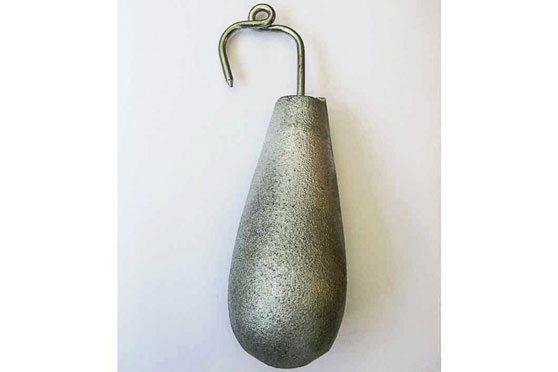 Paul Basten shares those concerns, but rather than always writing off blown fish and keeping them for the table, he has made his own release weight to get the fish back down as safely as possible.
The idea initially stemmed from a brochure put out by the Australian National Sportfishing Association on the subject, and Paul credits this organisation with the simple concept he adopted.
After buying a ‘puka bomb’ weight from his local Hunting and Fishing store, he straightened out a long-shanked hook and screwed it through the hook’s eye, before binding it with some heavy mono to stop any side-to-side movement. Next, a snap swivel was attached to the shank through the weight’s eye so it wouldn’t slide. Finally, the hook’s barb was crushed.
He attached the release device to a handline of 60lb mono clipped to the
snap swivel.
“I release all snapper over 560mm by hooking the device to the fish’s bottom lip before gently feeding it back into the water head first.
“Keeping a little tension on the line, I let the fish take it back down with the help of the weight. Once it is down to 25-plus metres, it will depressurize and easily swim off the barbless hook – or you can just give the line a tug and it will release the hook – hopefully helping to keep another good breeding fish doing what it should be doing.”
The Australian MPI have a very good brochure on a wide range of species and you can download it here, the main two of interest for the NZ fishery are snapper and kingfish.
Snapper
Suitability for catch and release Good.
Main factors that reduced survival Deep hooking and removal, and associated damage and bleeding.
Research
? 48–97% survival over three days, after five angling events in Victoria that used specific hooks and baits.
? Cutting the line on deep-hooked fish increased survival from 0–42% to 44–45%.
? Bleeding and damage to the throat and gills were more evident after deep hooks were removed than when lines were cut.
? 13–77% of deep hooks were shed over three to 61 days.
? Nickel-plated carbon-steel hooks modified with small notches degraded faster and were shed more readily than unmodified designs, or those made from stainless or red-lacquer carbon steel.
? Caught fish held in live wells for 60 minutes became stressed after 30 minutes.
? In NSW, fish caught from water deeper than 10 m often had barotrauma, and the symptoms remained similar among individuals caught from down to 120 m. Fish retrieved from 20 m had barotrauma, but all survived over three days after release.
? In another study in Western Australia, survival decreased from 97% at depths of 5, 15 and 30 m to 31% at 45 and 65 m over one to four days after release.
? A long-term tagging study in Queensland showed no detrimental effects of cutting the line on deep-hooked fish.
Best practices for catch and release
? Remove mouth hooks, and cut the line for deep-hooked fish.
? Use lures or actively fish circle hooks with natural baits to promote mouth hooking. ?? Choose appropriate hook sizes to minimise catches of undersize fish.
? Release fish immediately and avoid holding them in live wells to minimise stress.
? Fish with barotrauma (as indicated by a swollen red anus, stomach everted out of the mouth or bloated abdomen), usually caught from water deeper than 10 m, should be left untreated and immediately released if possible. Alternatively they should be returned to depth with a release weight if they remain floating on the surface, and only vented by an experienced operator if they return to the surface or predators are present.
Further reading and references
Broadhurst M. (2005). The science of releasing fish. Fishing World, February 2005, pp. 52–53.
Broadhurst M.K., Butcher P.A., Hall K.C., Cullis B.R. and McGrath S.P. (2012). Resilience of inshore, juvenile snapper Pagrus auratus to angling and release. Journal of Fish Biology 80: 638–650.
Broadhurst M.K., Gray C.A., Reid D.D., Wooden M.E.L., Young D.J., Haddy J.A. and Damiano C. (2005). Mortality of key fish species released by recreational anglers in an Australian estuary. Journal of Experimental Marine Biology and Ecology 321: 171–179.
Butcher P., Broadhurst M., Hall K. and Brand C. (2010). Barotrauma in snapper. Go Fishing 31, pp. 75–78.
Butcher P.A., Broadhurst M.K., Hall K.C. and Cullis B.R. (2012). Assessing barotrauma among angled snapper (Pagrus auratus) and the utility of release methods. Fisheries Research 127–128: 49–55.
Conron S., Gritxi D. and Morison A. (2004). Assessment of mortality of under-size snapper and black bream caught and released by recreational anglers. Primary Industries Research Victoria, Queenscliffe, Victoria, Australia.
Grixti D., Conron S.D. and Morison A. (2010). Post-release survival of recreationally caught snapper, Pagrus auratus, in Port Phillip Bay, south-eastern Australia. Fisheries Management and Ecology 17: 1–9.
Lenanton R., Wise B., St John J., Keay I. and Gaughan D. (2009). Maximising the survival of released undersize west coast reef fish. Fisheries Research Division, Western Australian Fisheries and Marine Research Laboratories, North Beach, WA, Australia.
McGrath S., Broadhurst M. and Butcher P. (2009). Juvenile snapper: increasing their post-release survival. Go Fishing 23, pp. 74–78.
McGrath S.P., Broadhurst M.K., Butcher P.A. and Cairns S.C. (2011). Fate of three Australian teleosts after ingesting conventional and modified stainless- and carbon-steel hooks. ICES Journal of Marine Science 68: 1–9.
Otway N.M. and Craig J.R. (1993). Effects of hook size on the catches of undersized snapper Pagrus auratus. Marine Ecology Progress Series 93: 9–15.
Pankhurst N.W. and Sharples D.F. (1992). Effects of capture and confinement on plasma cortisol concentrations in the snapper, Pagrus auratus. Australian Journal of Marine and Freshwater Research 43: 345–356.
|
|
Parts of this article are reproduced with permission of |

Fishing Reports Visit Reports
Canterbury Fishing Report - 03/09/26
Whitebait season underway. Spring is here, and along with it, the good old Canterbury nor-Wester!... Read More >
Bream Bay Fishing Report - 03/09/26
Fishing hard, weather conditions trying. Cold winds and lots of rain have made for testing... Read More >
Outer Hauraki Gulf Fishing Report 03/09/26
Workups building as spring approaches. Spring is starting to show its hand in the outer... Read More >
Bay of Islands Fishing Report - 03/09/26
Pacific bluefin tuna return. The day after I submitted the last report, we were out... Read More >


Wednesday 16 September 2026
Major Bites
 - -
- - Minor Bites
 -
-  -
- Thursday 17 September 2026
Major Bites
- - Minor Bites
-
Comments