
Prospecting for Squid
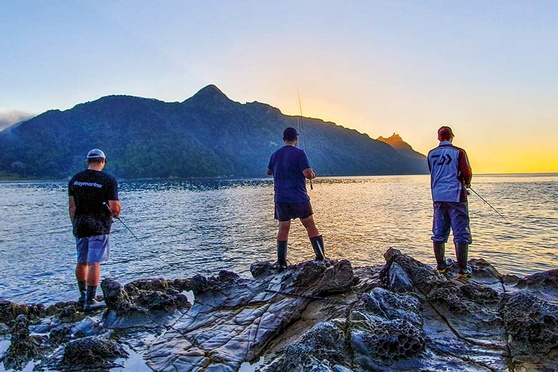
The season is in full swing and the common squid fishing areas are often packed with anglers, but enticing a bite can be difficult when there are more jigs than squid in the water. One way to avoid the crowd and competition is through prospecting new areas, suggest Jun Park, Rudee Lim, Ben Tupaea and Adam King – aka Team Eging for Squid.
Although it requires countless hours of research and casting in order to find the illusive spot x, it can be a game changer to your catch rate when you finally find it.
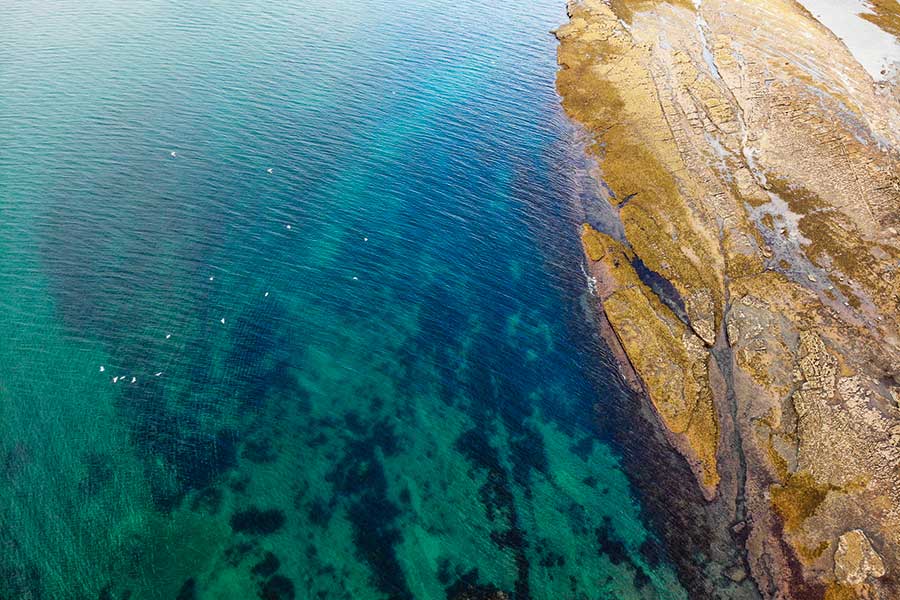
A beautiful ledge with clear water, kelp and rocky structure – all the signs of a promising squid fishing spot. Having access to a drone opens up another way to discover potential spots.
Understanding a squid’s habitat is an important aspect to consider. Generally, they can be found in areas that provide concealment from both predators and prey, which often consists of rocky structure and kelp. Using applications such as Google Maps that provide high quality satellite images can assist with surveying habitable areas for squid. Valuable information, such as the type of terrain and potential obstacles that may be present due to tides and weather conditions, can be derived through this initial survey. But rather than putting all your eggs in one basket, locating several suitable looking spots within an area allows you to cover more ground in a single trip and increases the likelihood of locating squid. Areas like peninsulas, isolated islands and enclosed bays are great to prospect as they offer a variety of locations to suit different conditions within a small area.
Squid rely on their visual prowess to hunt so it is no surprise that clearer water produces better fishing. Factors such as wind speed, wind direction, swell height and swell period all influence the condition of the water. Thanks to the growing number of weather apps online, it is easy to know the conditions prior to heading out. For us, Windy, SwellMap and Predict Wind provide reliable predictions to make informed decisions about where to hunt squid.
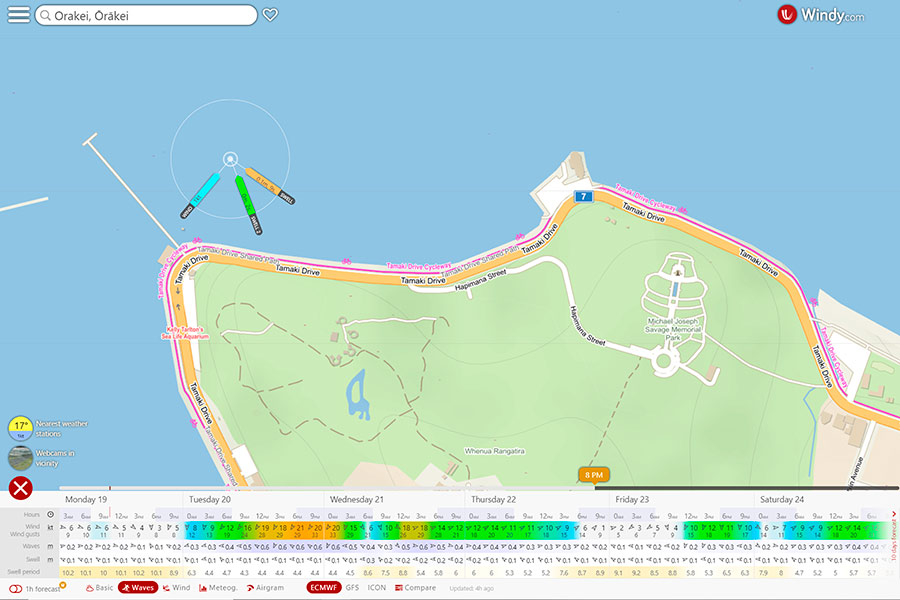 A low offshore wind and small swells are the kind of signs we look for in the Windy App when deciding on the location to fish. The Mission Bay area looks ideal to fish in this condition. Image: Windy.com
What wind works best?
As fishing for broadfin squid primarily takes place on the east coast of New Zealand, westerly or offshore winds offer the best conditions due to the land acting as a windbreaker, providing shelter to the coastal areas where squid inhabit. Conversely, easterly or onshore winds have the opposite effect, but depending on wind strength and location, these can still be fished. Unfortunately, weather predictions do not take the land features into account, and these can influence the wind direction, which can affect the way you intend to fish a spot.
Casting downwind is always favourable and results in a further cast. Casting upwind often requires a larger jig size and can prevent you from reaching the targeted area. Strong crosswinds make fishing very challenging by producing bellies of line, resulting in reduced casting distance and bite detection. A way to mitigate this is to close the bail arm as soon as the jig hits the water after casting, then wind in the slackline while pointing the rod downwards as close to the water as possible to submerge the line. Once the belly is removed, release the bail arm and this will allow the jig sink straight down. Winds less than 10 knots are ideal for fishing, but in some sheltered areas, pleasant fishing conditions can still be found even when it’s blowing up to 20 knots.
Swell is an important consideration when fishing landbased, especially on exposed platforms. As with wind, your ideal swell direction is leeward but the relationship between wind, tide and swell should not be underestimated. Wind blowing in the opposite direction to swell and tide, especially in the direction towards land, results in larger waves that stir the bottom and produce dirty water. For this reason, we look to fish in conditions with swell less than 0.5m and the period over eight seconds, with the wind, tide and swell being as close to the same direction as possible. Otherwise, we opt for locations that are more sheltered. Another factor to consider is freshwater runoff from rain which affects the salinity of the water, as well as visibility. Rain generally pushes squid into deeper water. Generally speaking, it takes about one to two days of offshore winds and swell to clear an area of debris and produce good fishing conditions. It helps to bear this in mind and watch the weather leading up to the planned trip.
Share the load
The often-arduous task of prospecting can be made easier by going with a buddy or as a group as you can cover more ground and work areas thoroughly. We like to stand about three metres apart and cast at different angles to cover as much of the section as possible before moving further down and trying a new spot. Make sure everyone is using jigs in different colours and sizes to ensure even the picky squid will be enticed. If you are casting into what you believe is six metres of water with a size 3.0 squid jig that sinks at three seconds per metre, you will need to wait 18 seconds to ensure you are on the bottom before beginning your prospect.
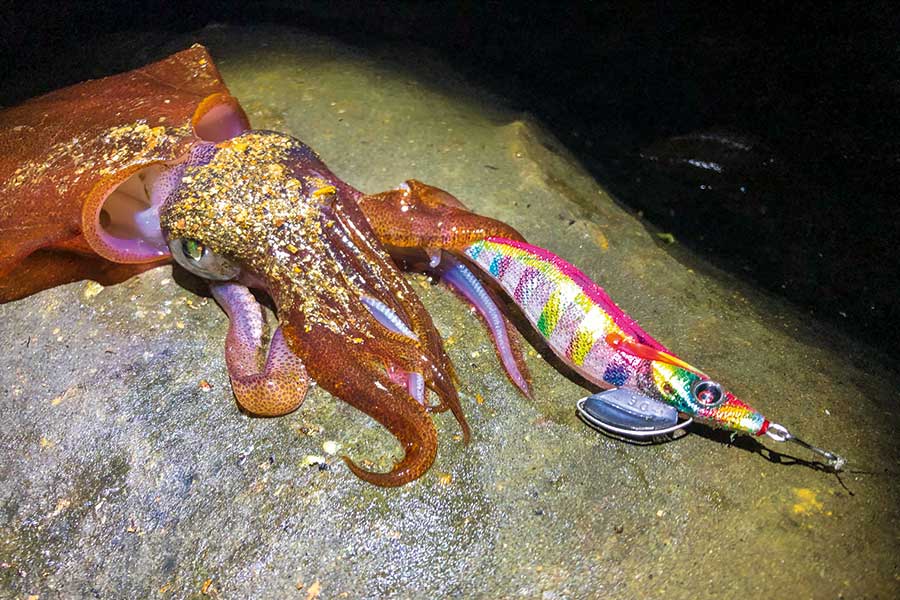
This ledge had all the signs of a promising squid fishing spot with lots of kelp and rocky structure. The spot wasn't productive during the day, but it came to life at night!
If you feel the jig is hitting the ground/kelp earlier, then you will need to reduce the wait time to be in the strike zone. Once we find a spot that holds squid, we will focus our attention there and swap to a jig of a particular colour or foil that is performing. Following a systematic process can greatly help in reducing the variables that lead to unfavourable results.
We hope this article helps you find your spot x and the ideal fishing conditions on a regular basis. The satisfaction of catching squid in a new location is worth every drop of sweat.
Squid Prospecting Tips
Because the behavioural patterns of squid can vary between different locations, to thoroughly prospect an area, we recommend:
• Fishing all tides: High, mid and low in both incoming and outgoing
• Fishing at all times: Dusk, dawn, night, day, overcast and sunny
• Using a variety of different jig colours, foils and sizes
• Using a variety of different techniques
• Targeting all depths of the water column

June 2021 - Jun Park, Rudee Lim, Ben Tupaea & Adam King
New Zealand Fishing News Magazine.
Copyright: NZ Fishing Media Ltd.
Re-publishing elsewhere is prohibited
Fishing Reports Visit Reports
Outer Hauraki Gulf Fishing Report 17/09/26
Spring wind the handbrake. Spring is starting to make its presence felt in the outer... Read More >
Top of the South Fishing Report - 17/09/26
Early snapper in Tasman Bay. Well, spring is finally here, and the days are getting... Read More >
Bream Bay Fishing Report - 17/09/26
Good snapper catches reported. After Tangaroa turned off the fish tap for a month or... Read More >
Bay of Islands Fishing Report - 17/09/26
Pacific bluefin tuna for the lucky few. The last fortnight has seen more fishable days... Read More >


Friday 25 September 2026
Major Bites
 - -
- - Minor Bites
 - -
- - Saturday 26 September 2026
Major Bites
- - Minor Bites
- -
Comments