
Preparing for IGFA angling
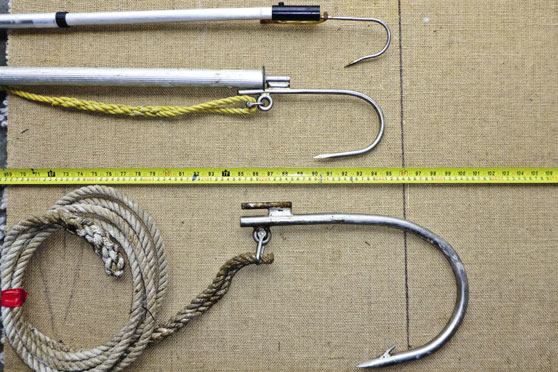
Preparing for angling IGFA style
Check the overall length of flying gaff heads and ropes.
IGFA representative Scott Tindale, a life member and recipient of the IGFA Life Time Achievement Award, offers some advice in preparing to take on the big ones according to the internationally recognized set of rules….
Looking out a window buffeted by gale force winds and torrential rain, one could easily doubt summer is actually here. But it is, and the warmer weather signals it’s time to get organised, because the game fishing season is upon us.
For most fishing clubs the end-of-season prize-giving and the AGM have been held, and newly-appointed committees are busy organising upcoming tournaments, indicating to the members it’s time to organise crews, decide on which tournaments to fish, and when to take time off work.
Out at the marinas the hard stands start to come alive, with workers busy antifouling and everyone rushing to get their boats shipshape before the Christmas rush.
Across town the tackle stores start to get busy restocking shelves with the new season’s offerings, while out the back the maintenance departments wade their way through the collections of customers’ reels needing servicing and new line.
For the big game fishermen it’s also time to blow the dust off the heavy stuff back home. It all needs checking for wear and tear in preparedness for ensuing battles.
For tackle junkies it’s a fun time, too. All those lures packed away last winter are pulled from hiding places, with anglers acting like children opening presents on Christmas day. Each lure has a story, with favourites sporting battle scars that revive memories of that one that got away, or perhaps the one that didn’t!
What lures were other successful anglers using last season, and do you have any of your own – just in case? Questions like these buzz around in your head while pondering the tackle selection in front of you.
For the big game fisherman every part of the gear has to be in top condition. Not only that, for many anglers it’s also just as important that it all complies with International Game Fish Association (IGFA) regulations. Whether you are aiming to fish tournaments, achieve national honours or possibly land a record, prepping for the game-fishing season requires attention to detail and knowledge of the basic IGFA rules.
IGFA rules cover every aspect of the catch (not just the fish itself), from the equipment used to who’s involved, how it’s done, and even how the fish is processed. Where and when a fish is caught are also covered. Reading up on the rules is important, but most of the issues overlooked by anglers can be addressed by simple preparation: arm yourself with a tape measure, masking tape, and a pen.
Let’s start with lines. There is actually no such thing as ‘IGFA-rated’ line. Manufacturers may make this claim, but it only means that they claim their line will not break over the specified IGFA line class. Generally this will be the case, but there are no guarantees. Having said that, an ‘IGFA-rated’ line is still the preferred type of line among sport fishers.
If you decide to add extra new line to your reel – top-shotting monofilament over braid or Dacron for example – be aware the line class will be determined by the higher-testing breaking strain of the two. Most polyethylene braided lines have the disadvantage of over-testing, so if you have access to a line tester at a club or tackle store, it would be advantageous to check any line before using it.
Unfortunately, you will not be able to pretest line in advance for records, as line samples off the reel you actually used will be required. However, by pretesting the line, you will have the peace of mind you’re fishing as close to the line class as possible. Note that any line testing over 60kg (the maximum IGFA line class) will disqualify your catch.
I like to label each reel with the line brand and stated line class. This is handy during the Nationals and critical should you come across an opportunity to target a line-class record.
Next thing to look at is the terminal tackle. Many competition fish and potential records are disqualified because the leader is over-length. Unfamiliar gear, swopping lures around during the day, and adding bling such as teasers, are just some of the reasons an over-length trace may be presented.
Wind-on leaders would be the biggest culprit. Remember you still have to add the lure and hook assembly, which adds to the overall trace length.
Whether traces are shop supplied or homemade, you will often have to cut them to suit your requirements. Measure everything to make sure the trace and double combination maximums for the line division you intend fishing are not exceeded. These vary depending on whether you are fishing line classes up to and including 10kg, or heavier. Again, I like to label each trace with its overall length. This makes the job easier to ensure the final assembly complies.
Note, too, that it pays to keep the final assembly well below the maximum allowable length to allow for possible knot slippage, line stretch or slight brain failure.
There are a few things to watch out for when setting up big game lures and baits. Most sport fishers carry game lures pre-rigged and ready to deploy. Some have removable hooks, making lures easier to store, while others leave the hook attached. On occasion this has caused some embarrassment after failing to attach the hook(s) or having left the safety corks on the hook points!
Mistakes like those mentioned are funny and make for a great story, but having a record disqualified because the hook’s eye extends out past the lure skirt is less humorous. Whether you use single- or double-hook combinations, compliant rigging options can be found in the IGFA illustrated guide to hook regulations for natural baits and artificial lures.
Another area frequently overlooked is the collection of gaffs, landing nets and tail ropes. Flying-gaff heads come in all sizes. Measure each one while assembled on the pole to ensure it is less than 2.44m (eight-feet) long. Not all parts are manufactured the same. Ropes may have been replaced – again, check the measurements are less than 9.15m (30 feet). Same goes for tail ropes: don’t use the anchor rope as a tail rope, as it will almost certainly be well over length (see opening photo).
The last thing to get ready is a copy of the IGFA Angling Rules for Saltwater, Freshwater and Fly Fishing. It is available online at www.IGFA.org and from fishing clubs.
Make a point of getting all of your crew to read it. There are strict rules relating specifically to each person involved in the catch. Deckhands are renowned for handling the rod after the strike and adjusting an angler’s reel for them, which disqualifies a potential record. It would be a shame to throw someone over the side following a fantastic catch!
|
|
This article is reproduced with permission of |

Fishing Reports Visit Reports
Outer Hauraki Gulf Fishing Report 17/09/26
Spring wind the handbrake. Spring is starting to make its presence felt in the outer... Read More >
Top of the South Fishing Report - 17/09/26
Early snapper in Tasman Bay. Well, spring is finally here, and the days are getting... Read More >
Bream Bay Fishing Report - 17/09/26
Good snapper catches reported. After Tangaroa turned off the fish tap for a month or... Read More >
Bay of Islands Fishing Report - 17/09/26
Pacific bluefin tuna for the lucky few. The last fortnight has seen more fishable days... Read More >


Friday 25 September 2026
Major Bites
 - -
- - Minor Bites
 - -
- - Saturday 26 September 2026
Major Bites
- - Minor Bites
- -
Comments