
Paddle crabs for bait
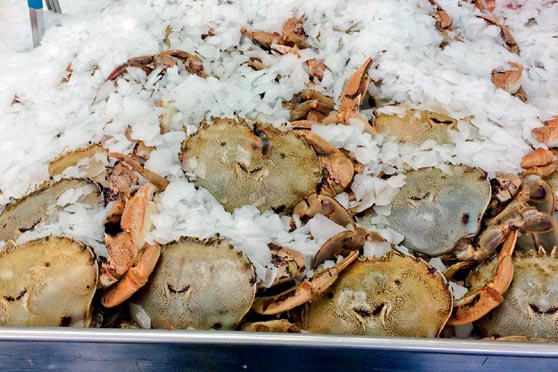
In previous articles I’ve touched on the virtues of using paddle crabs as surfcasting bait. Last weekend I was reminded of this in no uncertain terms, to the extent I feel compelled to devote a
whole article to paddle crabs and just why they make such fine baits.
Paddle crabs are a key part of the bait arsenal for Wellington based surfcasters, simply because they are second-to-none in their effectiveness on spotty sharks – and at certain times of the year, in
certain conditions, that’s the best we can hope for. However, their usefulness goes way beyond catching sharks, in ways that I never would have imagined when I started using them.
Paddles are also effective on several of our most desirable surfcasting species, including snapper, trevally, moki, gurnard and elephantfish (as well as spotty sharks, of course). Even better, it is
not that attractive to a number of ‘nuisance’ species such as red cod, small sharks such as spiny dogfish, rays, and, occasionally, even kahawai. This is hugely beneficial in locations where nuisance
species are present in big numbers and are the biggest barrier to success. Constantly retrieving and returning non-target species can be a huge time waster for surfcasters, where the difference
between success and failure is often defined by catching just one of the target species in many hours of fishing. With this in mind, it’s nice to have likely baits in the water for as long as possible. We all know the olfactory value of oily fish baits, but they also attract just about every fish in the sea.
Even highly regarded surfcasting baits such as mussel and crayfish attract trouble. Mussel is dynamite moki bait, but also highly attractive to red cod and small picker fish such as spotties and banded wrasse, which hit baits mercilessly and lead to lots of wasted time spent winding in and re-baiting.
Although crayfish is regarded by many as the number one surfcasting bait and has similar texture and flavour characteristics to paddle crab (also a crustacean of course), for some reason it
attracts more nuisance species: spiny dogfish, carpet shark and red cod to name a few.
To demonstrate how this works in practise, I recently returned from a day’s surfcasting in Palliser Bay, South Wairarapa. The bay fishes well for moki and elephantfish in early summer, so Tony Stenhouse and I headed over the Rimutaka summit from Wellington to taste some of the action. Palliser Bay is a prolific fishery, but surfcasters are often plagued by red cod and spiny dogfish whilst trying to catch more desirable species.
The conditions were excellent for surfcasting: flat seas with a blustery northerly at our backs, so hopes were high as we started casting out paddle crab baits in the afternoon. For the first two
hours or so we didn’t experience a single bite, whilst anglers down the beach from us caught red cod after red cod on squid and fish baits.
I remarked to Tony that I was quite happy catching nothing because the conditions looked good for our target species, and the longer our baits soaked untouched the better I rated our chances
of catching the fish species we wanted. He looked at me with a knowing smile – we might catch what we are after, or we could strike out altogether!
The next two hours were also pretty uneventful, except I caught a moderate-sized moki, a customary Wairarapa catch on paddle crab for this time of year in the conditions we were fishing. But after that our baits again sat untouched for some time, even though the anglers down the beach seemed to be busier than ever on those pesky red cod.
The sun dipped below the horizon of the Rimutaka Forest Park to the west and still everything was quiet. We started musing whether one moki was going to be the sum of our efforts – then Tony’s
rod went horizontal in its beach spike to a big fish. A spirited fight ensued, and although we hadn’t caught any earlier, we were convinced it had to be a decent spotty shark. However, instead a
large silvery elephantfish appeared in the wave in front of us. Tony guided it in and next moment, there it was, target species number two – and not a bad one either, in excess of 7kg. Paddle crab baits had struck again.

For good measure, a handful of moki rolled in immediately thereafter, before all went quiet again. Time to jump into the truck for the hour-and-a-half return journey to Wellington.
It had been a session with long lean spells and a short spike in activity that brought home the bacon. If we’d been using fish baits, that short spike (probably no longer than 30-45 minutes) may have been wasted winding in and untangling spiny dogfish and red cod. As it was, paddle crab bait enabled us to be more targeted and effective in our approach.

I always like to have a stash of paddle crabs in my freezer for occasions like that one. Usually I catch my own, which is simple enough using the basic crab pots widely available in retail stores.
The round pots – ‘opera pots’ – are similarly effective. Just tie an old fish frame into it, weigh it down with a rock, and wade it out over sandy or muddy bottoms.
Paddle crabs are common right around our coastline, though I find they are generally more prolific on sandy beaches on the open coast. They are best used fresh, but can be frozen for about
a month before they start to spoil. Keep them well wrapped to minimise freezer burn.
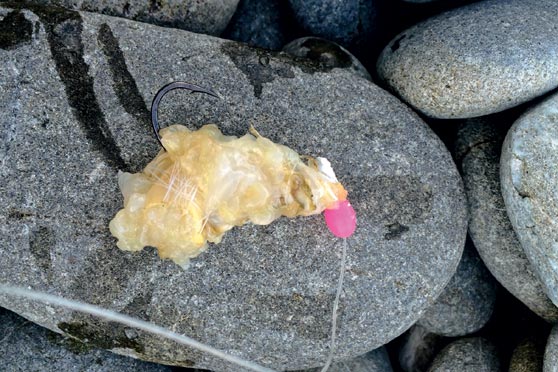
I prefer crabs about the diameter of a water cracker, which I cut in half to make two nicely sized baits. Next, I remove the legs and back shell, and thread the hook through the hard underbelly
before binding on with bait elastic. Smaller crabs (about the size of a 50-cent piece) can be used for single baits, whilst larger ones (up to the size of an adult’s hand) can be cut up into several baits.
Every now and then you will see them in fish shops, but they tend to be the larger specimens suitable for dinner.
I’ve noticed paddle crabs are less popular with surfcasters in northern parts of the North Island, and in fairness there are times when they don’t offer any advantages over more traditional baits
when targeting snapper in that neck of the woods. However, when kahawai and eagle rays are thick, especially in summer, crab can make all the difference. In the Far North I’ve employed it in this very scenario and experienced some epic snapper sessions.
|
|
This article is reproduced with permission of |

Fishing Reports Visit Reports
Raglan Fishing Report - 12/11/26
Big spring snapper. With the more settled weather over the last couple of weeks there’s... Read More >
Mercury Bay Fishing Report - 12/11/26
Snapper hit and miss. Most reports have been telling us it’s becoming more difficult to... Read More >
Northland Fishing Report - 12/11/26
The switch has been flicked on! Call it what you want, El Niño, global warming,... Read More >
Tauranga Fishing Report - 12/11/26
Snapper and kahawai in close. Again, we start on a positive note, with some nice... Read More >


Monday 16 November 2026
Major Bites
 -
 -
Minor Bites
 - -
Tuesday 17 November 2026
Major Bites
- - Minor Bites
- -
Comments