
Micro Slow Jigging
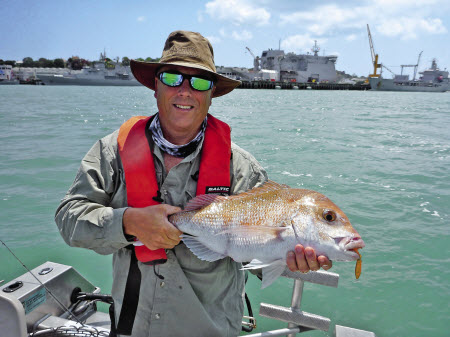 Like most fishing innovations, slow-jigging took a while to catch on in New Zealand, but in the summer just gone, slow-jigs seemed to be everywhere.
Most slow-jig fishing seems to takes place in 20 metres of water or deeper using jigs weighing up to 200g. This fishing technique is proving deadly on schooling snapper out in the deeper parts of the Hauraki Gulf and elsewhere around the country However, slow-jigs, particularly inchiku jigs, have applications beyond fishing in open water.
Light tackle fishing
For quite a few seasons now I’ve enjoyed success with small inchiku jigs in shallow bays, harbour channels and inshore margins over a variety of bottom types. It’s a technique that works well on snapper, but also takes other species, including trevally, kingfish, gurnard and kahawai.
While most conventional slow-jig tackle is designed for jigs weighing 60g and more, the sort of gear I’m using for inshore slow jigging is much lighter. The fishing style is more properly called ‘lure fishing’, because the same gear is used to cast a variety of small hard-bodied lures, including lightly weighted soft-plastics.
Indeed, my use of small inchiku jigs grew out of the success I was enjoying using small (3 to 4-inch), lightly weighted soft-plastics in the shallows. It was a small step to tie on a 10g Power Jig Rock-G Jig instead of a 1/8oz jig head and plastic bait.
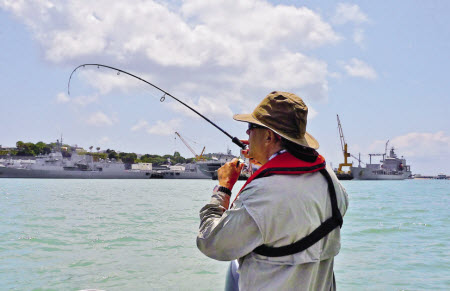
In really shallow water I fish small inchikus in much the same way as soft-plastics: I cast ahead of the drifting boat and slowly retrieve the lure using lifts and drops of the rod tip. As a rule I fish rather more slowly and gently than I would with soft-baits – they’re not called slow-jigs for nothing – but it’s a fairly similar technique.
When I’m fishing over a clean bottom, I allow the lure to touch down regularly, producing little puffs of sediment; fishing over kelp and reef, I retrieve a little faster to keep the jig from snagging the bottom.
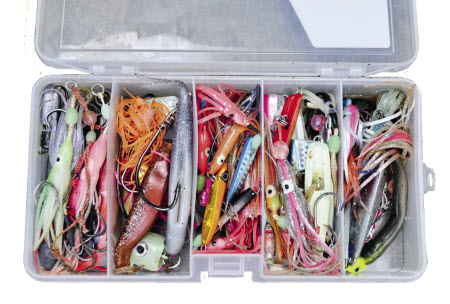 By small inchikus, I mean jigs weighing less than 20g, which is the smallest jig in the Daiwa Pirates range. I use Pirates, Power Jig Rock-G jigs and other inchikus sourced from specialist lure-fishing outlets like Auckland’s Go Fish, Hunts Sports and Yeehaa Tackle.
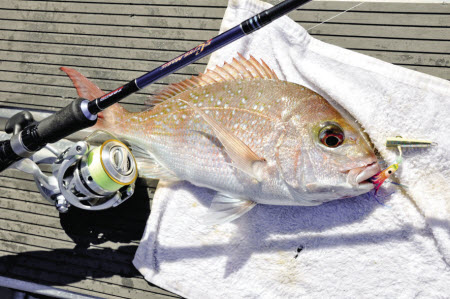
The tackle I use is lighter than my usual soft-plastics gear, and my favourite rod is longer, too. At 7ft 6in (2.3m), this rod is a designated ‘lure rod’ made in Taiwan for just this style of fishing. In many parts of Asia, casting small inchiku-style jigs from the shore (‘shore jigging’) or from a boat is extremely popular.
The pure graphite Power Jig rod I use is reasonably stiff right through to the tip. The taper gives it a parabolic curve under load and it can cast lures as light as a few grams. I match it with a small spinning reel (2500 size, but even smaller would be fun) spooled with 2-4kg superbraid line. As with soft-plastics fishing, a bright, visible line is an advantage for detecting bites. Trace is 5-7kg nylon or fluorocarbon.
Of course you don’t need a special rod to fish small inchikus – any light spin stick able to cast light lures a useful distance (or even an overhead outfit) will work. I’m using a squid (Egi) rod and a two-piece Daiwa 3-5kg spin rod to serve duty as lightweight inchiku rods.
These two rods have quite different actions, both compared to each other and to the ‘lure rod’. They are less stiff (softer) through to the tip, with more power in the butt than my lure rod, so less forgiving when a fish is hooked. If I’m not gentle I tend to tear small hooks free or bend them straight, so light drag settings are mandatory, but used with care these rods do the job perfectly well.
Cast and retrieve
 Unlike deepwater inchiku fishing, where it is simply a matter of lowering the lure to the bottom, jiggling it about a bit and then slowly retrieving it towards the surface (there’s more to it than that, of course – see Paul Senior’s article – but you get the idea), fishing inchiku lures in the shallows requires different strategies and a bit more input from the angler.
First off, I like to fish small inchikus right up into the margins where the water may be only a few metres deep. There isn’t much value in a vertical retrieve in such locations. As the water becomes deeper, the vertical component of the retrieve becomes more important, particularly the first metre or two after the lure lifts off the bottom, but for much of the fishing retrieve in shallow water the lure is bouncing along or planing just above the bottom on the horizontal plane.
As is the case when soft-baiting, many of the bites come as the inchiku is falling towards the bottom, either immediately after the cast or after lifting the rod tip to ‘hop’ the lure. These bites can be hard to detect, so you need to be alert to any movement or sudden slackness in the line. Lift the rod gently, but firmly, if you suspect a bite.
At other times, a fish will pick up the lure on the bottom and the bite will register as weight when you lift the rod tip.
Another typical bite – and more like the bites you get on inchiku jigs in deeper water – is the one that comes after you lift off the bottom, either to hop the lure or wind it back to the boat. These feel like taps or nibbles, and your best response is to keep on drawing the lure away with the rod (and reel if necessary). Fish generally hook themselves.
Where the bottom is clean, it’s possible to drag small inchikus behind the drifting boat, twitching them occasionally to hop along the bottom. Obviously with such lightweight lures, this is only practical in the right conditions: shallow water and/or little wind.
Because of the lures’ small size, many of the snapper and other fish hooked are also small, but even 7-10g inchikus appeal to a wide range of fish sizes. They hook big snapper, too – sometimes bigger than either your tackle or your angling skills can manage.
Easy does it
In Asia, similarly small lures are used to catch different species of often-smaller fish, so they are equipped with relatively tiny hooks that even modest snapper can break or bend. The assist cords can also snap.
One solution is to upgrade the hooks. Larger hooks and corresponding skirts can even make a small inchiku more attractive, giving it a larger profile, but don’t overdo it or the lure won’t behave properly. Usually, simply replacing the originals with a heavier gauge hooks and thicker assist cord is all that’s required.
Even if using upgraded hardware, learn to play hooked fish gently. Small inchikus are not good for horsing fish out of heavy cover. Use a light drag and a flexible rod to coax fish to the boat. I’ve been surprised at the quality of fish I’ve landed in ugly country using light drag settings – snapper seem to swim around rather than diving for cover as they do on a heavy drag.
Deeper water, too
 While I’ve mostly used small inchiku jigs in water less than 10 metres deep, lately I’ve been playing around with them in deeper water up to 25m. When conditions are right, it’s still possible to fish them effectively, though I tend to use the heavier 15-20g models.
Once again, I prefer to cast the lures away from the boat in the direction of the vessel’s drift. Because the water is deeper, the angle of the line is much closer to 90° by the time the jig touches the bottom, so the initial retrieve is less important, while what you do with the lure as the boat passes over it and after it ends up behind the boat is more important.
After the initial cast, bites on the drop are still significant, but most hook-ups come when the lure is close to the boat and you are fishing almost straight up and down. Slowly lifting the lure a couple of metres off the bottom is very effective – the longer lure rod is useful here – before dropping it back again and releasing line as you do so to compensate for the boat’s drift. Be alert for bites as the lure falls.
As you draw the lure up through the water with the rod, bites may be felt as a series of taps or nibbles. When you feel these bites, keep pulling steadily away, using the reel if need be, until the fish comes up tight.
Every once in a while, mix things up by slowly winding the small inchiku some way off the bottom, instead of just lifting it. This ploy will often result in a strike.
Because the lures are small, bites tend to be more positive than on larger inchikus, with snapper and other fish engulfing the whole lure rather than biting at the skirt. The softer tips of my rods are actually useful for this more up-and-down style of lure fishing, providing a bit of give so a fish can turn when it bites the lure. However, without the lure rod’s extra length, I often find myself also winding the reel handle rather than just lifting my rod arm.
Once the line starts to angle away from the boat and it becomes difficult to maintain contact with the bottom, begin a slow (really slow) retrieve and maintain it most of the way to the boat. Snapper will follow the lure a long way off the bottom and there may well be fish in mid-water.
Mr Consistency
Small inchiku jigs were amazingly consistent fish takers through spring and into summer this season, not just in shallow water, but in deeper water, too. I’ve used them with success in 20 metres of water and more, in harbour channels, as well as in open water. I’ve also taken lots of good-sized snapper in a few metres of water over sand, rock, reef and kelp.
Provided conditions allow these small lures to get to the bottom, they’ll take fish, and in many situations their smaller sizes have proved more attractive than larger inchiku jigs or soft-plastics, although they do demand a little more finesse from the angler. It’s well worth the effort.
 |
This article is reproduced with express permission of
written by John Eichelsheim - 2013 Originally published in New Zealand Fishing News ----- Advertisement -----
|
Fishing Reports Visit Reports
Outer Hauraki Gulf Fishing Report 17/09/26
Spring wind the handbrake. Spring is starting to make its presence felt in the outer... Read More >
Top of the South Fishing Report - 17/09/26
Early snapper in Tasman Bay. Well, spring is finally here, and the days are getting... Read More >
Bream Bay Fishing Report - 17/09/26
Good snapper catches reported. After Tangaroa turned off the fish tap for a month or... Read More >
Bay of Islands Fishing Report - 17/09/26
Pacific bluefin tuna for the lucky few. The last fortnight has seen more fishable days... Read More >


Friday 25 September 2026
Major Bites
 - -
- - Minor Bites
 - -
- - Saturday 26 September 2026
Major Bites
- - Minor Bites
- -
Comments