
Micro-jigging explained pt 1

Yes, we are familiar with the individual tackle components, but as a fishing system, it’s not quite on our radars – in the same way soft-baiting wasn’t understood 20 years ago. We knew it existed, we just didn't know what to do with it!
Now jigging is back and it looks as though this time it might stay long enough to be worth closer examination. Come for a wander down memory lane and learn about something old, something new and something yet to be discovered.
Jigging is one of the oldest forms of fishing with a lure. Shiny chunks of steel with hooks, dropped into holes cut in ice – wiggle, wiggle, wind fish in, then eat. Simple!
Fishing tackle has progressed somewhat in the last 100 years or so but the humble jig hasn't really changed that much in that time. Is that why we ran out of love for it, because it was still just a chunk of steel with a hook?
From the days of the Grim Reaper jig some 30-odd years ago to today, we lost a lot of love for smaller jigs. So, what happened? Why didn't we continue with the pursuit of light to medium jigging glory? Thirty years ago it was snapper after snapper on those Grim Reaper jigs and then the ball was dropped.
For me, it was simply that we weren’t ready for it yet, just like soft baits 40 years ago. We were just not up to speed enough with the finesse of it all.
But now it seems that suddenly we’re ready to step up to this style of jigging. So what’s all the buzz about these ‘micro’ jigs?
Why jigs?
Surely the soft baits we use these days and the techniques we implement to fish them, can knock the pants off a chunk of metal? Yes, in part, but jigs have a range of other abilities that soft baits can’t match, and this is where the big differences lie.
Weight– First and foremost, jigs sink faster than soft baits, dead baits, flies or hard bodies. They are the fastest sinking lure an angler can use. This is a great win for an angler. Getting your lure to the fish fast, is like the difference between running and crawling – you’ll get there crawling, but you’ll get there faster if you run! Being in the strike zone for more of the time basically equates to catching more fish. It’s simple arithmetic.
That said, don't throw all your soft baits out the window just yet. There are plenty of reasons why you need to keep them.
Jigging isn't the new ‘silver bullet’ to kill every fish swimming. It has limitations, particularly in shallow water. In the big scheme of things, you need at least five metres of water under you, ‘or’ to be fishing in at least one knot of current kit the water is shallow to get the value out of the jigs you’re fishing.
Soft baits in this shallow environment are perfect. That’s why we still need them. Jigs, however, are the new wave of tackle that will effectively fish deeper water more successfully than anything else. The difference is chalk and cheese!
The mainstream model categorises micro jigging as fishing with jig weights from one gram (yes, I said one gram) to 150 grams. I think that’s a little bit of a stretch for most people, so I’ve shortened up the goal posts and ranged it from five grams to 100 grams. That way there’s a defined line between micro-jigging and everything else that’s jigging.
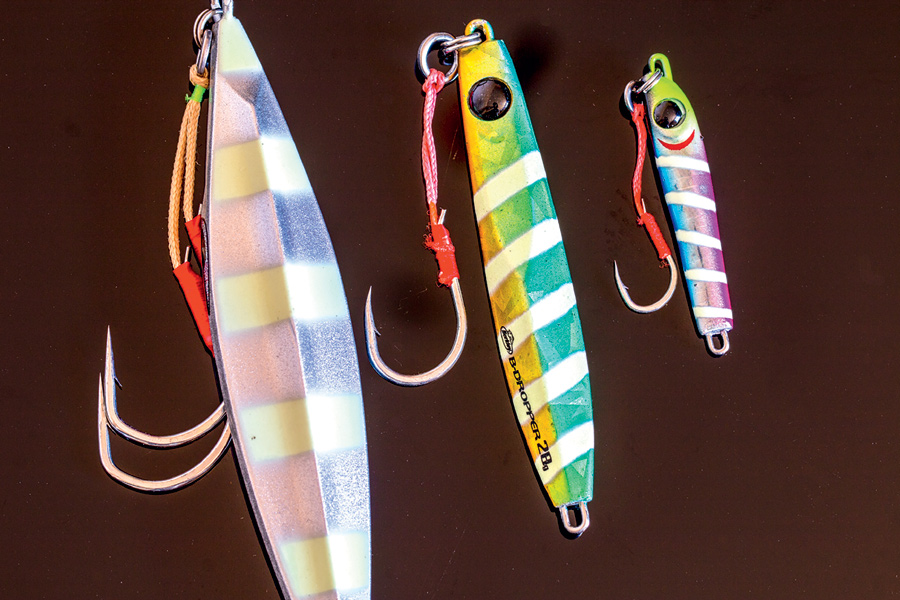
The flash- Not ‘The Flash’ from the 40s DC comic books, but the light refracted from the multiple sides of any jig.
Light refraction is incredibly important in attracting predatory fish. Fish use light in its various wavelengths as visual cues that something is or might be up for grabs in the form of food. This is most evident when you drop your micro-jig overboard into a school of very small bait fish. If they are not completely scared out of their wits by it, they will totally attack it like their life depends on it. It’s an attraction versus food related response.
The light that’s reflected from your jig comes off it in several different wavelengths. There are wavelengths we see as normal light and some that only fish can see. For most micro-jigging, you’ll be in a depth range that is within the normal to shorter wavelength region (keeping in mind that yellow, green, blue and purple are primary colours in 10 to 50 metres of water).
It’s all well and good to know what colours are going to be more attractive sub-surface, but it’s not what you should be concerned with. The fact ‘light’ in general is being reflected is much more important.
It is a ringing dinner bell for all predatory fish and it is the most attractive thing about your jig in the water.
Looking at your jigs, they will have two main, flat sides. These sides might also be broken up into facets that reflect even more light. All in all, the reflections of light your jig gives off are what makes it so effective!
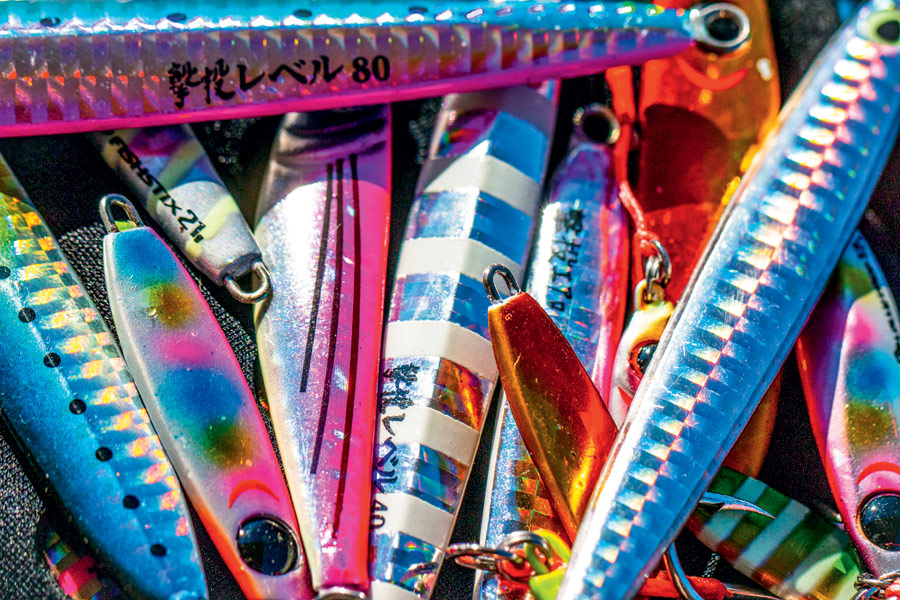
The shape – Knife, Butterfly, Area, Down, Aero, Skid – these are just some of the names given to micro-jig shapes and designs.
Some refer to the way the jig falls through the water, others let you know how your jig is weighted. Where and how the jig is weighted affects how it will fall through the water.
Where this weight is distributed across the length of the lure determines how the lure will move in the water column on the drop. There are also shape attributes to consider that affect action on the drop – flatness, angles of body shape, curvature and amount of weight divided on each side of the jig.
All of these properties play a part, but none so much as where the bulk of the weight is distributed. There are two main designs that you have to work with: level and bottom weighted.
Determining the way in which your jig will swim by looking at its design attributes is not that easy to do. Firstly, you’d need to get in the water and secondly, you’d better take a slow-mo video camera with you! Although the two major jig shapes (bottom weighted and level weighted) swim differently, they do it pretty fast. You can only really tell the difference by the time it takes to cover several metres under the boat.
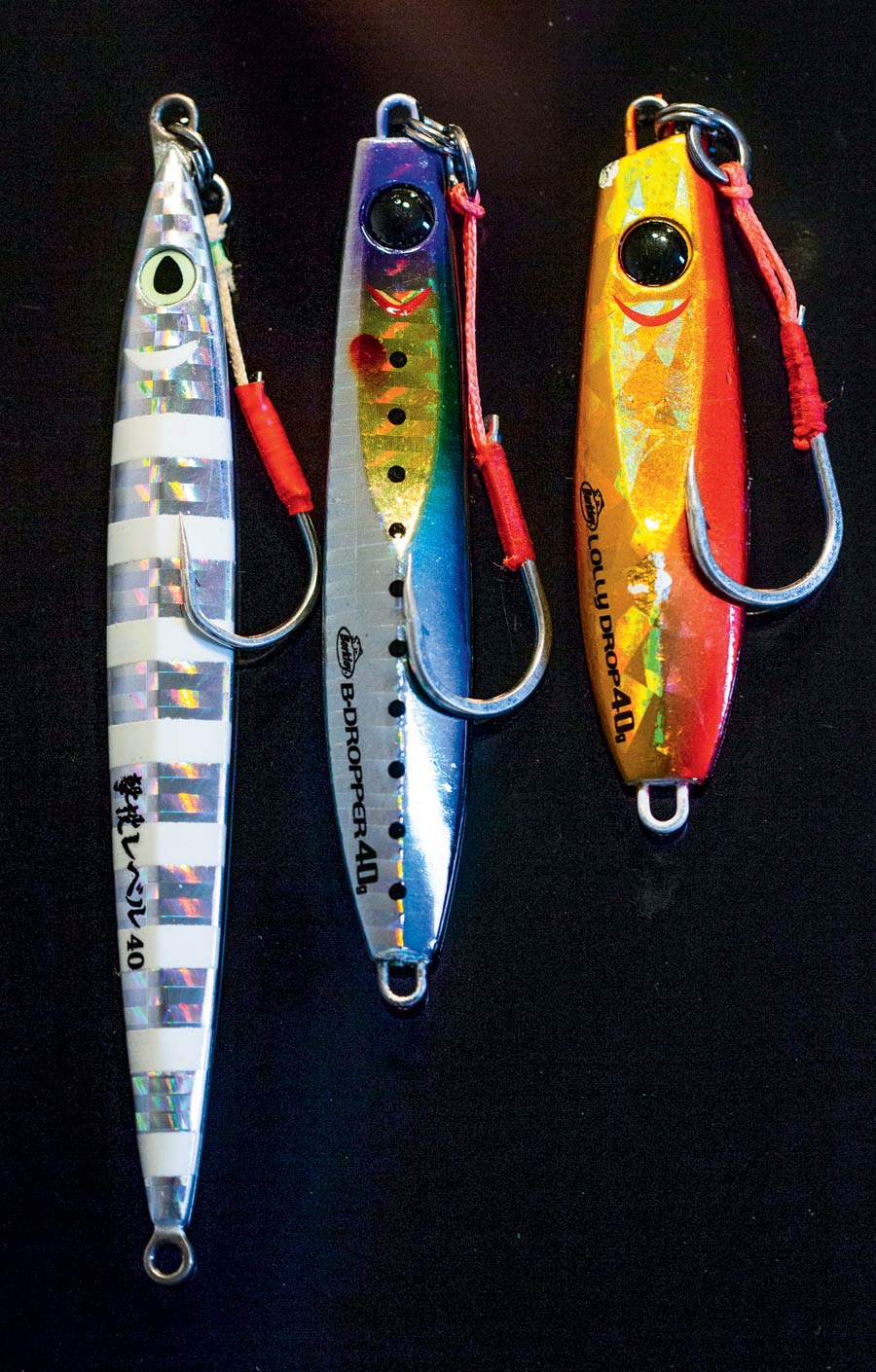
Hooks– If you’re buying a Japanese made and designed micro-jig there’s a good chance that it won’t come with hooks. This, as you can imagine, is for a good reason! There are just as many hook combinations as there are jigs, and because of this, you need to select the right one for the job.
Before we jump into that, let’s look at how and why these hooks work!
Commonly known as assist hooks, these hooks (or hook if you only have one attached) are connected to your lure via a piece of polyethylene or Kevlar cord. This gives them the ultimate ability to ‘swing’ around and catch your fish as it tries to inhale the lure.
Assist hooks are attached to jigs via a piece of cord to take the direct contact point away from the jig. Big issues arise when you have a hook directly contacting a heavy weight. Nearly every fish, as soon as it’s hooked, will shake its head. If you have the weight of the lure attached to the hooks, then that weight becomes the leverage the fish will use to ‘whip’ the lure around until it tears the hook(s) out.
This is certainly the case with treble hooks and metal lures. By attaching hooks using a cord you elevate the direct connection and the fish has less chance of shaking free!
Situating the hooks at the head end of the lure means you can drop them right onto reef and not get snagged every time.
Back to the reason some jigs don’t come with hooks. This style of fishing is used to catch all manner of sea beasts, from little slimy mackerel to massive kingfish. Just because it’s micro, doesn't mean it’s only for catching micro fish!
Remember, jigs might be small but so is most of what fish eat – more on that in a tick! Because of the variation in fish types, sizes and line classes used in this style of angling, you need to be able to pick and choose hooks to suit. For instance, with light line (2-5kg) you might chose a light-gauge size 1 or 2 set of assist hooks; medium line class (5 -10kg), you might choose that same gauge hook but increase the size to 2/0 or 4/0. For heavy micro-jigging (yes there is such a thing) you can choose one of the many heavy-gauge hooks.
Having a choice of hooks is important because, as you’ll see in part two, you can change them to suit your conditions and angling style very quickly and easily. Hooks don’t live on jigs forever!
Hook size is also an issue for an angler new to micro-jigging. Most of the hooks are relatively small in size in comparison to hooks you’d use for the same fish if you were bait fishing. A size 1 heavy-gauge assist doesn't look like it would catch a 20kg kingfish, but it will!
It’s all a matter of ‘horses for courses’. If you’re fishing a medium line class micro-jigging outfit, say 1.0 -1.5 class (PE 1-1.5, 10-15lb or 5-7kg line) and fishing 2kg of drag, then you can get away with a relatively small, light-gauge hook.
But you couldn't run that same hook set-up on a 40kg (80lb) line class jig rod with 12kg (24lb) of drag. You might potentially be hooking and landing the same size fish, but the drag weights are different and that’s the big issue. Always ask yourself, how hard will I be pulling through the line?
Keep in mind too that a small hook in heavy-gauge steel is very hard to straighten. That’s just the physics of its design and construction. The larger the hook, the harder it is to set into the fish past the barb. Light-gauge hooks will win every time!
|
|

Fishing Reports Visit Reports
Outer Hauraki Gulf Fishing Report 17/09/26
Spring wind the handbrake. Spring is starting to make its presence felt in the outer... Read More >
Top of the South Fishing Report - 17/09/26
Early snapper in Tasman Bay. Well, spring is finally here, and the days are getting... Read More >
Bream Bay Fishing Report - 17/09/26
Good snapper catches reported. After Tangaroa turned off the fish tap for a month or... Read More >
Bay of Islands Fishing Report - 17/09/26
Pacific bluefin tuna for the lucky few. The last fortnight has seen more fishable days... Read More >


Friday 25 September 2026
Major Bites
 - -
- - Minor Bites
 - -
- - Saturday 26 September 2026
Major Bites
- - Minor Bites
- -
Comments