
Livebaiting from a jetski
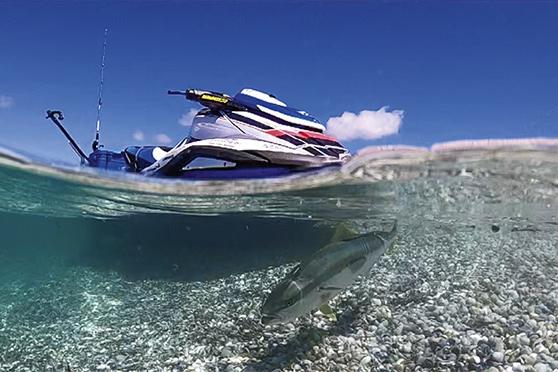
One of Kirk Davis’ favourite forms of fishing is livebaiting, as you never know what you’re going to catch. He shares how he uses this method on his Waverunner.
On the back of my ‘ski is the Jetfish Manta bait station. This has eight rod holders, as well as a split-lid 70-litre Icey-Tek bin that has been plumbed into the ‘ski so I can have an endless supply of fresh flowing saltwater. It can hold at least 20 jack mackerel and keep them alive all day with ease (though it is very rare that they stick around with me all day!).
With the swimming pool for the day always ready to go, the harder part is finding the livebait and getting them to bite. I will often search the edge of rocky coastlines where the weed meets the sand, or over isolated shallow reefs.
Once in one of these locations, a good sounder really comes in to its own. I run a nine-inch Lowrance Elite Ti2 on the ‘ski with an Airmar in-hull transducer, and it works a treat. I can do over 40 knots and still read the bottom perfectly while running – when I am looking for fish it never lets me down.
Once I have found the livebait, getting them to bite can sometimes be hard. This varies depending on the moon phase (the full moon is not a great time to catch jack mackerel), and of course, fish can just be fickle! Experimenting is key. One thing I have discovered over the years is that at certain spots, the colour of bait flies makes a massive difference. I once spent almost an hour over brilliant looking sign, barely getting a bite. As soon as I changed my flies from green to red, the bite was instant with multiple hookups, and my bait tank was full in just a few minutes! So, experiment – you never know what will work. I prefer not to bait the flies most of the time, but if that isn’t working, don’t be afraid to bait them.
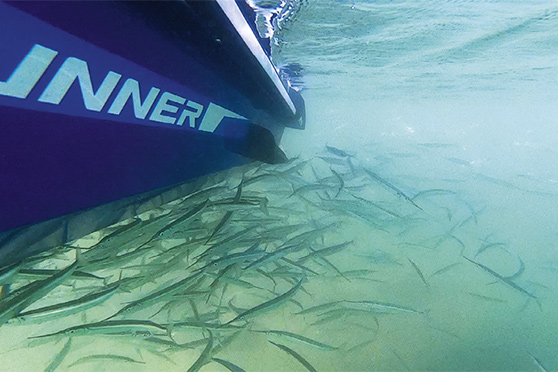
Piper are great livebaits and can be found in shallow waters.
With the livebait on board, it’s now time to find the target species. Most of the time this is kingfish, but over summer I will often livebait for big snapper. This is a really exciting way of targeting snapper, and you know that if you get one, it will be big!
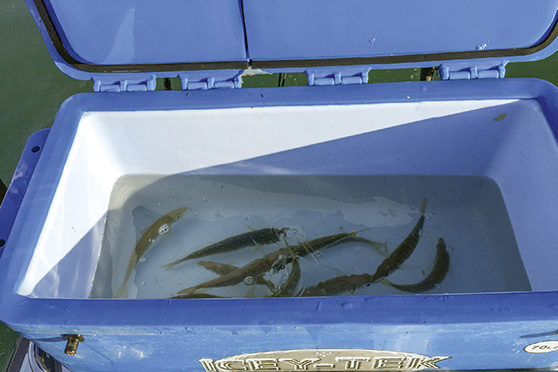
The writer's bait tank can keep twenty mackerel alive all day.
John dory are another target, and they are often found in the same place as you got the livebait. Today though, we will focus on the mighty kingfish.
Yellowtail kingfish are one of the strongest fighting fish readily available to the bulk of recreational anglers. They can be found all over the North Island, and parts of the South Island at the right time of year. Despite being thought of as a summer fish, if you know where to find them and how they are feeding, they can be caught year-round.
The options to target them are many. If fishing the Hauraki Gulf, the kingies will be there in good numbers as the workups kick in. Livebaiting for them in a work-up scenario can be fun as you will also get snapper, however, you will also get a lot of kahawai. Kahawai will regularly eat large jack mackerel and can be a bit of a pain if your jack macks are on the smaller side.
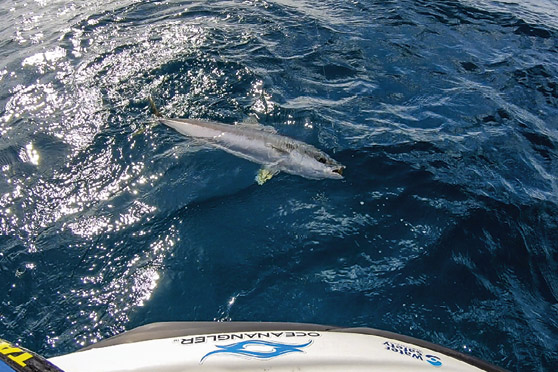
In the Hauraki Gulf, the kingies will be there in good numbers as the workups kick in.
Still in the gulf, there are many islands and reef systems that hold kingfish. Slow trolling an unweighted live bait around many of the islands will produce a result, particularly in spring and summer. The JetFish Waverunner can be clicked into gear, and it will idle forward at about two knots. This is a perfect speed for a little livey to be towed at, and if the kings are there you will know about it before long!
When I am trolling a livebait, I like to hold the rod in my hand. This lets me feel what the fish is doing, and I can easily tell if it is getting agitated. Often kingfish will come and have a look at the bait and play with it for a bit before they grab it, and you can tell when this is happening if you are holding the rod. I will often drop the ski back in to neutral for a few seconds to see if that entices the bite, and, if this doesn’t get a result, kick it back into gear to make the kingy think his lunch is trying to get away from him. This usually works, and then it’s fish on!
A different option to find the fish is over a deep reef. The advantage of the sounder working well at high speed is the ability to see those reefs while on the run. A few times now I have run over an uncharted little reefy outcrop on the way to somewhere else, and because it is uncharted, it usually hasn’t been fished much so pays dividends.
Once I have found the fish, I will then drop the livebait down to the depth the fish are holding. You can see this easily on the sounder, and by using multi-coloured J-Braid, I can see how deep the bait is at a glance. For this type of fishing it is best to have a sinker above a swivel to get the livebait down to the kingfish quickly. If you try and drop it down unweighted, the livebait will sense those kingfish and will not swim anywhere near them!
If you have done all the hard work to get the livebaits and find the kingfish, then the rest should be a formality. It is not uncommon for baits to be in the water less than a minute before getting smashed, so hang on tight!
|
|
This article is reproduced with permission of |

Fishing Reports Visit Reports
Outer Hauraki Gulf Fishing Report 17/09/26
Spring wind the handbrake. Spring is starting to make its presence felt in the outer... Read More >
Top of the South Fishing Report - 17/09/26
Early snapper in Tasman Bay. Well, spring is finally here, and the days are getting... Read More >
Bream Bay Fishing Report - 17/09/26
Good snapper catches reported. After Tangaroa turned off the fish tap for a month or... Read More >
Bay of Islands Fishing Report - 17/09/26
Pacific bluefin tuna for the lucky few. The last fortnight has seen more fishable days... Read More >


Saturday 26 September 2026
Major Bites
 - -
- - Minor Bites
 - -
- - Sunday 27 September 2026
Major Bites
- Minor Bites
 - -
- -
Comments