
Livebaiting For Winter Kingfish
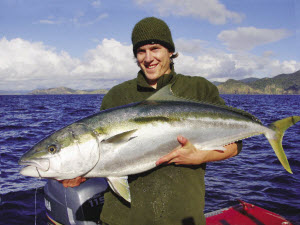 Winter is not normally associated with catching kingfish, as they tend to be absent from many of their summertime haunts.
Nor do the cooler water temperatures help, as this causes their metabolism to slow, reducing their appetites and making feeding times spasmodic.
However, this is not reason enough to scratch them from your target list altogether. In fact, winter is my favourite time to target kingfish. With the plagues of summertime rats absent, the fish you do catch tend to be bigger and fatter. After all, the equivalent 14-kilo summer fish can be pushing 20 kilos through the winter, simply due to being in a fat, healthy, pre-spawn state. This also makes for a much tastier fish should you wish to keep one.
Where?
Reefs and rocks rising from deep water are prime locations to find winter kings, as well as the exposed rocky coast. It is common knowledge among LBG fishers that winter is prime time for catching big kings on the exposed ledges. Indeed, any somewhat exposed reef/rock/headland with decent current flow and a population of semi-permanent baitfish is worth investigating. Harbours are worth a mention, too; while not present in high numbers, in the right locations some truly massive winter kingfish can be seen shadowing schools of grey mullet and kahawai in the shallow margins.
How?
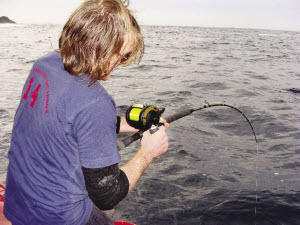 Mechanical jigging is a very effective method of targeting winter kings, especially on the deeper grounds. However, it does not suit every location, and while being a popular and efficient way to fish, it’s important to remember jigs are not the be all and end all of kingie fishing. Live-baiting may be a bit ‘old school’, but in certain circumstances it can prove the best option.
While all manner of live-baiting techniques can be used, from down-rigging and running-sinker baits through to ballooning, the method I most often adopt is simply slow trolling medium to large free-swimming baits without any weight or balloon added.
This method works best in the shallower areas around 10-30m deep. I like to back-hook my baits rather than bridle-rigging them in this situation, as this means the baits swim down when towed, much like a bibbed minnow does.
However, care must be taken not to tow the baits too fast, as this will kill the bait or wear a hole in its back until the hook falls or rips out. Also, too much speed can result in less kingfish bites, as baits get pulled away from the fish before they have a chance to get into position for a successful bite.
The optimum trolling speed tends to be an extremely slow 2-3 knots; the baits should be swimming under their own power most of the time, but also be gently led around the targeted area, rather than dragged. A lot of boat engines cannot push the boat slow enough, even when just in gear. The solution is to fish with the boat in neutral and knock the boat in gear spasmodically to nudge forward, then out again, before repeating the process. Think of it as almost a steered drift.
Nor does it pay to set the baits too far back behind the boat; this provides any kingfish hooked with a useful head start towards reaching the bottom. Around 10-20m back is usually far enough.
Forget gluing yourself to the sounder as you would when jigging. Instead, rely on your baits; they are your eyes and will signal any kingfish presence, generally becoming more active when in the vicinity of kings. Baits that come up and start swimming on the surface are a sure bet that something’s lurking below, and if they continue to show agitation, stay in the area and keep going back over the spot. Slowing the boat or pulling it out of gear as soon as the bait becomes agitated can help draw a bite. After a bit of practice the angler and skipper should find it easy enough to tell the difference between a naturally lively bait, an agitated bait, and a weary or near-dead bait that needs changing.
What bait?
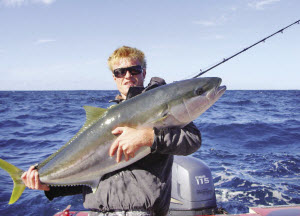 A wide variety of baitfish are suitable for slow trolling; jack mackerel, slimy macs, kahawai, and koheru are just some of the regulars. However, koheru (sometimes known as ‘blues’) stand head and shoulders above the other baitfish options. Their irresistibility to kingfish is truly remarkable; rarely is one refused, regardless of how uninterested in feeding or lazy a winter king may be.
In all cases though, the livelier they are the better, and having a good supply of them will often pay big dividends. Keep in mind that baitfish such as koheru require a lot of oxygen, so need well plumbed live-bait tanks or constant water changing to survive. Provided you have plenty of baits on hand, it pays to change the baits regularly. I will often change to a new bait after as little as 20 minutes without a bite if I know kings are in the area. It can make all the difference.
What tackle?
Live-bait hooks are a matter of personal preference. I like non-offset, short-shank 8/0-11/0 hooks that are generally marketed as ‘live-bait hooks’. Hook size is dependant on bait size. Provided you don’t wait too long to strike a fish, 90% of fish should be hooked in the corner of the mouth (i.e. with a bait like a koheru, provided the bite is committed and forceful, five to 10 seconds is all that’s required; with kahawai you may need to wait a little longer). The use of offset hooks often results in gut hooking, even when using circle-type designs.
While it’s easy enough to bang a livie hook on a jigging outfit, rods and reels used for live-baiting need not be fancy or capable of putting out ridiculously high amounts of drag. Something simple – such as a Shimano TLD25 outfit or similar – is ideal, especially if loaded with 15kg line. This weight of line is strong enough to provide a bit of fire-power, but still light enough to provide a sporting fight.
Once hooked up, kingfish usually head straight for the rocks. There’s little room for error in shallow water so be prepared to chase every fish. It’s no use playing the fish for a bit to wait and see if it’s a good one before choosing to chase, as it will invariably be too late. Starting with heavier tackle is a good stepping stone towards using lighter gear in the future.
Staying on top of the fish and positioning the boat in between the fish and the rocks will help you avoid being broken off. Then, once the fish has settled down, it can be worked towards deeper water and clear ground. On lighter tackle this process becomes a bit trickier, requiring a skilled skipper and angler to work in unison if fish are to be extracted from the foul. With careful boat and angler work, you can pull a fish out of a location on just six-kilo tackle, when you would probably get completely blown away using ‘stand and deliver’ tactics using 24- or 37-kilo gear.
Whatever line-class and tactics you use though, you’ll find live-baiting to be a highly productive, cost-effective and enjoyable way to fish. And in an era of high-tech jigs and soft-plastics, this can make a refreshing change – even in the depths of winter.
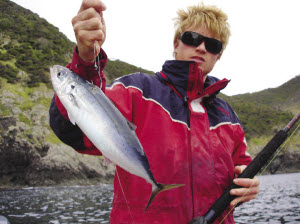 Koheru, the ultimate kingfish live bait!
 |
This article is reproduced with permission of |
Fishing Reports Visit Reports
Raglan Fishing Report - 12/11/26
Big spring snapper. With the more settled weather over the last couple of weeks there’s... Read More >
Mercury Bay Fishing Report - 12/11/26
Snapper hit and miss. Most reports have been telling us it’s becoming more difficult to... Read More >
Northland Fishing Report - 12/11/26
The switch has been flicked on! Call it what you want, El Niño, global warming,... Read More >
Tauranga Fishing Report - 12/11/26
Snapper and kahawai in close. Again, we start on a positive note, with some nice... Read More >


Thursday 19 November 2026
Major Bites
 -
 -
Minor Bites
 - -
Friday 20 November 2026
Major Bites
 - -
Minor Bites
- -
Comments