
Landbased Straylining Tips and Techniques

A recent trip to the Far North has seen Andy MacLeod with lots of fresh fillets to take home and plenty of information to help fellow rock fishers.
Stray-lining lightly weighted or unweighted baits is my favourite rock-fishing method bar none. Done correctly, it entices more bites than perhaps any other rock fishing method, largely because it’s possible to fish directly into the berley trail.
Almost every single serious rock fishing session I’ve been involved in started with some berley, closely following by the flicking out of stray-lined baits, either to catch a kahawai for live-baiting or to snag that big, early morning snapper.
Stray-lining is exciting because with the right tackle and technique it’s possible to be in contact with your bait at all times, so you can feel everything that’s going on at the end of your line. This might involve constant pecking from small fish or slow draws from bigger fish. Even better, it is effective at attracting bites from most of our desirable inshore fish, including snapper, kingfish, trevally and kahawai. I’ve also caught blue moki and some big sharks this way.
However, for me it’s the most effective way to target snapper, trevally and kahawai. At various times I’ve managed to catch these three species in three successive casts by stray-lining baits into an established berley trail.
Because stray-lining involves casting baits without much weight – perhaps a ¼ or ½-ounce ball sinker, but frequently no sinker at all – it demands tackle with casting capability. Mostly you will be fishing into the berley trail at your feet, but the ability to cast 30 to 40m can be beneficial. Both heavy and light tackle can be employed for stray-lining, but primarily I’ll cover medium to heavy-duty tackle (10-15kg) techniques for catching fish in the 2-10kg range.
In remote (and some not so remote) rock locations, a number of species can turn up in a decent berley trail. What follows is a passage extracted from my fishing diary – it’s pretty typical of what I see on my missions:
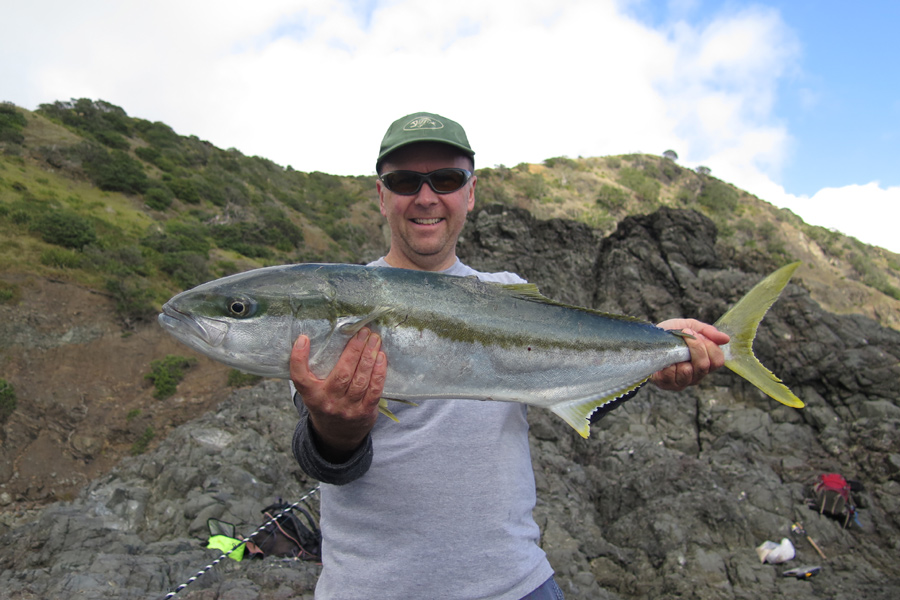
Early start and the berley was in the water just before sunrise. Some snapper (1-3kg) were caught close to the bottom before the light strengthened. As the day grew brighter, kahawai were visible in the top of the water column and started hitting our baits before we could get them down deeper. Kahawai remained present in the berley all day, but the fishing slowed through the middle of the day. As the tide began to run harder in the afternoon our persistence with the berley paid dividends with some modest-sized kingfish and a couple of large trevally turning up, the kingies moving up and down the water column freely, but the trevally staying down lower and mostly just out of view. We accounted for a just-legal kingfish and one of the two trevally (coming in at 4kg).
ALL OF THE FISH caught that day were caught stray-lining; my own catches were made with the same rod and reel combo, with adjustments made to the strength of my leader, hook size and sinker weight throughout the day, according to the species present in the berley.
Generally speaking, this type of fishing involves close-quarters fighting, muscling up against spirited fish in rugged rock conditions. Therefore my ‘default settings’ consist of a heavy-duty eggbeater reel, 15kg main line and five metres of 60 or 80lb leader. This setup enables baits to be readily cast and stealthy baits to be effectively presented (though sometimes lighter equipment is required to entice a bite on fine, calm days), whilst also providing the firepower to stop strong fish before they can reach the safety of rock and weed. Alternatively, it’s possible to use heavy tackle loaded with suitable braid for a better drift and bait presentation. However, braid has poor abrasion resistance qualities compared to [the equivalent poundage of] mono, so can part upon making contact with rocks whilst under pressure.
Hook size is determined by the species I’m targeting. Normally 3/0 or 4/0 for kahawai and trevally, and 5/0 or larger for snapper, depending on how big I think they are. Hooks are simply tied onto the end of my leader.
A natural drift increases hook-ups, so sinker weight needs to be kept to a minimum. If conditions allow (i.e. little wind or current), I won’t use a sinker at all. Otherwise, start with a quarter ounce, and only graduate up to half an ounce if absolutely essential. The small sinker should sit on top of the hook, sliding up and down the leader.
As the passage from my diary indicates, different species operate in different parts of the water column. Kahawai and kingfish range from top to bottom; snapper tend to hold nearer the bottom, out of sight (unless they’re really hungry); and trevally sit somewhere in between. Knowing these things, it’s possible to adapt stray-lining techniques so baits are presented at different depths. For example, when focused on catching kahawai, I keep my bait moving in the top third of the water column; for trevally I cast over the top of the berley trail and let the bait drift naturally down until it hits the bottom – and then wind in and repeat. For snapper, I move my bait slowly across the bottom back towards the rock.
Between these techniques and knowing how different species behave on the end of the line, my mates and I correctly call the fish we’ve hooked before we sight them 90% of the time.
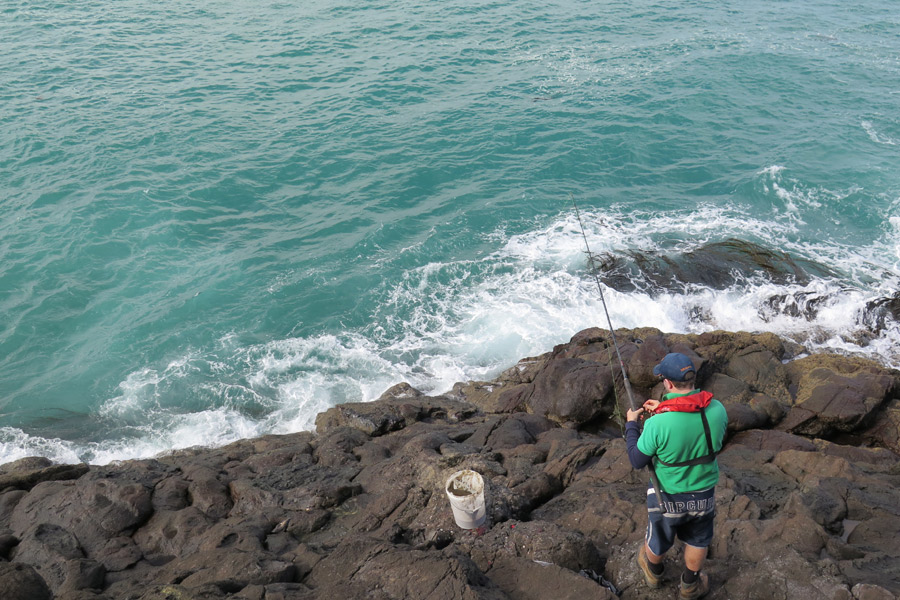 However, every now and then stray-lining turns up some surprises, usually when the bait is dropping through the water column (again proving the value of the natural drift). Generally these are bigger, active fish like kingfish, XOS trevally and big tope sharks (a species that typically moves along the bottom, but which comes right up to the surface if there’s a decent feed to be had). On a recent trip away we lost two very big (and unseen) kingfish on stray-lining gear. Such was their weight and power, we estimate these fish to be in excess of 25kg – so we were under-gunned using the gear described above.
Rat kingfish are regularly taken while stray-lining, even if there are no live baits deployed to draw them in. Berley and the presence of feeding kahawai in the berley often attract kingfish in for a look; fired up, they will readily take a well-presented stray-line bait. Rat kingfish in the 5-10kg weight bracket make for excellent short-range sport fishing, but you must put the brakes on them fairly quickly to avoid being busted off at most rock spots.
I often stray-line all day long when rock fishing. It is an active form of fishing – you are constantly casting and retrieving (albeit at the slower rate than spinning) – but to do it properly you really need to stay on your feet. However, it accounts for probably 80% of my rock-caught fish, so for me that’s an effort worth making. It is also a versatile technique that can be employed in all conditions, including when live-baiting in big swells and bottom fishing is impossible. I recently spent half a day stray-lining a rock spot in three metres of swell, and didn’t even contemplate using any other techniques.
Once fish are hooked, the comfort and ease of use of stray-lining gear (and the lack of heavy sinkers) makes for an enjoyable sport-fishing experience, especially on bigger, more powerful fish in difficult terrain. My basic technique is to keep the fish on the move and coming up the water column. Kingfish, trevally and snapper head instinctively down towards the closest structure, so it is important at this point to maintain a steady drag to stop them reaching it. At the very least, try to tire the fish out and take the sting out during that first run.
For some reason stray-lining is not talked about by rock fishermen, despite being a very popular and effective technique. The subtleties are learned with experience, and relate to careful selection of hooks, sinkers and leaders tailored to the target species. Also, while almost any bait can be employed while stray-lining – small stripbaits, pilchards and squid are all good options – presenting it in the right part of the water column is particularly important. And, of course, you then need to impart the right action afterwards, as I touched on earlier.
So if you enjoy rock fishing and haven’t given stray-lining a go, try it! Just remember to use lots of berley. Oh, and one last hint: invest in a pair of polaroid sunglasses so you can see what species of fish turn up in the berley.
|
|

Fishing Reports Visit Reports
Outer Hauraki Gulf Fishing Report 17/09/26
Spring wind the handbrake. Spring is starting to make its presence felt in the outer... Read More >
Top of the South Fishing Report - 17/09/26
Early snapper in Tasman Bay. Well, spring is finally here, and the days are getting... Read More >
Bream Bay Fishing Report - 17/09/26
Good snapper catches reported. After Tangaroa turned off the fish tap for a month or... Read More >
Bay of Islands Fishing Report - 17/09/26
Pacific bluefin tuna for the lucky few. The last fortnight has seen more fishable days... Read More >


Saturday 26 September 2026
Major Bites
 - -
- - Minor Bites
 - -
- - Sunday 27 September 2026
Major Bites
- Minor Bites
 - -
- -
Comments