
How To Use Berley When Landbased Fishing
Berley can make an enormous difference to your strike rate off the rocks – it can help you winkle fish out of a hitherto stone cold spot, or turn an average session into a spectacular one. Andy Macleod explains how he uses berley to improve his catch rate and some logistics around its use off the bricks…
A consistent berley trail is important to attracting fish to your vicinity and keeping them there, and my experience has lead me to agree with this wholeheartedly. Deploying large amounts of berley consistently will bring the fish into range and keep them feeding actively. When things are really firing, big numbers will turn up and compete enthusiastically and carelessly right at your feet. I’ve heard it said that too much berley offers fish a full meal and will soon result in them disappearing, satisfied with their full belly. I think this is nonsense. My practical experience is simply that more berley means more fish feeding harder for longer, so I’ll pack in as much berley on my rock fishing trips as space, energy and money will allow.
When arriving at the rocks there is a lot to be done, such as rigging rods and laying out the essential tackle. But the first thing I always do is get the berley going. It can take time to reach the fish and bring them to your feet, so get it in the water and doing its job straight away – the theory being that fish arrive just before your first cast into the tide.
The type of berley you use will depend not only on your target species, but the fish you are trying to avoid. Our favourite Kiwi rock species – kahawai, snapper, trevally and kingfish – are all suckers for fish berley (in my experience, pilchard berley in particular), but fish berley also brings around sharks and barracouta which can tie up valuable time, especially with their habit of biting through line. Tope and bronze whalers are the main culprits in the north, while barracouta become more of a problem further south. Kahawai themselves can be a nuisance, turning up in huge numbers and munching down every bait on offer when you have your heart set on snapper or trevally.

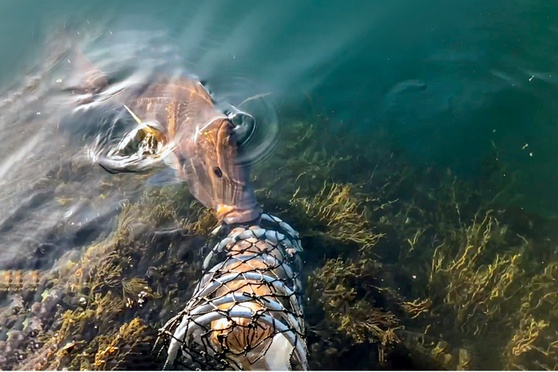
Normally wary snapper can be enticed right up to the angler's feet once the berley trail kicks in.
With the above in mind, keep some shellfish berley on hand – this seems to be less attractive to undesirables but snapper and trevally are still partial to it. But make sure you bring plenty of fish berley because if the undesirables are not around it’s damn good. Salmon is a good oily berley that I’m making more and more use of. Pilchard is so good that I supplement my usual berley with the occasional handful of pilchard cubes, which you can buy pre-cut these days from tackle stores or cut up yourself on the rocks. In areas with good snapper, trevally and kahawai populations, the speed of the response to a few pilly cubes in the water has to be seen to be believed.
As for deploying berley, I am a fan of directly controlling its dispersal by mixing and storing it in a bucket and manually flicking it into the tide at regular intervals using a soup ladle. Although this is labour intensive it keeps you engaged in the act of berleying and in touch with how much is going out. There is nothing wrong with the old-fashioned method of using an old sack or heavy mesh onion bag, but depending upon the size of mesh a lot of berley can get stuck in the bag, and often these are the tasty morsels the fish love the most.
You should also be very wary of the disposable mesh bags that come with the berley sausages available in tackle stores – these rip very easily on barnacle covered rocks and in no time at all you’ll see your $10 berley sausage floating away in the tide where it won’t help your fishing at all. If you are using the sack/mesh bag method, make sure you secure it with tough rope or twine – it’s tempting to use some nylon from your tackle box but as the bag rises and falls with the swell even the heaviest nylon tends to rub through on the rocks.
Turning back to the bucket and ladle method, it helps to thaw out your berley before you arrive on the rocks. If you have an early walk lined up to Spot X, load your pack the night before to allow the berley a good eight hours to defrost. This helps you to mix it properly in the morning. I have a large pack which I can fit a 20 litre sealable bucket into, and upon arrival at the rocks I drop a large berley sausage into it, top it up with about three-four litres of water and chicken feed or bread crumbs to give it some “body”, and mix it into a gooey paste of goodness. I supplement this mixture with old bits of bait, fish guts and pilchard cubes throughout the day. I’d rather use these things to my advantage than leave them to cook and go to waste on the rocks.
There is a bit of an art to flicking the berley properly with the ladle, and novices tend to deposit quite a lot on the rocks around them, but it gets easier with practice! Repeat the process and make up a new brew when you run out. This method requires persistence and means there is little time to rest, but the results make it worthwhile in my opinion.
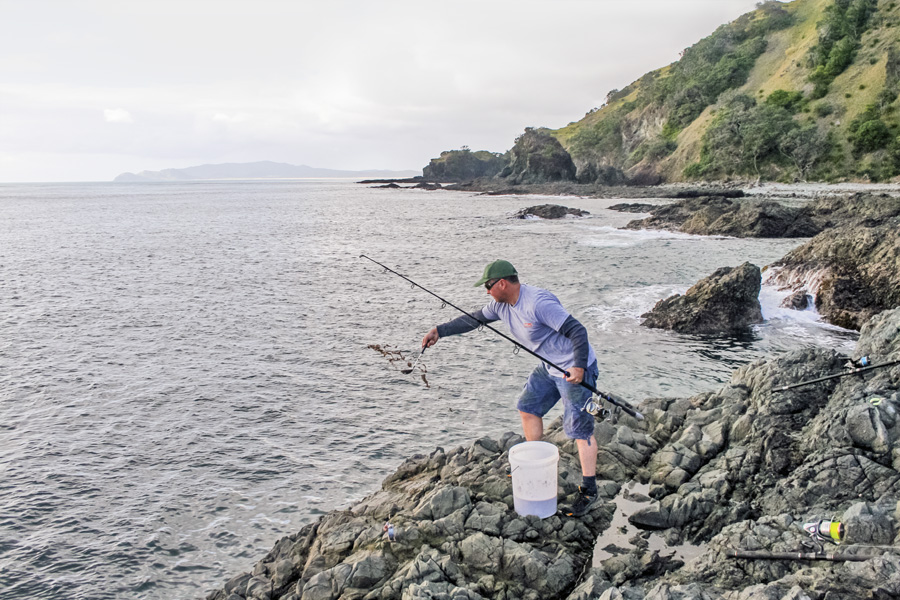
The writer's preferred method of berley disposal is to create a slurry which is ladled into the tide.
Seagulls can act as the taxman when berleying. They often drop into the water and thieve berley bits. At their worst they are a real nuisance. It pays to be philosophical about this but here are a couple of tricks that can help get the berley past them:
Make sure your berley is thawed and has a paste-like consistency ,rather than deploying it in frozen chunks – these float on the surface and seagulls can pick up and fly away with them whole.
When deploying whole pieces of bait as berley (e.g. fish strips or pilchard cubes) throw these in large handfuls so the seagulls can’t get them all. Most will sink below the seagull zone safely.
You can also make your own berley, and in the past I’ve made some nice concoctions of pilchard, paddle crab and tuna berley at home with a kitchen blender and by padding them out with boiled rice. These days, however, I make use of the excellent variety of berleys available in different sizes at tackle stores. I’m not as fussy about the quality of my berley as I am of my bait and neither should you have to be either, but it is still important to look closely at what you buy – make sure it is properly sealed and hasn’t obviously been thawed and refrozen several times. Fresh frozen is always best!
Berley is something of an insurance policy – I always feel vulnerable when I head out fishing without it!
|
|

Fishing Reports Visit Reports
Manukau/West Coast Fishing Report - 15/10/26
Big spring snapper in 60 metres. The El Niño weather pattern isn’t going to be... Read More >
Rotorua Fishing Report - 15/10/26
Solid start to the season! The Rotorua lakes have all started the season well, and... Read More >
Tutukaka Fishing Report - 15/10/26
Big snapper in shallow. Things remain relatively quiet on the fishing front out of Tutukaka,... Read More >
Tauranga Fishing Report - 15/10/26
Bait and temperature on the rise. It’s been great to get out and see some... Read More >



Friday 23 October 2026
Major Bites
 - -
- - Minor Bites
 - -
- - Saturday 24 October 2026
Major Bites
 - -
- - Minor Bites
- -
Comments