
Koheru - catching and using it for bait!
Koheru the ultimate bait!
Koheru appear to be almost magical in their attractiveness to predators. Mark Kitteridge discusses the best ways to catch them.
What is it about koheru that makes them so irresistible to big predators? Sure, live mackerel are hardier, piper and pilchards get eaten by EVERYTHING, and a small live skipjack is rarely passed up by any marlin with a pulse (or shark for that matter), but I believe koheru make the very best baits of all.
.jpg)
There’s something about the koheru’s glowing colouration, strong A.D.D. tail beat, and almost tuna-like body that big predators simply cannot resist. To make them even more attractive, they come in a rather universal size – typically 20-30cm – perfect for a wide variety of predators, from big snapper and kingfish through to the biggest of marlin. These super-charged baits take off like rockets when dropped back in the water with a 6/0-9/0 hook attached, yet once that burst is over they are reasonably easy to handle, and they troll nicely, too.
Many people don’t really know what a true koheru looks like, often confusing them with yellowtail mackerel. To clarify matters, the yellowtail (jack) mackerel’s upper body is browny-yellow in hue, whereas the koheru has a bright blue/emerald-gold colouration (depending on the environment and amount of stress it’s under) and more fusiform body shape. If still in doubt, check the lateral line: if there’s a long row of sharp, bony scutes towards the tail, it ain’t a koheru!
Determining the species will also help you to catch them, as although koheru occasionally take flies, they are far better targeted using a small baited hook (#8-10 saltwater styles) drifted amongst the berley or with a tiny jig.
Koheru tend to be bigger and are stronger fighters than their yellow-tailed cousins, so it pays to use slightly heavier tackle to catch them — 4-6kg is perfect.
.jpg) The main aim is to bring them in reasonably smartly but not too smartly – there’s a fine balance between landing your koheru before something big eats it and doing this so quickly the hooks rips out of its soft mouth. To this end use a reasonably long (2-2.3m) rod that’s fairly light tipped to better absorb any sudden bursts of speed from hooked koheru. Also, by incorporating two or three metres of 5-6kg fluorocarbon leader material, the jig/bait not only looks more natural, it copes better with the punishment inflicted on it during a torrid bait-catching session and provides elasticity for increased shock absorption. Finally, don’t have the reel drag up too high, as this negates the other measures.
The main aim is to bring them in reasonably smartly but not too smartly – there’s a fine balance between landing your koheru before something big eats it and doing this so quickly the hooks rips out of its soft mouth. To this end use a reasonably long (2-2.3m) rod that’s fairly light tipped to better absorb any sudden bursts of speed from hooked koheru. Also, by incorporating two or three metres of 5-6kg fluorocarbon leader material, the jig/bait not only looks more natural, it copes better with the punishment inflicted on it during a torrid bait-catching session and provides elasticity for increased shock absorption. Finally, don’t have the reel drag up too high, as this negates the other measures.
Finding koheru
The only disadvantage of using koheru as bait is that they can be hard to find. They prefer clean, reefy, open-ocean areas from around Tauranga northwards. Some keen fishers jealously guard their koheru ‘spots’, as these great baitfish can be wiped out by excessive pressure.
Koheru usually arrive abruptly in schools that vary greatly in size – and as their departure can be equally abrupt, it pays to be ready for them.
Catching with bait
.jpg) Most people tend to deploy a lightly weighted or unweighted baited hook tied to the end of 4-6kg nylon/fluorocarbon line.
Most people tend to deploy a lightly weighted or unweighted baited hook tied to the end of 4-6kg nylon/fluorocarbon line.
The size of the hook is important, as you want the koheru to get its mouth right over the baited hook, but not easily swallow it right down – they’re too valuable to become injured or killed whilst trying to retrieve a hook from deep in their gills/gullet.
Also consider the size and shape of your bait. Fat, square baits tend to catch the current more and are hard to swallow, so cut your baits into narrow, slim strips. Pale-coloured baits such as skipjack tuna belly (fresh is much tougher than frozen) or squid are best, remaining visible for longer as they sink and ‘winking out’ when eaten, signalling to the angler it’s time to gently strike. Fresh tuna is the better bait of the two, as it’s really oily, keeps its flavour well, and the skin holds the bait together nicely. Squid is tough, but needs to be changed on a regular basis as the flavour washes out relatively quickly. Pilchard strips can also be used, but are easily ripped off the hook.
.jpg)
Berley will really help your cause, and should be deployed from the surface so you can see when the koheru arrive. However, they can sometimes be present deeper down, out of sight, especially when under pressure.
While a thicker trail of berley particles helps bring the koheru to the boat, you should slow it right down once they arrive or the school will quickly eat its fill and depart. Indeed, such is the importance of getting the berley dispersal right, some of the keener guys dedicate one person exclusively to berley distribution and de-hooking live baits when caught.
Baits should be dropped down amongst the berley particles and allowed to drift down slowly. Unweighted baits look more natural, but if any wind/current is present, a small amount of weight may be required to keep the offering where it’s supposed to be rather than ‘sailing’ away across the water’s surface. I nearly always add a small split-shot or swivel attached 30cm or so up from the hook, and then use the rod’s length to slowly lower the baited hook so it descends at the same pace as nearby berley particles. When I’m no longer able to drop it any further, I wind up and start the process again.
On the jig
.jpg) My koheru-catching days dramatically changed when I discovered how effective small jigs can be – 5-7g jigs are ‘the bomb’! Initially I used 7g chrome Grim Reapers, but more recently I have come to like Little Jack Sharasu jigs (which I’ve only ever seen at ‘Go Fish’ in Northcote, Auckland).
My koheru-catching days dramatically changed when I discovered how effective small jigs can be – 5-7g jigs are ‘the bomb’! Initially I used 7g chrome Grim Reapers, but more recently I have come to like Little Jack Sharasu jigs (which I’ve only ever seen at ‘Go Fish’ in Northcote, Auckland).
While jigs usually work a treat, experienced people who should know (i.e. arguably the greatest sport-fishing skipper in New Zealand, Rick Pollock) say that they aren’t always best, so it pays to have some bait sets ready to go, too. Now, when someone like Rick makes a suggestion such as this, it ALWAYS pays to listen! That said, I haven’t had to change over to bait for many years. I don’t know whether it’s my technique, the jigs I use, or both. Maybe it’s just been dumb luck so far!
Whatever jig you end up using, it’s got to be small (5-8g), slim and preferably shiny, its treble replaced by a #8-sized Gamakatsu Live Bait hook or similar. This single hook not only holds koheru a lot more securely because of its bigger ‘bite’, it’s also easier to remove from their mouth. Trebles and landing-net mesh don’t mix either.
I generally tie my jig onto the already mentioned 2-3 metres of 6kg fluorocarbon trace, which is strong but still pretty hard to see. Just as when using flies for mackerel, good fishermen experiment with the jig’s action and presentation depth to see what works best at the time. Try presenting the jig in the same area as the drifting berley (especially if koheru can be seen eating it), or underneath, perhaps just out of sight. As for the action, I find tiny little lift and drops work best, just a few inches up and down, occasionally alternating with long, slow lift and drops. You’ll be able to tell when you’re doing things right: deep down you might feel a few little nips and momentary hook-ups (if you aren’t hooked up already), while nearer the surface you’ll be able to see small bunches of koheru flashing up and down in pursuit of the jig. A hook-up is usually only seconds away…
Landing your koheru
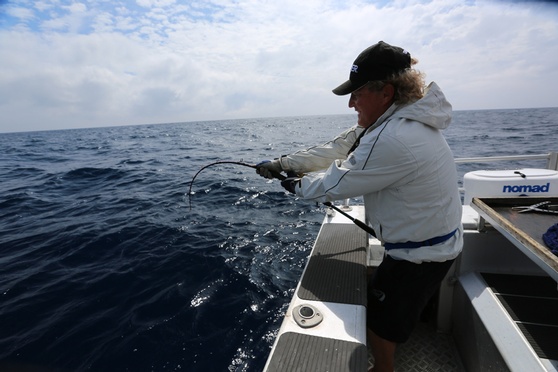
.jpg) Upon seeing the bait ‘wink out’ or getting a nip on the jig, affect a quick but small strike. Next, keeping the rod bent but reasonably horizontal (big lift-and-wind movements allow the ‘kohi’ to turn and head off again), try to smoothly and efficiently turn the koheru so it’s coming back at you and, hopefully, into the waiting net. Yes, a net! Lifting koheru over with the rod will see many rip off. Why waste such precious baits?
Upon seeing the bait ‘wink out’ or getting a nip on the jig, affect a quick but small strike. Next, keeping the rod bent but reasonably horizontal (big lift-and-wind movements allow the ‘kohi’ to turn and head off again), try to smoothly and efficiently turn the koheru so it’s coming back at you and, hopefully, into the waiting net. Yes, a net! Lifting koheru over with the rod will see many rip off. Why waste such precious baits?
On the subject of nets, I find rubber-meshed nets are kinder to the baitfish and less likely to tangle with the jig’s hook.
That’s the textbook way to land them, but many koheru – especially the bigger ones – will not have read the script. If they do manage to get their tails pumping and power away, don’t try to stop them, as you risk ripping the hook out or snapping the line. As you do with any fish brought boatside, guide the koheru into the net headfirst as they have no ‘reverse’.
A lot of what is ultimately possible with these baits depends on how well they’re cared for after capture. For a start, koheru are very active fish, so you’ll need a relatively large live-bait tank with good water flow to store them for any length of time. It is also possible to store up to half a dozen in a large plastic container/barrel and then bucket water in and out regularly – but that’s a hassle. Tuna tubes are great, but obviously you can only look after as many baits as you have tubes!
How you unhook the koheru makes a big difference to their longevity as well. So rather than unhooking them with your hands, which damages their protective coating of slime, use a stainless steel butter knife. The back of the knife is slid along the trace, past the jig, and down the hook’s shank to the mackerel’s mouth. Then, keeping pressure on the trace and hook, smoothly swivel the hook upwards until the koheru is dangling on the upside-down barb of the hook. A couple of gentle shakes combined with the koheru’s own weight – and perhaps some wriggling – should see it fall off the hook into the live-bait tank untouched by human hands.
Don’t fill the tank too full with baits, either. Better to have fewer good baits in good health than a bunch of dead and dying ones!
|
|
|

Fishing Reports Visit Reports
Tauranga Fishing Report - 28/05/26
Tarakihi on the bite Trips are few and far between at this time of year,... Read More >
Canterbury Fishing Report - 28/05/26
Fresh and salt turning it on! It is not very often I get to say... Read More >
Bay of Islands Fishing Report - 28/05/26
Lures paying dividends We finally had a break in the SE winds that have been... Read More >
Manukau/West Coast Fishing Report - 28/05/26
Snapper and gurnard in the harbour The weather has finally taken a turn for the... Read More >


Major Bites
Minor Bites
Major Bites
Minor Bites
Comments