
Jigs - turning full circle

Jigs - turning the full circle
Fishing, like fashion, trends in cycles. Editor Grant Dixon takes a look at the path jig fishing has taken over the last 20 years…
.jpg)
My introduction to fishing metal jigs came after arriving in Auckland some 21 years ago to take up the editorship of this magazine.
As luck would have it, my appointment coincided with spring in the Hauraki Gulf, which saw me heading out with colleagues to fish the snapper aggregations. At the time I was armed with my west coast ‘stump puller,’ a 1.7m (5’6”) rod ‘matched’ to a 4/0 Olympic reel spooled with 15kg mono, which was light tackle for me in those days!
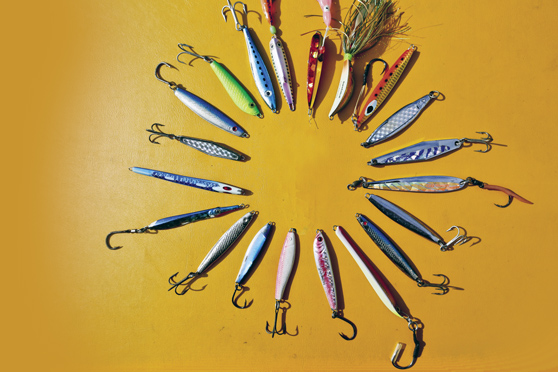
My companions, the sport-fishing elite of the day, all sported the latest kit, including Composite Developments Albagraph rods and Daiwa SL30SH reels, a couple of them spooled with the lightest Dacron available – the first of the ‘new fangled’ (and very expensive) braid and lines.
I brought along bait and my faithful ledger rigs, while they had boxes of metal jigs in the 60-100g range. Lethals, Branks, Stingsilda and Grim Reaper were popular brands.
The short story is: they won, I lost. The jigs slayed the snapper, and thanks to plenty of publicity in magazines such as ours, they became the latest fishing fashion. Bait was out, ‘bling’ was in!
Who could have imagined the transformation and evolution of lures used to target the more popular species such as snapper and kingfish two decades later? Nor could anyone have known how effective they can be. Consequently, most anglers have given lure fishing a try at some stage – albeit with widely varying degrees of success.
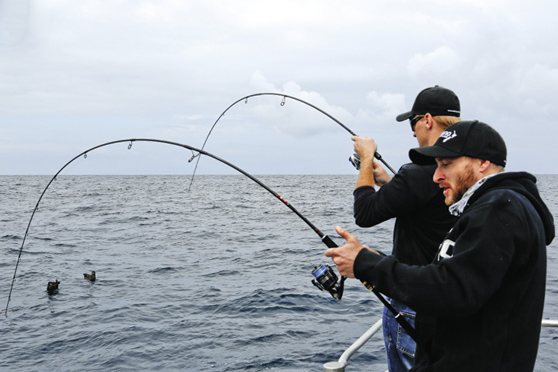
For me, fishing metal has provided a much more sporting approach to my fishing. While it is great to sit back in the boat with the Shimano 6500 Baitrunner in the rod holder while waiting for that screaming run, fishing lures is more like hunting – you are actively seeking out your quarry.
There’s no need to set and retrieve the anchor, since lure fishing is usually done on the drift, with perhaps a drogue deployed to slow progress, allowing your lures more time in the strike zone.
I was reminded recently of just how effective ‘traditional-style ’metal lures could be on snapper. It kicked off when a ‘care parcel’ arrived on my desk from Aussie lure maker Halco. Included in the contents were several 60 and 80g Outcast jigs, which caught my eye, with memories flooding back of distant-past successes using similar-style lures on the snapper.
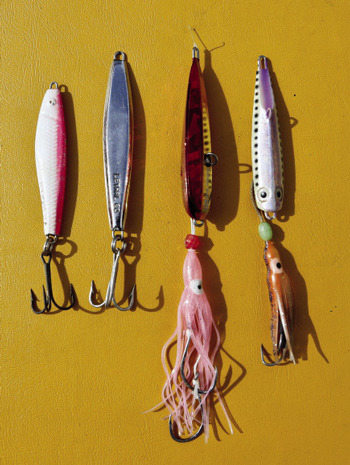 I was not disappointed. In fact, on one trip the snapper were biting the lures so suicidally that I had to lie on the bottom of the boat to protect my fingers when tying new ones on! Even so, a couple of barracouta bites still saw my ‘new favourite’ lures eventually gone – until Halco came to the rescue with a second selection, earmarked for use over the festive holiday break.
While all these Halcos are effective, the white ones seem to be the best. In all instances, though, I replaced their trebles with single assist-hook rigs attached to the lure’s top eye. Halco now has them available off the shelf armed with assist hooks.
This re-connection with conventional jigs reminded me just how far the technology has come in the last 20 years.
Traditionally we Kiwis have mostly been bait fishers, with the Aussies following the lure styles coming out of Asia – Japan in particular – more closely. But in the last decade the development of lure fishing has accelerated, with metal lures now playing a huge part in the tackle industry’s overall scene.
It seems the metal revolution was ignited by inchiku-type jigs, with Thompson Walker Ltd introducing the Prowler range and having the drop on the field for a season. They were followed by Brittain Wynyard Ltd and Douglas Johnson and Co Ltd with their respective Bay Rubber/Pirates and Lucanus products.
I remember Pat Langevad telling me about this new ‘secret weapon’ he’d been testing that had caught over 80 snapper and, despite the rubber ‘tail’ being much the worse for wear, was still going strong. We subsequently put those lures through their paces during one of our annual ‘Daiwa Days’ and they proved as good as Pat’s claims.
Similarly, I was given one of the first few Lucanus lures to arrive in the country, and while anchored up in Spirits Bay aboard Double Strike in the Far North, I fished it on a soft-bait outfit down the berley trail, nailing a 19kg kingfish!
These lures certainly looked weird to my eyes, initially getting doubtful looks from other wary anglers too, but once promoted through the fishing media they started selling like hot cakes, despite their relatively hefty price tags. Beauty was in the eye of the beholder!
New players, such as Paul Senior with his Ocean Angler brand, came onto the scene and turned the latest lure fishing into a social-media frenzy via their distinctive style of internet marketing. Our own Mark Kitteridge is playing a part in this, too. Almost every issue he or Paul Senior has ‘discovered’ a new style of lure or a new technique to fish an old one!
Slow Knuckles, Bottomships, Kaburas, Crazy Charlies, Beta Bugs, Jitterbugs and the like were designed to flutter, weave and spin their way enticingly to the bottom, and to trigger the predatory instincts of the target species when lifted up or retrieved. Then, of course, there are the ‘must have’ accessories, such as attractants – Secret Sauce and Trigger X to name but two!
As well as being an active way of fishing, where you go to the snapper rather than attracting them to you with berley, jigs introduce a more sporting element when seeking dinner for the table. That small pannie you would have ripped to the surface on a baited ledger rig can now actually pull some string if caught on the right gear.
And, better still, while the constantly revised jigs and techniques continue to appear on the scene, the old ones remain effective, enabling lure fishers to develop extensive repertoires that make them better equipped than ever to succeed, whatever the situation.
You might remember that at the start of this feature I suggested jigs had come the full circle… but I was wrong – the circle just keeps expanding!
|
|
This article is reproduced with permission of |

Fishing Reports Visit Reports
Canterbury Fishing Report - 01/10/26
Freshwater season underway. Wow, it’s October already, and our freshwater season is underway, and the... Read More >
Top of the South Fishing Report - 01/10/26
Snapper about but not yet firing. It’s certainly nice to see daylight savings upon us... Read More >
Hauraki Gulf Fishing Report 01/10/26
Big reds in the shallows. The weather has made getting out on the water challenging... Read More >
Bay of Islands Fishing Report - 01/10/26
Snapper moving in. A few Pacific bluefin are still gracing the weigh stations with last... Read More >


Tuesday 6 October 2026
Major Bites
 - -
- - Minor Bites
 - -
- - Wednesday 7 October 2026
Major Bites
- - Minor Bites
- -
Comments