
Jigging secrets for big snapper revealed

I’d been thinking about writing this article for a while now, but like most anglers found myself suspecting that the really big snapper tend to be caught on live and dead baits.
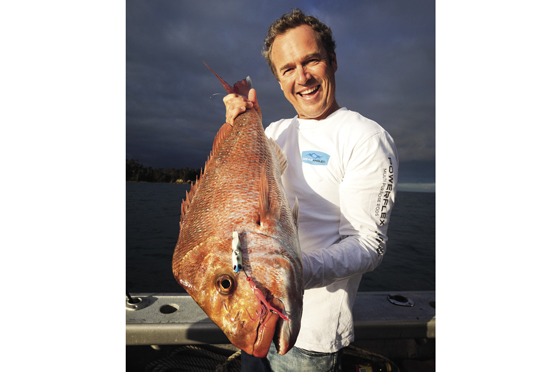
However, it seems the scales (pardon the pun) have turned in recent times. As a lure designer and developer, I generally hear about any particularly good lure-caught catches, and over the last three years there have been three reports of 30lb-plus (14.6kg) snapper caught on metal lures – well, all the same lure actually – the ’Jitterbug’, an inchiku-style jig.
Many of you know I sell this lure, which makes writing about these successes a sensitive issue, but surely having the same model lure catch three snapper that size is genuinely something pretty special?
The two most recent catches were David Chees' 35lb (15.85kg) monster from the top of Coromandel and a 32lb (14.5) fish in a similar area.
As you can see, it is possible for lure fishers to land monster snapper over 30lb – and as for other beauties over the old trophy mark of 20lb, well, that’s almost easy! So let’s talk about the best ways to target these bigger specimens.
Colville Channel
The water between Channel Island and Great Barrier Island is the best place I know of to target giant snapper on lures. It has many things going for it: big currents (especially the Colville Channel); deep 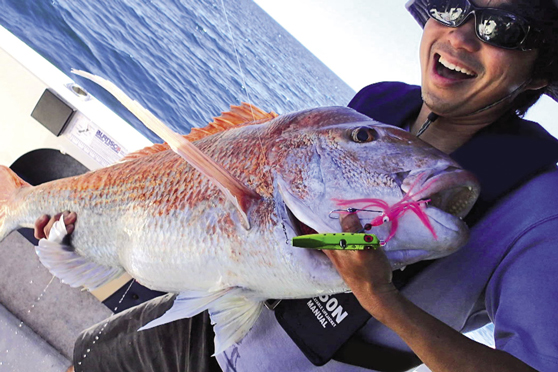 water (up to 65m) and lots of structure in the form of low foul and banks. These are my favourite structures. Low foul is just that – reefs and rocks that don’t stick up far from the sea floor, maybe 3-4m. The second, banks, can be slight rises up to about five metres spread over a large area. I find these less-dramatic structures are better at holding large snapper than traditional reef systems.
Colville Channel is quite a distance from Auckland, limiting the number of fishers who can get there, and you need 10 knots or less to fish it Also, it is somewhat protected by the weather; you need reasonable conditions to fish the area effectively with lures. The wind direction should ideally be with the tidal flow (wind against tide can turn the area into a bit of a nightmare), which means fishing the outgoing tide in a southwest wind and the incoming tide in a nor’easter. The last two hours of the outgoing tide is usually the best time to fish this area.
In all cases it pays to have a decent fishing drogue on board; if your drift’s too fast, you won’t be catching!
Terminal tackle
The best lures to use for BIG snapper tend to be inchiku jigs in either orange/gold or green/red, and the same in the new-style sliding lures. As for effective weights, 80g and 100g are well proven.
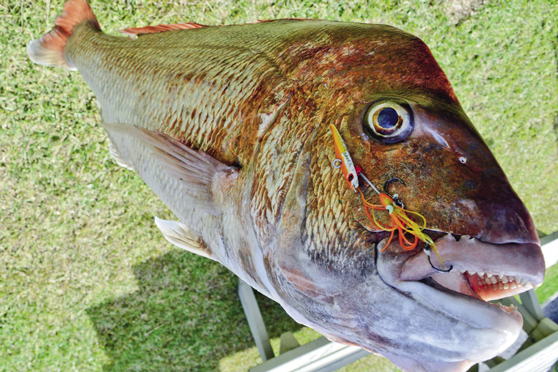 While various scent additives can make a surprising difference when the fishing’s really tough, one of the 30lb-plus fish was taken on the inchiku jig armed with a small sliver of squid on one of its hooks. Indeed, it’s a technique I sometimes encourage myself when the situation’s desperate and I want to add a bit of flavour.
There’s no need to change to heavier braid and trace line when targeting giant snapper. You are fishing over sand, so there’s no structure to get busted off on. I recommend using no more than 20lb/10kg braid matched with 20lb/10kg fluorocarbon when fishing inchiku-style lures, while fishing sliding lures requires just a slightly heavier trace material – 30lb/15kg – as there is more chance of the leader coming into contact with the snapper’s teeth.
As for recommended fishing tackle, while your soft-baiting gear will catch fish, you’ll find that a specialist rod equipped with a bendy tip will make a huge difference to your success rate.
Patience Bank
I often fish a bank about five kilometres northwest of Channel Island that rises up to 42m. It is not marked on traditional charts, but is shown on the new Navionics sonar charts, which you can download as an app on your phone. I have fondly named this the ‘Patience Bank’, as patience is required to fish here.
After arriving, you need to scout around, using binoculars to look for any birds; if the current is running, you will usually find shearwaters feeding, which means baitfish are present. This is always a good place to start. Often there will be kingfish chasing the baitfish around too, so be prepared to get hit in any part of the water column.
Once in the area of the baitfish, I look for the snapper using my sounder, zooming in as far as I can on the five metres above the seafloor. As most of the snapper will be hard on the bottom, you may not see their marks if the sounder is set on its regular range.
It’s really important to realise that the bigger snapper nearly always sit on the up-current side of the bank, which means searching on the correct side. Concentrate on where the bottom of the ocean is changing from deeper water going uphill to the top of the bank. This is where you will find the snapper.
Plot the school
 Snapper schools can be large, so spend a bit of time plotting out the area where the main activity is located. Don’t just place one mark on your chart plotter; place one when you start seeing the school, keep on going, and then place another mark when the school stops. Make a few more passes over the school using the same technique and you will be able to plot out the whole school rather than relying on one mark, which could be anywhere in relation to the school.
That completed, start your drift up current and work through the school with your lures near the bottom. I need to say again, rely on your sounder rather than the birds in this area, and you will catch more big snapper.
Sometimes you may not find much on the sounder, which is when the second technique of ‘patience’ can pay off. This aspect involves making long drifts on the up-current side of the bank – at least 30 minutes – with the main goal being to attract fish to your lures. Once you start catching, a feeding frenzy usually builds, both in intensity and fish size. I have used this technique successfully several times now and it has nearly always produced good results for my charter guests over the past two years or so.
TIP
If you’re hooked up but the fish gets off, a bigger fish attracted by the frantic activity sometimes smashes the lure soon after. So if fighting a fish and it gets off, instantly drop the lure back down again, and be ready for the big hit.
I am fully confident you will catch big snapper if you’re prepared to follow the techniques I’ve described– although putting a bit of time into learning more about this very exciting area will pay big dividends, too.
|
|
This article is reproduced with permission of |

Fishing Reports Visit Reports
Raglan Fishing Report - 12/11/26
Big spring snapper. With the more settled weather over the last couple of weeks there’s... Read More >
Mercury Bay Fishing Report - 12/11/26
Snapper hit and miss. Most reports have been telling us it’s becoming more difficult to... Read More >
Northland Fishing Report - 12/11/26
The switch has been flicked on! Call it what you want, El Niño, global warming,... Read More >
Tauranga Fishing Report - 12/11/26
Snapper and kahawai in close. Again, we start on a positive note, with some nice... Read More >


Monday 23 November 2026
Major Bites
 - -
Minor Bites
 - -
Tuesday 24 November 2026
Major Bites
- Minor Bites
- -
Comments