
Jigging from a kayak
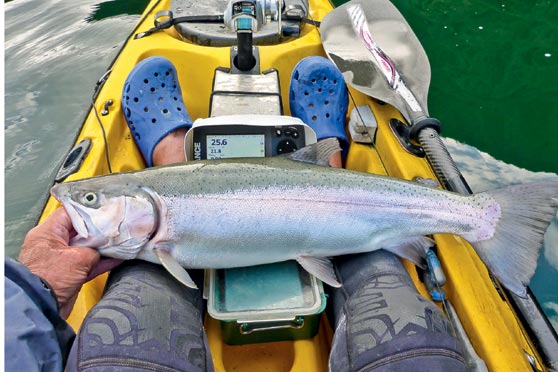
As a ‘dyed in the wool’ fly fisher, I had come to regard trout jigging as a somewhat degenerate way of catching trout and never contemplated doing it.
However, recent knee surgery has prevented me from negotiating the rough terrain along rivers, forcing me to do all my fishing from the kayak.
Last January we had a holiday at Kuratau on Lake Taupo, where I tried jigging for the first time. It happened to coincide with the mass return of post spawners (or ‘slabs’ as they are less affectionately called by anglers). Once I had found the right smelt fly in my voluminous fly box, I pulled up hungry, mostly emaciated fish from just about anywhere I put a line down. This only
reinforced my belief that jigging was just too easy and lacked the mental stimulation that comes as a result of repeated failure.
Facing yet more surgery, I decided to try jigging at Lake Rotoiti, which I knew from past night-fishing trips held some ‘wall hanger’ sized rainbows. I had booked a bunk at the Fish & Game Ngongotaha Hatchery, and on arrival got all the ‘good oil’, including a contour map of the lake, from the very helpful staff.
Within an hour I’d slid the kayak off its cradle at Ruato Bay and was ready to go. The lake was chopped up by a gusty westerly, but my big Tagit Nylex drogue slowed me down sufficiently to keep my line on a reasonable angle.
As soon as I drifted into deeper water, I started seeing fish arches on my Lawrence Elite 5 sounder but failed to raise any interest down below. Eventually I hooked a chunky 1.5kg football on one of the smelt flies I’d enjoyed so much success with at Kuratau; clearly these fish were a lot pickier then their half-starved Taupo cousins.
Later on I managed to get another one of similar size before it got too dark. So while not the spectacular start I had hoped for, at least I was on the board.
The next morning I was on the road before daybreak. Overnight the wind had changed to the southeast, making it offshore with only a slight ripple at The Pipe, a well-known fishing spot near Hinehopu.
Within minutes of launching, I saw a very defined thermocline on the sounder at 15 metres. Trout arches were scattered in groups between 20-25m, with clouds of smelt frequently showing a bit lower down. It was like reading a book, and in the process reinforced that a good fish-finder is the most valuable tool when trout jigging.
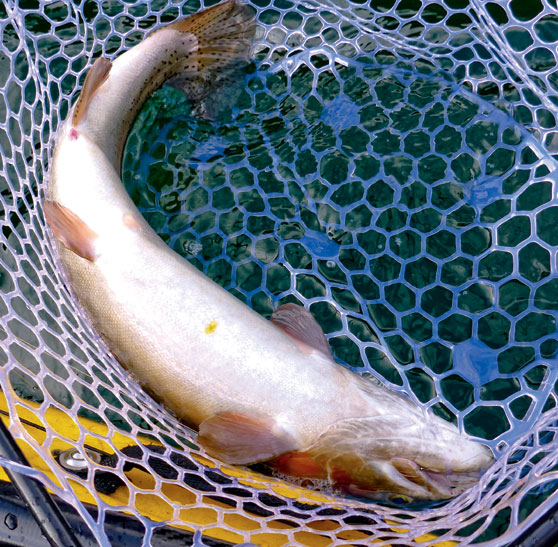
As had happened the previous day, seeing lots of fish did not translate into instant hook-ups. It took me quite a while before my rod tip was pulled down by a solid trout, which I eventually slid into my fly-fishing net after a spirited fight. That was the easy part, because it took me much longer to free the fish and my two other flies from the string mesh of my old fold-up net. This nuisance happened with almost every fish I landed.
During that day I explored the drop-offs along the northern cliffs and small bays, and regularly took fish from schools I drifted over. Mid-afternoon the sounder screen suddenly started blinking and shortly afterwards died as the battery ran out of juice. With the sounder now out of action I lost all connection with the aquatic world beneath my kayak and was forced to call it a day. On the way back home, I bought a silicon-bagged net and a spare battery.
By next morning the battery was still not fully charged, so having a charger for each battery is definitely the way to go on multi-day fishing trips.
Overnight the wind had turned again, with a good chop coming straight at me while launching at The Pipe the next morning. Things had also changed beneath me. There was no thermocline and the fish and smelt marks were noticeably fewer. As the F&G rangers later explained, the strong wind had created a current that had not only mixed the water layers, it had also moved the food, and some of the trout had followed.
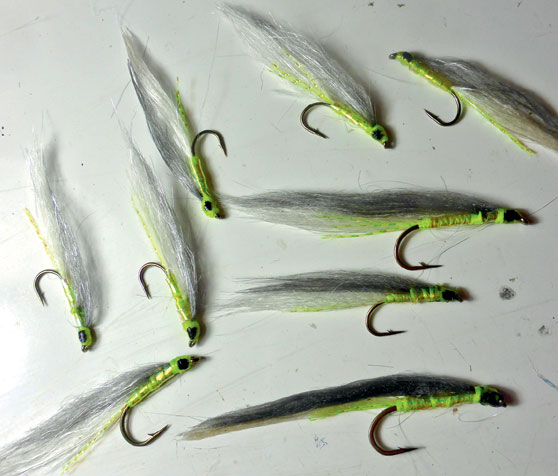
Fishing turned out a lot harder, so I decided to have a break and come back to fish with lumo flies after dark.
As the sun went down, the wind began to subside and the lake surface flattened to a sheet of glass. While all along the shore people had retreated into their houses, the backlit sounder screen told me that the trout were still there, and within the next hour I binned two beautiful six-pounders. Since I was wet from the waist down, I only lasted an hour before the night chill drove me off the water.
On my final day I wanted to explore the western end of the lake, closer to the Ohau Channel. I wasted a lot of time finding the Otamarae Ramp, and then more time and energy trying to find fish. There the thermocline was at 25m, 10m lower than at the eastern end of the lake. Without seeing a single fish arch I cut my losses and drove back to The Pipe.
Before leaving for home I quizzed the F&G staff about this, and learnt that during the summer they receive regular complaints about the lack of fish in that part of the lake. Apparently the Rotorua water coming out of the Ohau Channel is several degrees warmer than the main body of Rotoiti, causing the trout to favour the eastern bays’ cooler water.
Lessons learned
I quickly learnt that jigging success totally depends on one’s ability to read what shows on the sounder screen. This makes jigging a very interactive fishing method that encompasses: finding the fish; presenting the right flies at the right depth and in the right manner; controlling one’s drift; and all the while watching the sounder like a hawk. In addition to its sonar mode, my sounder’s built-in chart-plotter proved invaluable to marking hot spots along drop-offs that held good concentrations of fish.
With the help of advanced technology, jigging is an exciting way of hunting trout that fully taxes the fish-hunting skills of the angler.
I used a low budget seven-foot 3-6kg Okuma X-Factor baitcasting rod with a low-profile overhead reel. ‘Rainbow’ braid really helps to present the flies at the same depth as the fish are holding. For those anglers not tying their own flies, Pat Swift’s jigging fly sets are proven fish takers.
Trout jigging from a kayak has two advantages: kayaks are stealth vessels that do not need a boat ramp to get on the water. On the other hand, I found it hard to stay over the fish in the wind with paddle strokes while jigging at the same time. For that a kayak with a pedal-driven propulsion system would be ideal.
While Rotoiti is no longer the trophy fishery of the past, its rainbow trout are still some of the best conditioned lake fish in the country. The lake’s high fertility supports large schools of smelt, bullies and koura, which ensures that trout grow big quickly. However, the real key is the expertise of the fishery managers who supplement the insufficient natural recruitment with enough hatchery-reared, late maturing fingerlings to maintain an optimal stocking rate. They have certainly got it right at Rotoiti, because during my short visit I caught some of the best trout I’ve seen in recent years.
All of this has meant I’m now looking at trout jigging with different eyes and have already started to tie new flies for another visit before the winter sets in.
|
|
This article is reproduced with permission of |

Fishing Reports Visit Reports
Raglan Fishing Report - 12/11/26
Big spring snapper. With the more settled weather over the last couple of weeks there’s... Read More >
Mercury Bay Fishing Report - 12/11/26
Snapper hit and miss. Most reports have been telling us it’s becoming more difficult to... Read More >
Northland Fishing Report - 12/11/26
The switch has been flicked on! Call it what you want, El Niño, global warming,... Read More >
Tauranga Fishing Report - 12/11/26
Snapper and kahawai in close. Again, we start on a positive note, with some nice... Read More >


Monday 23 November 2026
Major Bites
 - -
Minor Bites
 - -
Tuesday 24 November 2026
Major Bites
- Minor Bites
- -
Comments