
Jigging for Trout

This vertical method of fishing has become the most popular style in recent years, with many boat fishers targeting trout from Lake Taupo and the Rotorua lakes, especially over the summer months.
Finding trout is one of the challenges I enjoy about jigging; I guess it’s that hunting-stalking thing. The biggest buzz is seeing a fish come on the sounder screen above my flies, winding my gear up to it, and the flies getting nailed!
It can be very competitive on my boat: we’re always trying to get to the best spots first. This is where recent fish-finder/GPS technology - such as CHIRP, down-scan, side-scan and 3D capabilities - has provided anglers with huge advances, making finding fish even easier. If considering a new sounder/GPS, buy the biggest screen you can fit/afford. A wealth of information can be displayed at the same time using split-screen functionality on the latest units.
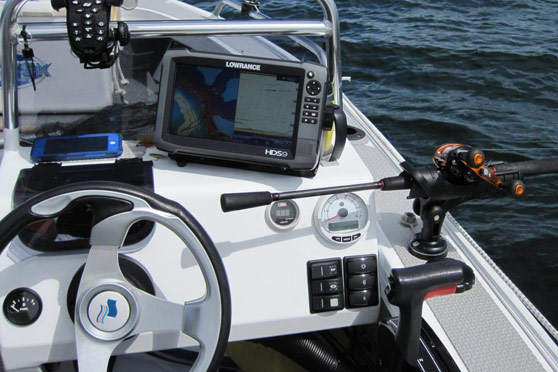
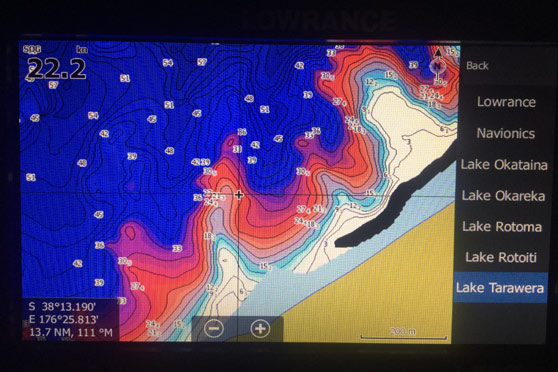
However, as far as I’m concerned, the best thing to happen in the last few years is the bathymetric mapping available with Insight Genesis. Already available for Lowrance and Simrad users to download free of charge, all the Rotorua lakes should be completely mapped by the end of this season. These maps are being created by our sounder-GPS units, recording the data as we travel and fish. These maps are extremely detailed and accurate; to see underwater reefs, guts, banks, and ridges in such detail is like having the lights turned on. Consequently, this has led to a better understanding of the role of structure, not just under the boat but more holistically around the surrounding area as well, and its role in determining where fish are likely to be. Better still, in combination with a remote-controlled GPS electric motor mounted up at the bow, we can now stop and electronically ‘anchor’, or ‘jarl’ – a cross between jigging and harling – in any direction, irrespective of wind. Developments like this provide the next steps in the evolution of jigging, so I recommend a look on the internet to learn more.
Where and how to target fish
Trout tend to be a little harder to find early and late in the season. The cooler lake temperatures mean no thermocline is created, so the food and fish are more evenly spread through the whole lake. Often harling and trolling can be as productive as jigging. I prefer to jig a little shallower (15 to 20 metres) when conditions are like this, and do better on bully and koura patterns.
By the middle of summer jigging comes into its own. The warmer lake temperatures produce a strong thermocline, which sees the smelt congregating in schools and becoming the main food source for hungry trout. This can happen anywhere – out in the open over sand or up against underwater ledges. A congregation of boats is always a good sign you are in the right area.
However, I have recently been targeting strong thermoclines in the middle of summer. These temperature breaks normally form at around 20 to 25 metres, no matter what the water depth, and the trout push the smelt against them. This situation is already utilized by downrigger fishermen, but can be adapted by jiggers either drifting or by using an electric motor (jarling).
Drift fishing is popular in light to medium winds (larger craft can be controlled using sea anchors and drogues) over areas where the bottom is not too foul.
Anchoring to jig can be successful if good numbers of fish are present in a confined area. It is also a popular method in strong winds and when fishing against structure with a vertical drop-off.
If fishing at anchor in strong winds, it pays to have your sinker a few metres off the bottom to stop it snagging as the boat swings back and forth. I also suggest shortening your droppers between the swivel and the fly to 10cm to keep them at right angles to the backbone of the trace. (I generally run 15 to 20cm droppers when drifting or jarling.)
The tackle
Overhead rods with trigger grips between 2 and 2.5 metres and small baitcasting reels have become the go-to outfits.
The reels are first loaded with 5 to 10 metres of light mono (6kg), then joined to 100 metres of 5-6kg braid. The pre-loading of mono stops the braid from slipping around on the spool arbour.
The braid is then top-shotted with seven metres of 6kg fluorocarbon. This acts as a shock absorber, which is necessary when using stiff graphite rods and small hooks in shallow water.
Three-metres of fluorocarbon trace is connected to the fluorocarbon top-shot with a tiny swivel. This trace incorporates three, two-way or three-way swivels, with a clip on the bottom to attach a sinker.
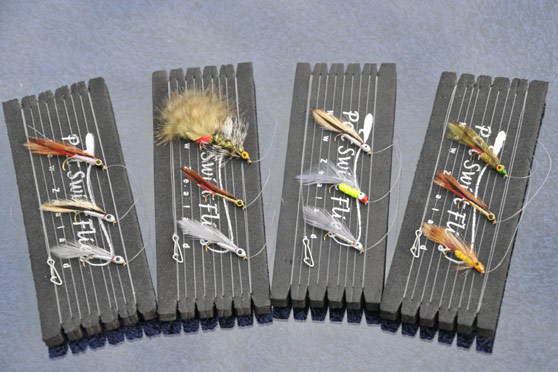
The flies are attached to the swivels using 10 to 20cm droppers of 4.5kg fluorocarbon. (When using two-way swivels, always tie the fly to the bottom ring of the swivel. Tying it to the top causes the knot to pull into the V in the centre of the swivel, causing the fluorocarbon to fracture while playing a fish.)
Sinkers are generally 1½ to 2oz teardrop types with a swivel fitted at the top. I suggest tying a simple overhand knot one centimetre up from your sinker. This creates a weak spot, so if your sinker becomes snagged, the balance of your trace can be saved.
Whether you are buying pre-made jigging rigs or assembling your own, always have spares on hand, ready to go. With more than 10 knots to tie in each trace, it is time consuming to start from scratch. A hot bite may only last a short time and you don’t want to spend it tying up traces.
Flies
Most fish are caught on smelt flies in the summer months, with the balance falling to bully and koura patterns. Bullies and koura stay close to the bottom, so are best tied to the bottom dropper (one metre up from the sinker). Generally, I do better with bully and koura flies moving on the electric motor or drifting, rather than fishing at anchor.
Smelt come in a range of sizes and shades of colour, from small juveniles tied on size #12 hooks to large adults on Size #2 hooks. I usually like to fish smaller, paler transparent patterns off the top droppers and larger darker patterns from the bottom droppers. The size of smelt can change several times in a season, so it pays to have a range of sizes, but size #6 and #10 cover most situations.
UV flies, or flies tied with materials that reflect UV light, have become the norm in most fly boxes. I find these patterns work best early morning, late afternoon or in low-light conditions.
Some of my favourite patterns this season so far include:
Grey Ghosts, Slimy Ghosts, Jack Sprats, Ginger Micks, Adult and Mini Rabbits, Parson’s Glory, Kilwell No. 1, Bully light and dark, Olive Rabbits, Super Koura, Rubber Legs Woolly Bugger, Epoxy Bugger and Mini Bugger.
The vessel
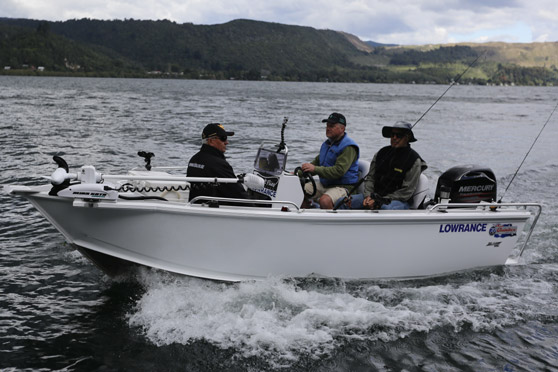
I have jigged in everything from kayaks to large launches, and all can be great platforms, but my preference is for small, open, low-profile craft.
These low-profile craft often provide just as much fishing space, drift more slowly than those with wind-catching superstructure, and are more manoeuvrable – an advantage in staying on top of fish once they’ve been located.
Whatever the craft used, I like to see Railblaza rod holders fitted. These hold the rods out parallel to the water, and the fish will often hook themselves even if the rod is not being held.
And, as mentioned earlier, electric motors, whether bow or stern mounted, combined with a good quality battery, add a new dimension to jigging.
Look after those trout!
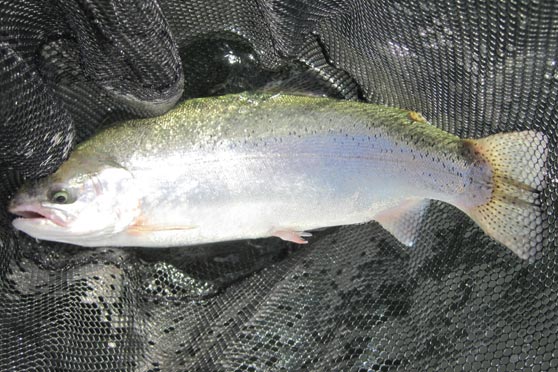
My last message is to hold the fish in the net in the water if intending to release it, as this will do the least harm and give unwanted fish the best change of a speedy recovery. Do not bring them on board. Forceps are handy and help to speed the unhooking process.
If taking trout to eat, put them on ice, or at least in an insulated bin with a frozen water bottle or two. It’s always a shame to see good quality fish sitting in open bins.
Fishing Reports Visit Reports
Outer Hauraki Gulf Fishing Report 17/09/26
Spring wind the handbrake. Spring is starting to make its presence felt in the outer... Read More >
Top of the South Fishing Report - 17/09/26
Early snapper in Tasman Bay. Well, spring is finally here, and the days are getting... Read More >
Bream Bay Fishing Report - 17/09/26
Good snapper catches reported. After Tangaroa turned off the fish tap for a month or... Read More >
Bay of Islands Fishing Report - 17/09/26
Pacific bluefin tuna for the lucky few. The last fortnight has seen more fishable days... Read More >



Saturday 26 September 2026
Major Bites
 - -
- - Minor Bites
 - -
- - Sunday 27 September 2026
Major Bites
- Minor Bites
 - -
- -
Comments