
Jigging for albacore - using light tackle

Paul Senior likes to try new things when it comes to fishing; some of them are his ideas while others build on someone else’s discoveries.
I have been spending some time with a very keen angler called Michael Walkley. He told me he’d been jigging for albacore on the west coast and had caught over 20 fish up to 10kg in a morning. Now that’s something new and exciting!
I had to have a go, so a plan was hatched to get out with Michael and his dad in their recently acquired FC530 boat.
A west coast virgin myself, I must say I was quite anxious about crossing the infamous Manukau Bar in a 5.3m tinny, however Michael assured me his dad was well experienced and that I shouldn’t worry. Even so, I could not help continually checking the weather leading up to the trip, just to put my mind to rest.
Finally the day came, and we hooked up the FC530 and set off for the launching ramp at Little Huia, 25 minutes drive away. On the way there I remember thinking to myself how awesome the countryside was, and how different the terrain was to the east coast. For me it was certainly all new and I was getting really excited about what lay ahead.
It soon became apparent that Michael and his dad had done this many times before: the launch was quick and efficient, and we were soon heading towards the bar. However, before venturing out the South Channel we had our lifejackets on and had checked in with the Coastguard to advise of our crossing. We had breaking waves to the north of us and a clear, deep water channel straight ahead that was relatively tame. Next thing I knew we were over the bar and into deep water, stopping only momentarily to call Coastguard to advise we had crossed safely. We set off, firstly to look for promising signs and then to set two marlin lures and a couple of bungies for albacore. The strategy was to find the alberts by trolling and then drop jigs once we had found them.
The terrain out there is a sloping bank that starts at the west coast beaches and gradually gets deeper and deeper. I soon learned that instead of fishing structures, the locals use depth contours as reference points as to where the fish are holding, so it became a matter of finding the correct depth and then working the area.
I sat at the front of the boat and started watching; we’d got out to about 35m when the surface activity increased. Birds started to show up and baitfish could be seen erupting from the water, obviously being chased by something.
It turned out that the baitfish were small saury –lots of them – and their pursuers were albacore tuna. The bait would scatter and the alberts would have a feed for 30 seconds or so, then it would end and start again at a different location close by. So my thinking became: ‘Find the depth the bait is holding in, then hunt at that depth.’
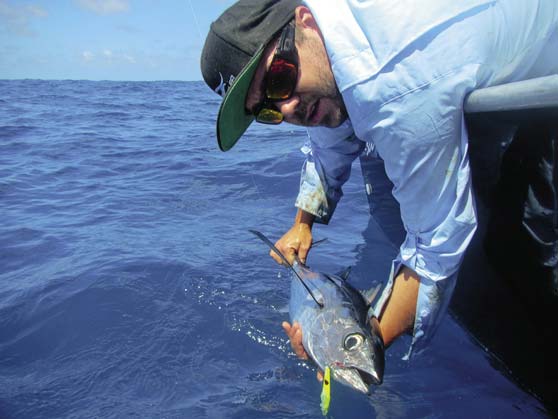
We started to catch albacore in these areas on the bungies, stopping to drop the jigs and catching one, or maybe two, before the action stopped.
Next, I started thinking about how these fish seemed to be feeding: they were chasing fast-moving baitfish – not rounding them up like the work-ups I’ve been used to on the east coast – so we discussed a change of plan. We agreed that we’d try pulling in the trolling lures and get out the jigging gear instead. Then we’d chase after the surface action and drop jigs right into the bust-ups.
Fortunately, as it was so calm, we were able to spot the birds with the binoculars and chase them down at high speed. Then, once in amongst the surface activity, we dropped our lures – and guess what, we all hooked up instantly – a three-way hook-up! We were all using light gear and our drags were screaming. The three of us had smiles from ear to ear and were laughing out loud. This was just awesome!
The fish would go on blistering runs and dart all over the show, mostly near the surface and horizontally, which made for a unique fight. We even had a bust-off from crossed lines. It was light tackle sport-fishing with lures at its finest. So, with trolling now out the window in a big way, it was ‘run and gun’ with jigs for the rest of the day.
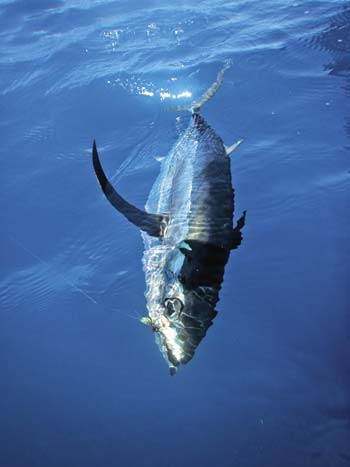
Albacore move fast, so we tended to catch one or two fish before they moved on through, and then it was generally time to move and find the next patch of action. The most effective strategy was to look through the binoculars, burn over to the action, catch one or two fish, then look again.
Albacore have large eyes, which suggests they are visual hunters and can see slight differences in lures and colours. The colour that was working the best was lumo with a pink stripe down the middle.
It also became obvious on the sounder what the albacore activity looked like. They were always in the top 15m of the water column and looked like red blobs mixed in with the baitfish. So if you try this style of fishing, check out the sounder screen for this type of sign.
Knowing what to look for on the sounder was valuable later in the day, when the birds were a bit quieter. We used the fish-finder to find the action just below the surface – a strategy that also produced plenty of fish.
Another point of interest stemmed from when I crossed lines and busted off. I re-rigged with 15kg fluorocarbon leader rather than 10kg – and the slight change had a noticeable effect on my catch rate, which plummeted!
This reinforces my opinion about these fish having good eyesight. So I re-rigged, going the other way this time, down to 8kg leader – and instantly my fortune changed; once again I was enjoying plenty of hook-ups.
The fish we were catching ranged from 3 to 8kg, and Mike and his dad caught them up to 10kg a few weeks before, so you can see why these fish are so much fun on light tackle.
If you want to have a crack, I suggest using a spin set with a 2000-3000 size reel spooled with light braid around 6kg tied to a rod length of 15-20lb leader. Albacore don’t fight dirty and the water’s deep, so light tackle is the way to go.
Mike and his dad have been out some more since our session, and have consistently caught albacore on every trip. On the last trip they hooked a marlin trolling, so it’s all starting to happen.
No wonder I’ve been a repeat visitor several times, too – the west coast’s a very fishy and spectacular place to visit, and it’s opened my eyes to a whole new fishing area. Best of all, this west coast location offers sport and game fishing that’s very close to Auckland!
|
|
This article is reproduced with permission of |

Fishing Reports Visit Reports
Outer Hauraki Gulf Fishing Report 17/09/26
Spring wind the handbrake. Spring is starting to make its presence felt in the outer... Read More >
Top of the South Fishing Report - 17/09/26
Early snapper in Tasman Bay. Well, spring is finally here, and the days are getting... Read More >
Bream Bay Fishing Report - 17/09/26
Good snapper catches reported. After Tangaroa turned off the fish tap for a month or... Read More >
Bay of Islands Fishing Report - 17/09/26
Pacific bluefin tuna for the lucky few. The last fortnight has seen more fishable days... Read More >



Saturday 26 September 2026
Major Bites
 - -
- - Minor Bites
 - -
- - Sunday 27 September 2026
Major Bites
- Minor Bites
 - -
- -
Comments