
Jetski fishing - getting started

What? On that?” is probably the most common response I get at the ramp while chatting to fellow fishers at the end of a day. My usual reply is that I’d go anywhere on my Waverunner I’d go on my boat, and that it has all the equipment required for an awesome fishing adventure – probably more than most boats!
The key to successful fishing on a PWC comes down to selecting the right balance of gear and then efficiently stowing it on board. This involves: fishing rods and reels; bait, berley and lures; not to mention the camera gear I’m carrying when filming an episode of Fishy Business...
Fortunately, some pretty clever thinking and equipment placement makes carrying what’s needed easier than you might think. After all, the front of my Waverunner has a huge hatch that opens to reveal a lot of storage space. I have stowed a tent, food, sleeping bag, pillow and air mattress in there for an overnight trip, so there’s plenty of room.
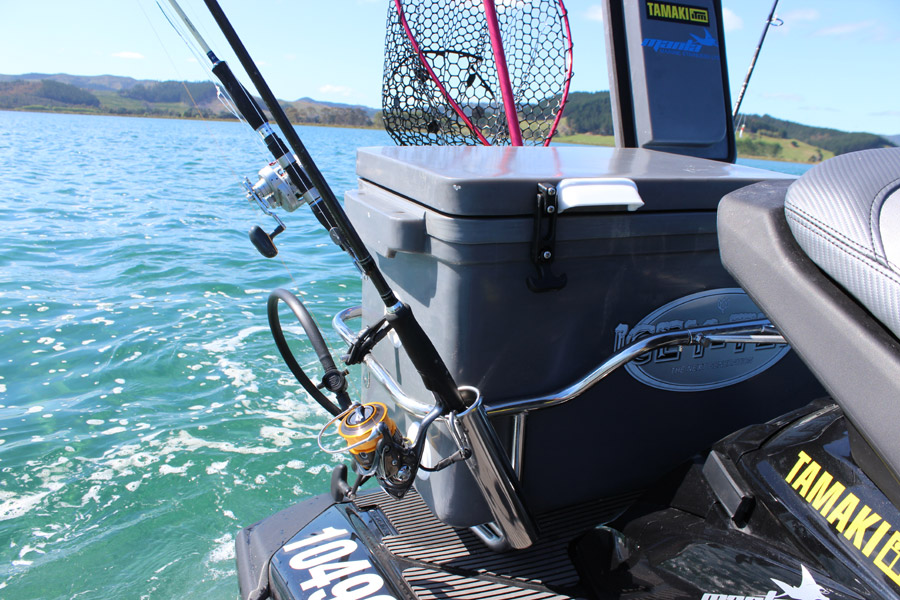
The other end of the PWC accommodates the fishing gear. The stainless steel Manta bait-station connects back there and holds seven rods, as well as the 70-litre, split-lid Icey-Tek insulated icebox. Seven rod holders are about right for a good day out, although (as every angler will tell you), you can never have too many rods!. As for the split-lid bin, it’s perfect for the rare occasion I keep a kingfish for the smoker; invariably they’re much longer than the bin, so it’s possible to leave the tail protruding while the rest of the contents stays nice and cold in the other section.
One of the many great things about a Yamaha Waverunner (from a fishing perspective) is that Yamaha is the only brand that has a ‘telltale’ spout shooting up behind it when the engine is running. But only when there is no fishing kit attached, as the outlet for the spout sits right under the Manta bait-station and the Icey-Tek.
Consequently, I disconnect it to stop water splashing up onto the fishing reels. The great thing about this is that I now have a fl ow of water to use whenever the engine is going, so with a little bit of Kiwi ingenuity, I now have a fully functional live-bait tank that will keep baitfish alive all day.
Back towards the other end, in the steering department, is one of the most important pieces of equipment for fishing: the Lowrance HDS7 Touch sounder-GPS unit. Every serious fisherman will tell you that you should always get the best sounder you can afford, and the HDS7 from Lowrance is definitely right up there. This unit has built-in CHIRP technology (enhancing the signal) and is perfectly suited for the ‘ski because it’s completely waterproof. I have mine installed in the glovebox so it’s right at my fingertips.
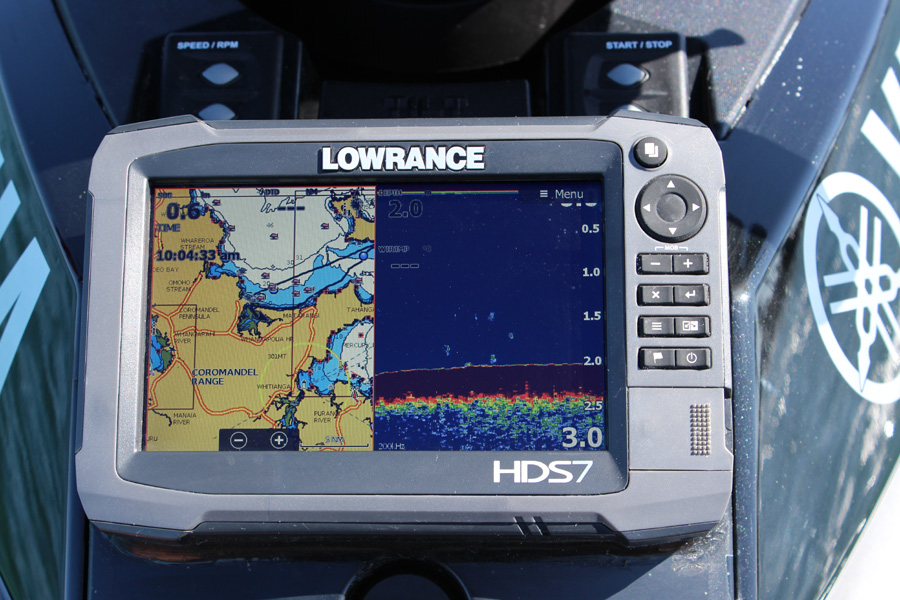
I use an in-hull transducer which sits in liquid and ‘sees’ through the hull perfectly. One reason I use an in-hull unit rather than an external or transom-mounted model is because a transducer is a very sensitive piece of equipment, so shouldn’t be touched, let alone dragged across fine gravel and sand while the ‘ski is being pulled up on the beach.
The second reason is that if you get a through-hull or other transducer installed by someone who is not a dealer for the PWC, you are probably invalidating your vessel’s warranty if anything goes wrong.
In the glovebox itself, I also have some snacks, a spool or two of fl uorocarbon trace, and a couple of small tackle boxes (it is surprisingly cavernous).
In one tackle box I carry a range of soft-bait heads of various hook sizes and weights, and in the other a mix of live-bait hooks and more traditional tackle such as swivels and small sinkers. I also carry a tackle bag with the gear I don’t use as often, which sits in the front storage compartment.
Just forward of the handlebars is another completely waterproof storage compartment – perfect for the car keys and mobile phone – and me, the final storage facility, with a waterproof handheld radio and portable locator beacon (PLB) carried in case of emergency.
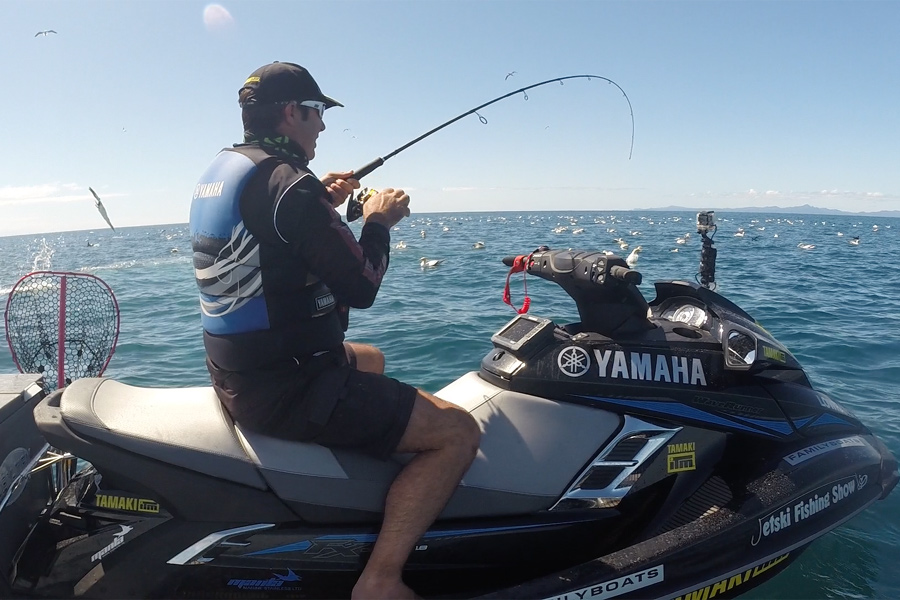
The Waverunner is so stable you can stand on one side no problem, and so economical you can travel around 150km on one tank of fuel. That is more than 95% of boaties will do in a day, and if I intend going even further, it is very easy to strap a 20-litre container to the back.
As you can see, I’m able to carry pretty much everything required for a day out – as much, if not more, than the average boatie takes.
Obviously, if it gets rough, you’re probably going to get a little wetter on the PWC than in a boat, but I don’t get concerned coming home if a 20-knot breeze sneaks up on me. Even in winter I only fish in shorts and a long-sleeve shirt; you don’t get wet enough to warrant wearing an uncomfortable wetsuit all day.
So next time you see a fellow PWC fisher at the ramp, ask them to show you their setup, and don’t be surprised if they have been far and wide on a day full of adventure.
|
----- Advertisement -----
|

Fishing Reports Visit Reports
Raglan Fishing Report - 12/11/26
Big spring snapper. With the more settled weather over the last couple of weeks there’s... Read More >
Mercury Bay Fishing Report - 12/11/26
Snapper hit and miss. Most reports have been telling us it’s becoming more difficult to... Read More >
Northland Fishing Report - 12/11/26
The switch has been flicked on! Call it what you want, El Niño, global warming,... Read More >
Tauranga Fishing Report - 12/11/26
Snapper and kahawai in close. Again, we start on a positive note, with some nice... Read More >


Monday 23 November 2026
Major Bites
 - -
Minor Bites
 - -
Tuesday 24 November 2026
Major Bites
- Minor Bites
- -
Comments