
Inshore Fishing in Autumn

Autumn is one of my favourite seasons. The worst of the summer heat has gone, along with most of the insect pests. The leaves of deciduous trees are colouring and starting to fall, and it is harvest time for all sorts of delicious fruits and vegetables.
Traditionally, autumn can provide some of the best inshore fishing of the year for many popular species. Kingfish have returned to their traditional home grounds after heading offshore to breed around mid-December. They are hungry and feed hard to regain the condition lost by spawning. By autumn these fish are normally in good shape again.
Snapper are also in great shape by autumn. Thick-shouldered and with a bulging gut, their scales shine like newly minted silver, gold and copper coins and they leave a thick coating of fat on the knife blade when you skin their fillets. Snapper are serial spawners, often having had several spells of breeding over the warmer months, especially in the more northerly parts of their range. Between spawning sessions, they feed to help maintain some sort of condition, then, in autumn, work hard to build up fat reserves before many of them move offshore for winter.
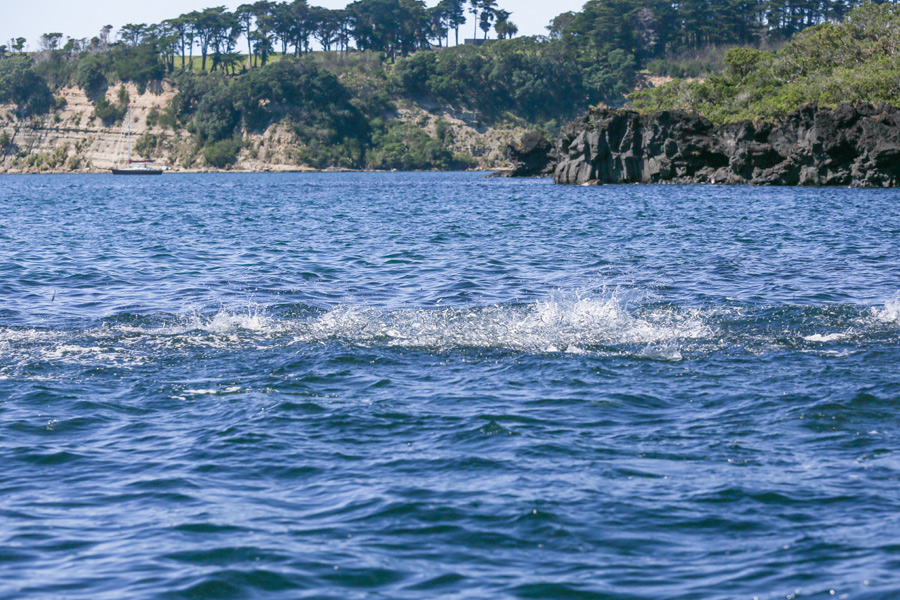
Mobile food sources such as the early autumn inshore anchovy run are attracted into the shallows by plentiful plankton.
Likewise, kahawai are in peak condition before spawning in autumn. Easter is a good time to fish for them in my neck of the woods (the northern Hauraki Gulf). They are as fat as mud and full of high-energy jumping. Trevally are another prime autumn inshore fish.
Why do fish feed inshore at this time? Part of the reason is water temperature. In autumn, the waters are still warm from summer, and this helps ramp up the metabolisms of fish, making them feed more actively.
Another part of the equation is that sunlight penetration is better in shallow water and sunlight is what powers photosynthesis, which is the basis of most of the marine food chain – plankton. Photosynthesis mostly takes place in water under 40 metres deep and not only provides the basis of the food chain but also fosters habitat like weed banks.
Mobile food sources such as the northern late summer and early autumn inshore anchovy run are attracted into the shallows by plentiful plankton. When winter arrives, the angle of the sun to the water surface becomes flatter (so more light is reflected) and the days become shorter. The water temperatures drop and so do light levels, reducing photosynthesis and hence plankton levels. At this time, the inshore waters become less attractive for many fish.
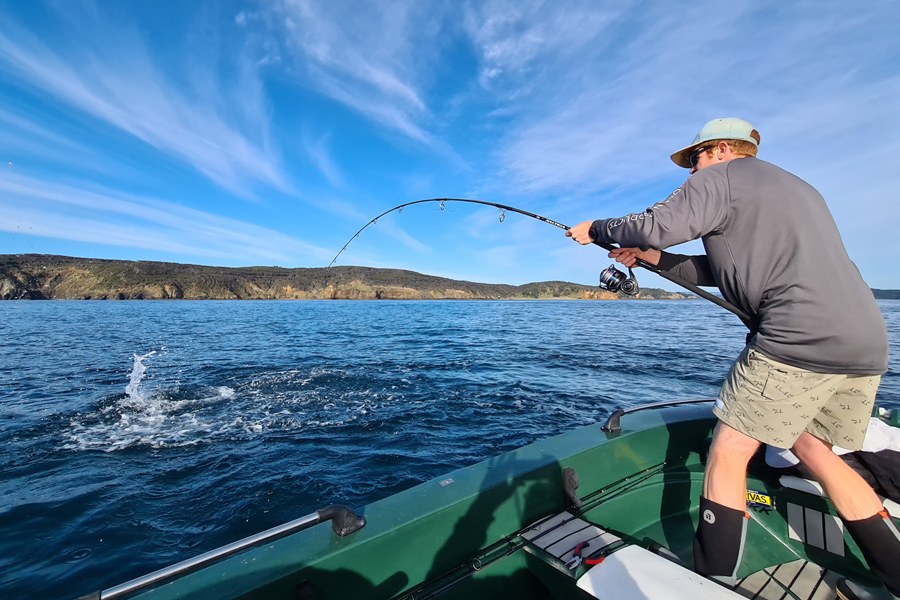
Small boats shine in inshore environs.
Another part of the equation is that sunlight penetration is better in shallow water and sunlight is what powers photosynthesis, which is the basis of most of the marine food chain – plankton. Photosynthesis mostly takes place in water under 40 metres deep and not only provides the basis of the food chain but also fosters habitat like weed banks.
Mobile food sources such as the northern late summer and early autumn inshore anchovy run are attracted into the shallows by plentiful plankton. When winter arrives, the angle of the sun to the water surface becomes flatter (so more light is reflected) and the days become shorter. The water temperatures drop and so do light levels, reducing photosynthesis and hence plankton levels. At this time, the inshore waters become less attractive for many fish.
So basically, the fish are in shallow water in autumn because it is warm, comfortable, and there is plenty of food to help rebuild the body condition that will carry them over the harder times of winter.
And what do I mean by shallow water? I have regularly caught decent snapper in water as shallow as three metres on both baits and lures. Almost no water depth is too shallow for fish if the circumstances are right. But one thing is important for shallow water fishing: low light conditions. Fish are shy and spooky in shallow water, so early and late in the day is best, and shadows cast by steep hills can be exploited. Overcast conditions may help extend bite times until later in the day as well.
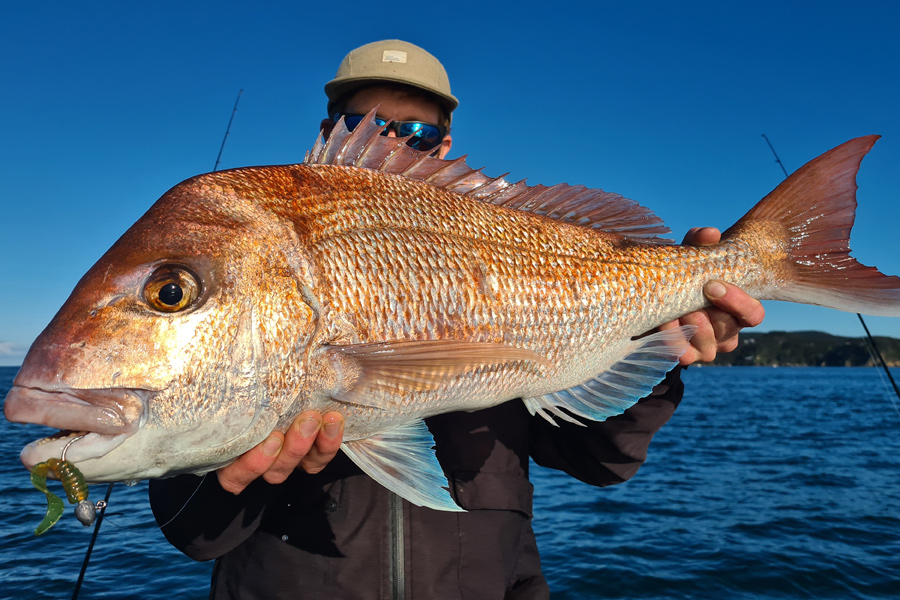
Going down in lure size is more likely to be beneficial than using bigger lures. Photo: Nick Jones.
Small boat advantages
If you are largely an inshore fisherman, then autumn is a great time to be on the water. All the popular species previously mentioned will be feeding up large in the shallows where they are in easy range of both shore-based fishermen and the owners of small boats who, for the sake of safety and comfort, mostly fish sheltered inshore and coastal waters in their small craft.
Small boats (including kayaks) really shine in inshore waters. For a start, lower capital cost puts them within reach of most anglers. Running costs are likewise reduced. Oars or paddles cost nothing to run but sweat. My 4.3-metre tinny is powered by a 40hp two-stroke outboard and I find it ideal for coastal and estuarine fishing. My fuel/oil costs for a standard day of fishing are only about $25. At today’s fish prices, that is equivalent to only about half a kilo of snapper!
Inshore spots mostly require less travel to get to, which further reduces fuel usage, and increases the time you have with a line in the water.
There are plenty of other advantages to inshore autumn fishing for the owners of small boats. With the summer holiday period done and dusted and many people back at work, the boating traffic is much reduced (especially during weekdays). Excess engine noise can put fish off the bite in shallow, enclosed waters, especially during peak holiday periods. Savvy fishermen like to stay away from areas where there is a lot of boat traffic and fish in the quiet backwater spots.
A further benefit of the reduced boat traffic after the summer peak is less crowding at popular boat ramps. To those in regional New Zealand, this may sound like a bit of an Auckland joke, but during fine summer weekends and public holidays at some public ramps in the Hauraki Gulf, for example, there can be 45-minute queues to launch or retrieve a boat, along with difficulty in finding a park for the trailer and tow vehicle somewhere near the ramp.
Autumn weather
The weather in autumn can be a bonus, too. The cyclone season should have passed by then, with calm days more common and the scorching temperatures of high summer giving way to more moderate conditions. It is easier to keep your catch cool and in good shape, and annoyances like flies, mozzies and wasps are less of a hassle when cleaning the catch.
However, our autumn weather has its downsides. Winter conditions can be starting to get in a few practice runs, so around areas of coastline that feature reasonable-sized river mouths, heavy rain can have quite an effect on fishing. With higher freshwater runoff, post-storm turbidity can be high, and salinity reduced. The usual table fish (snapper, kahawai, etc.) can be hard to find when there is a lot of sediment in the water, and the catch can be mostly confined to shark and ray species. It usually takes about three days (six tidal flushes) to settle down, but as a bonus, fishing in the shallows can be good in clearing water. Presumably, the fish are attracted by food items flushed out by the storm.
.jpg)
The weather in autumn can be a bonus, too, with calm days more common.
Rocky coasts that don’t have large freshwater outflows but have been battered by big seas can fish very well as the conditions start to settle, too. Fish, often large specimens, move in to feed on any food items that have been victims of the storm. But in both of these scenarios, fishermen should be safety conscious. Boaties, when underway, need to keep a sharp watch for floating debris washed out by a storm, while shore fishers should be aware of the chance of the odd big wave sweeping the rocks in the aftermath of bad weather.
Tides, too, can make a difference to inshore fishing but these effects vary so much from spot to spot that they are not a factor that I can even generalise about. Having said this, in general terms I do think that channels tend to fish best on the outgoing tide, and very shallow flats on the incoming to high tide. One truism already mentioned is that shallow water mostly fishes best in low light conditions (for obvious reasons), and as long as the tide is running, you are in with a chance.
Lures in the shallows
If bait fishing is not working, try soft-plastics, sliders, inchikus, small flutter jigs, or any other artificial that takes your fancy. This will mean pulling up the anchor and drift-fishing so you cover more ground and potentially have a better chance of finding some fish.
Sometimes one type of lure works better than another, and varying your lure size, colour or action may prove a key factor. Going down in lure size is more likely to be beneficial than using bigger lures. In the inshore shallows, the smaller sizes of lures can often work best, particularly when the fish are feeding on smaller prey items.
A good example of this is when snapper in the Hauraki Gulf and points north are feeding on the small anchovies that move into the inshore waters in late summer and autumn. Then, small lures certainly have an advantage as the snapper become fixated on these small prey items (around 30-40mm in length). Tiny inchikus, softies, or flutter jigs can often out-fish larger lures, but this can also mean constant hookups of undersized fish (if there are a lot of them around), which should be avoided. Sometimes in this situation, a larger lure (such as a five-inch softbait), can mean catching larger, as the bigger lure intimidates small specimens.
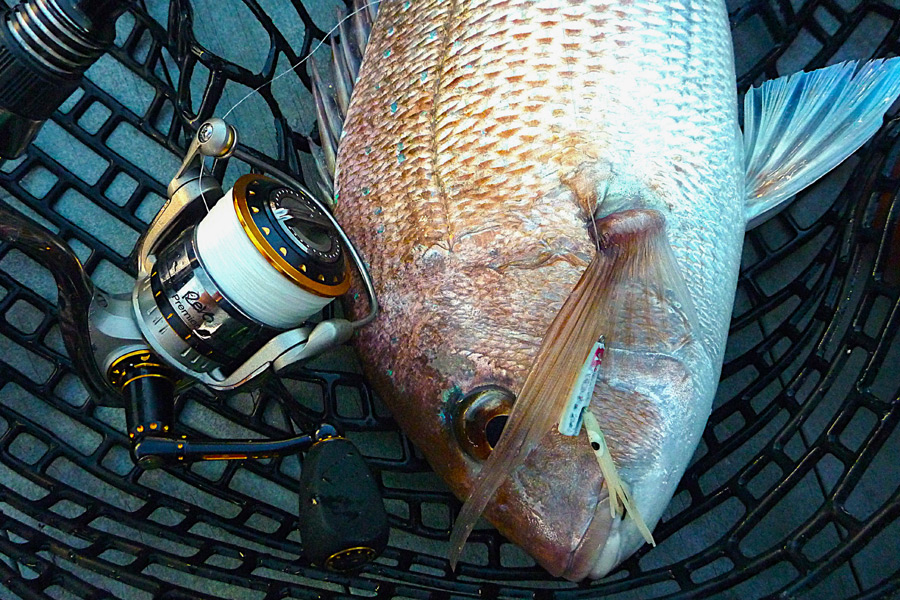
Small inchiku jigs prove very successful on shallow-water autumn snapper feeding on anchovies.
Some of my best fishing and biggest snapper of recent years have come from lure fishing in super-shallow waters – three to eight metres. Some of these fish have struck a lure with the knot that joins the braid to the leader, out of the water. Fishing in the super shallows is often in heavy rock and weed. In such skinny water, incoming swells can suddenly lift and break, and fishing in this zone needs careful boat handling (the engine running and a man on the helm). Fishing the shallow foul with lures requires the angler to be on top of their game, too – to extract powerful fish from the rough stuff is a challenge.
Besides being a lot of fun, I find that lures often out-fish baits and tend to produce bigger fish. I enjoy lure fishing, particularly with softbaits, but while this is a front-line technique these days, there are occasions when artificials are not the best approach.
Stealth fishing with baits
I like to fish the fringe water – small channel edges and holes on the mudflats, where I can get away from boat traffic wakes and noise, and simply relax. Fish tend to be spooky in very shallow water. Kayakers have every advantage here. If you are a boatie, keep noise to a minimum, and when coming up to favourite shallow-water spots in a dinghy, cut the engine well short of the spot and make the final approach with oars or paddles. Or, if you idle in on the engine, allow an extra half an hour for things to settle down before prime fishing time approaches.
Slip the anchor and chain over quietly, hand over hand. In the shallows, this is no effort. Some fishermen slip an old bicycle tube over the chain to deaden noise. Avoid dropping things on the deck or knocking items on the hull. The boat (particularly if made of aluminium) acts like a loudspeaker underwater. Matting like an old jute sack (getting hard to find now in this plastic age) or marine carpeting will help reduce noise, and keep your voices down, too. Believe it or not, even this can make a difference in still, calm, shallow conditions.
Cast away from the boat. The shadow and wave-slap noise of the hull means that the bigger fish will be out the back of the berley trail (assuming you are using berley – you should be). I like to have my baits about 20 metres back.
Softly, softly
Another aspect of the ‘softly, softly’ approach to bait fishing is to use lighter tackle. I can recall many occasions when nothing was biting on conventional tackle, but a switch to lighter gear produced the goods.
Reduce the thickness of your trace material. Eight- or even six-kilo mono is plenty of trace for most inshore bottom fish and harder for them to see, with the added advantage of allowing your bait to move around more naturally. The exception is when fishing heavy foul for big fish when you need a bit of firepower: say, 10kg leader.
I prefer to use nylon monofilament rather than fluorocarbon for my leaders as I haven’t seen any better results with saltwater table fish with fluorocarbon (trout are a bit different). I like the more reliable knot strength of nylon and the more natural bait presentation this softer material provides.
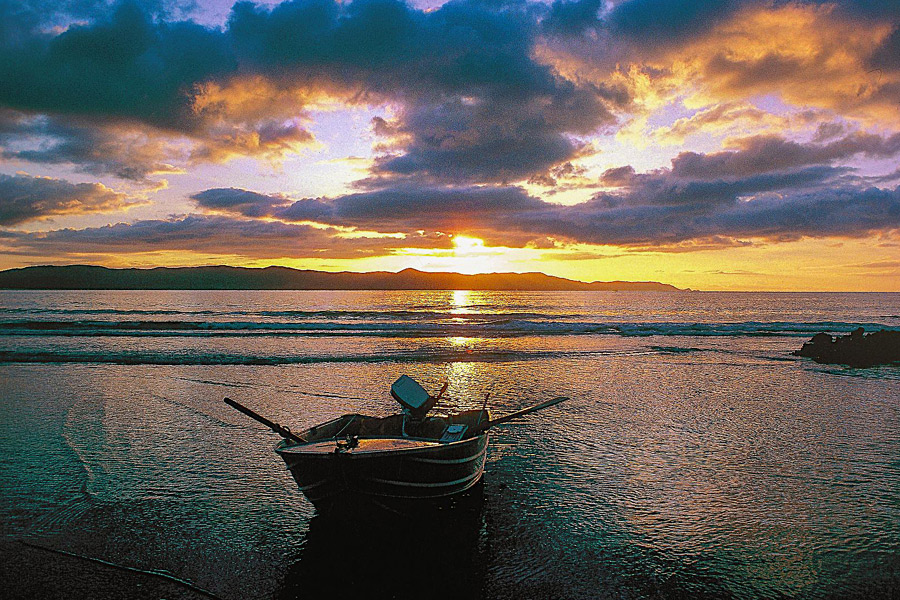
Inshore waters, low light and a small boat; a recipe for autumn success.
This brings us to the main line. Although I am a firm fan of PE lines for many applications, there is a case to be made for the use of light nylon monofilament when bait fishing in the shallows – say three- or four-kilo line. This is partly about visibility, but mainly about stretch. Braid has very little stretch and in shallow water it is easier for a cautious fish to sense that something is not quite right. Mono has up to 30% stretch and a fish is much less likely to be alerted that there is more to its potential dinner than meets the eye.
When bait fishing very shallow water I use very light, long spin rods - 7’6” or 8’- suited to three- or four-kilo line. The extra reach gives me much more strike power, allowing me to remove line bellies more easily when tightening up on the fish.
This light gear shows the smallest bites. Often, the most effective technique is to put the rods in the holders with the reels in gear. The long, soft rods (added to the stretch of the mono) allow a bit of forgiveness while the fish is biting, and when the tip hits the water, you are hooked up! If there is a bit of wind putting a belly in the line between the rod tip and the water, just watch for movement in the line belly to detect bites. I use 4/0 circle hooks to avoid deep hooking undersized fish and like to let the fish tighten up, then just give a firm lift of the rod to be sure the hook is set.
Because I am mostly fishing in just a few metres of water, only a small ball sinker is usually required – just enough to beat any current and prevent the bait from drifting out of the strike zone. The ball sinker runs freely down on top of the single circle hook. I keep an eye on the line and leader for damage and re-tie regularly.
The adage ‘fish your feet first’ is a true one. The shallows have produced some very pleasant evenings bait fishing from small boats, often in waters not far from home. Although a lot of the fish are pannies, they are top table fish and run like emasculated moggies on skinny string in the shallows. The simplicity and relaxing nature of shallow-water, light-tackle fishing takes a lot of beating – just the call of a few nearby wading birds and the burnished gold-and-pink sunset sky for company are a great balm to the soul.
- By Sam Mossman
Fishing Reports Visit Reports
Tauranga Fishing Report - 28/05/26
Tarakihi on the bite Trips are few and far between at this time of year,... Read More >
Canterbury Fishing Report - 28/05/26
Fresh and salt turning it on! It is not very often I get to say... Read More >
Bay of Islands Fishing Report - 28/05/26
Lures paying dividends We finally had a break in the SE winds that have been... Read More >
Manukau/West Coast Fishing Report - 28/05/26
Snapper and gurnard in the harbour The weather has finally taken a turn for the... Read More >



Major Bites
Minor Bites
Major Bites
Minor Bites
Comments