
How to rig lures
 While it is important to choose the right lures and teasers and to run them in the optimal spots, it is also critical to understand how to correctly rig the lures. If well rigged, they will swim to their maximum potential and increase your chances of hooking striking fish.
Without an aggressive bite from a fish, it is hard to get a good bite to hook-up ratio; much is determined by how well your lure has been chosen, rigged and placed.
Unfortunately, rigging lures is not straight forward, and often the cause of hot debate. High on the conflict list: should you rig the lure strictly for the highest hook-up ratio possible, which might be to the detriment of the lure’s action so it does not raise as many fish as it could, or do you rig the lure for maximum presentation potential and, in doing so, hopefully raise more fish with more aggressive bites?
Personally, I am of the opinion that getting the lures to run to their best is the way to go. That conclusion comes from my time on the water as a charter captain and as mate working with some of the best skippers around. I have kept a record of strike to hook-up ratios on all styles of hook rigs, and found the different rigging styles all seem to level themselves out over time. But I also noticed the guys who got their lures swimming to maximum potential definitely raised more fish, so they were presenting sharp hooks to more marlin and creating more chances to catch fish.
With all that said, I do have different ways of rigging different types of lures. The first category covers angled-face lures. These are the hardest lures to rig due to their sensitive nature in the water. They are much more easily influenced by the hook rig used in comparison to flat or cup-faced lures, with the hook rig acting as a rudder and keel, just like on a high-performance racing yacht.
I use a 180-degree double-hook rig on angled-face lures, with steel cable connecting the two hooks. I have found this cable sits nicely and allows the rig to move more naturally in the water. Importantly, it also gives a lot better abrasion resistance than mono. In this rig I like to make the front hook of the rig fixed, but leave the back hook swinging.
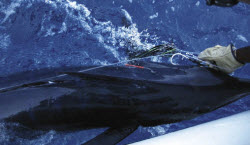 To fix the front hook, I wrap a small length of electrical tape around the eye of the hook and the mono loop connecting the two together. I use just enough tape to hold it in place while the lure is trolling. I want the tape to break free on the strike and leave the whole rig as loose as possible, so there are no longer any leverage points that could help the fish throw the hooks.
Once I have the lure rigged, it is very important to get the orientation of the hooks correct. I feel the best way to correctly position the hooks is by using some form of hook-lock set on, or into, the back of the lure. Hook-lock sets hold the hooks securely and allow the angler to make slight adjustments if required. For angle-faced lures, the orientation of the hook rig should have the front hook of the rig sitting upwards and the trailing hook pointing down. I also like to have my trailing hook just inside the skirt, as I do not want the hooks too far apart, as this may hinder the lure’s performance. In extreme cases the lure may spin.
Flat, cupped and bullet-faced lures fall into the second category. I rig all these lures with a single swinging steel cable hook rig, with the hook as far back as legally possible in the skirt. The reason for the cable is the way it sits and moves in the water. I leave this rig completely loose so the lure retains as much freedom and movement as possible. Some of these lures have a large amount of head-shaking swimming action; stiffening up the hook rig slows this down and facilitates steel-cable fatigue. Just as importantly, the loose rig allows the hook to keel itself and swim as stably as possible without spinning.
Having the hook as far back in the skirt as possible also gives you a couple of advantages. First, it provides the best chance of getting the hook well down the marlin’s mouth if eaten from behind. Second, it can help to minimise the number of bill-wrapped fish, with the hook ending up on the outside of the marlin’s face when it swings its bill across the lure, giving it more time to find a target further down the marlin’s face. Significantly, it also gives you the benefit of hooking the fish from outside the mouth inwards. This is truly the best place to hook a marlin, as it is extremely difficult to get the hook out afterwards. It’s also another reason why I like the rig nice and loose.
With a stiff rig, the hook will rarely be in the perfect position, regardless of what rig or lure you use, because the lure will have rolled in the marlin’s mouth as the fish swings across the lure. In contrast, the loose rig is left to find its own place and can wrap itself into a position of hooking more easily than a stiff-rigged hook.
The next issue to examine are the hooks themselves. This is very much a matter of personal choice. I always use a closed-gape tuna-style hook. I like to use stainless steel hooks simply because they are a lot easier to look after. Like every hook, stainless steel hooks have their pros and cons.
I also use closed-gape hooks because they suit the rigs I like. They are the perfect hook for a loose rig, as they are designed so the point always pulls itself in, without the need to drive the point in, as you are trying to do with a stiff rig.
The choice of hook size really comes down to the size of the lure. Bigger lures can carry bigger hooks than smaller lures, and that can be the main reason for sometimes using big lures: big lures enable us to get big strong hooks into fish. But the majority of the fishing we do here in New Zealand will be covered by hooks from 8/0 through to 11/0 or 12/0.
The old rule of thumb that decrees the hook should fit over the lure’s head is a pretty good one. As with everything though, a little common sense needs to prevail, as a little seven-inch lure rigged with a 12/0 hook is not going to perform very well!
Some simple ideas
Rigging lures with wire stiffens the hooks up, enabling them to be orientated so the lure’s performance is optimised. This is the way the writer likes to rig straight-running lures such as those with flat, cupped or bullet heads.

Being able to ‘snub’ the hook the right way up allows it to act as a keel and rudder, and keeps the lure running well.

A double-hook rig, orientated at 180 degrees, is the writer’s choice for cut face lures.

The wireman needs to take extra care with double-hook rigs when dealing with ‘green’ fish – it is often said ‘one hook for the fish, the other for the crewman’.
 |
This article is reproduced with express permission of
written by Bonze Fleet - 2011 Originally published in New Zealand Fishing News |
Fishing Reports Visit Reports
Raglan Fishing Report - 12/11/26
Big spring snapper. With the more settled weather over the last couple of weeks there’s... Read More >
Mercury Bay Fishing Report - 12/11/26
Snapper hit and miss. Most reports have been telling us it’s becoming more difficult to... Read More >
Northland Fishing Report - 12/11/26
The switch has been flicked on! Call it what you want, El Niño, global warming,... Read More >
Tauranga Fishing Report - 12/11/26
Snapper and kahawai in close. Again, we start on a positive note, with some nice... Read More >


Sunday 22 November 2026
Major Bites
 - -
Minor Bites
 - -
Monday 23 November 2026
Major Bites
 - -
Minor Bites
- -
Comments