
How to find active fish
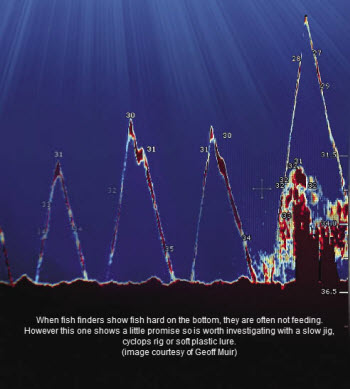 Finding fish marks on your sounder can be quite easy, but if those fish are not in a feeding mood, it can still be hard to take home a feed of snapper.
When I’m taking charters fishing, it’s important to locate fish that are feeding, as this greatly increases my clients’ chances of catching fish.
Consequently, I look for telltale signs that fish are actively feeding and moving around. Often, when in the feeding mood, they will be found well off the bottom.
Most of the fishing I do is out in the deeper waters of the Hauraki Gulf in 30-50m depths, usually over a sandy bottom. It’s a bit like a desert in these areas, with my hunting grounds often involving a featureless bottom with only slight falls and rises, and no foul ground. Therefore, the focus of my fish-finding technique out in these vast, featureless areas is to locate baitfish; I’m looking for mid-water baitfish on the sounder, rather than just the bottom-hugging, classic snapper sign. (Often, classic snapper sign with no baitfish in the vicinity means inactive fish that are not feeding.)
The presence of baitfish in these areas makes a big difference, as any snapper nearby tend to be feeding on them, rather than scrounging around on the bottom for food. (This explains why snapper in these deeper areas have sharp teeth, unlike many of their inshore brother and sisters who feed on crustaceans, shellfish etc and tend to have worn, ground-down teeth.) So if I find baitfish marks and snapper marks together, I expect the snapper to be actively feeding and concentrate my efforts in the area.
 But that’s not all there is to it. By looking at the varying denseness of the bait schools on your sounder, you can get an idea of what the baitfish are up to. If not being harassed, they will be more evenly distributed and show up as spread-out marks on your sounder, with no dense areas. However, once predatory fish show up, the bait schools become tightly packed for defensive purposes. None want to be on the outside where they’re vulnerable, so they naturally swim towards the school’s centre, condensing the school in the process, and showing up as a denser looking mark on your sounder. Often the schools under attack show up on your sounder with a flat side or ‘wall’ on one side, indicating where the predatory attacks are coming from, too. As a result, the school’s density and shape will give you a good indication of predatory presence.
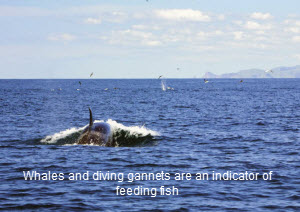
Once you find this type of area, there will often be other marine creatures as well – such as birds, dolphins and whales – showing on the surface. The snapper are never far away in these situations, so drop your offerings around the bait schools under attack and you greatly increase your chances of catching.
Tackle
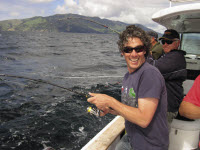 We use overhead reels loaded with 4-6kg braid, short, lightweight parabolic rods and a rod-length of leader. Our favourite method is to use paddle-tailed soft-plastics on Cyclops Deepwater Rigs. Jigs, slow-jigs, inchiku jigs and whole baits also catch fish in such situations.
Make sure you use enough weight to get to the bottom, fish on the drift, and use a sea anchor if necessary to slow your drift.
In these situations, snapper can be feeding on the baitfish high up in the water column, so it pays to wind up and drop down constantly. I reckon there’s a bit of a hierarchy system amongst the snapper schools over sand, with the larger snapper closest to the bait school and the smaller ones deeper down, feeding underneath. That’s why it’s so important to wind up at least halfway and drop again if targeting the larger fish. On many occasions I have seen a client drop down and get nailed just below the boat, calling the fish for a large kahawai – then up pops a large snapper, much to their delight.
 |
This article is reproduced with permission of |
Fishing Reports Visit Reports
Raglan Fishing Report - 12/11/26
Big spring snapper. With the more settled weather over the last couple of weeks there’s... Read More >
Mercury Bay Fishing Report - 12/11/26
Snapper hit and miss. Most reports have been telling us it’s becoming more difficult to... Read More >
Northland Fishing Report - 12/11/26
The switch has been flicked on! Call it what you want, El Niño, global warming,... Read More >
Tauranga Fishing Report - 12/11/26
Snapper and kahawai in close. Again, we start on a positive note, with some nice... Read More >


Sunday 15 November 2026
Major Bites
 -
 -
Minor Bites
 - -
Monday 16 November 2026
Major Bites
- - Minor Bites
- -
Comments